
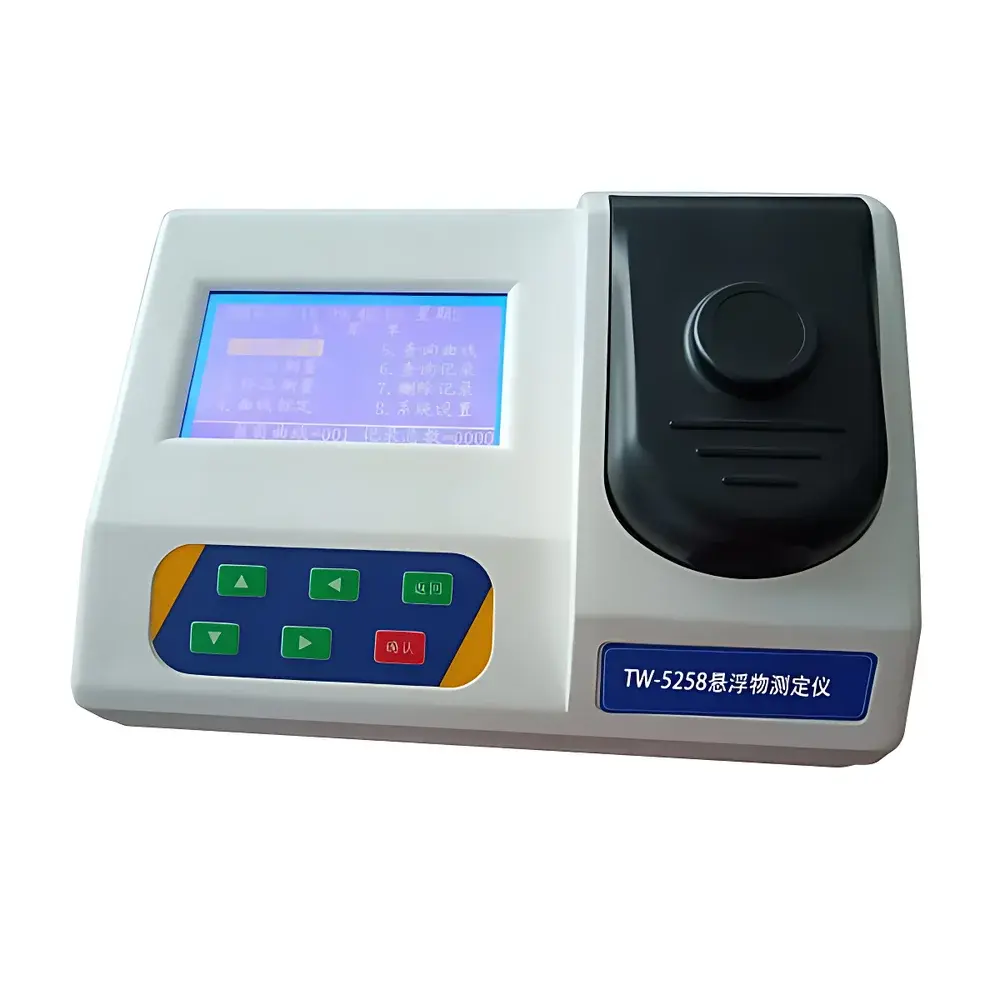
TUNE VOLT TW-5258 Laboratory Suspended Solids Analyzer
| Brand | TUNE VOLT |
|---|---|
| Model | TW-5258 |
| Origin | Beijing, China |
| Instrument Type | Benchtop Laboratory Analyzer |
| Measurement Range | 0–1000 mg/L |
| Minimum Resolution | 0.01 mg/L |
| Accuracy | ≤ ±2% F.S. |
| Repeatability | ≤ 3% |
| Optical Drift | < 0.002 A in 20 min |
| Dimensions (with printer) | 340 mm × 250 mm × 130 mm |
| Dimensions (without printer) | 266 mm × 200 mm × 130 mm |
| Operating Temperature | 5–45 °C |
| Relative Humidity | ≤ 85% RH |
| Power Supply | AC 220 V ± 10%, 50 Hz ± 0.5 Hz |
| Weight | 4 kg |
Overview
The TUNE VOLT TW-5258 Laboratory Suspended Solids Analyzer is a dedicated photometric instrument engineered for precise quantification of total suspended solids (TSS) in aqueous samples using the standardized turbidimetric principle. It operates on the premise that light scattering intensity—measured at a fixed wavelength under controlled optical geometry—is directly proportional to the concentration of non-dissolved particulate matter suspended in water. Designed in accordance with core principles referenced in ISO 7027 (water quality — determination of turbidity) and aligned with ASTM D3921 (Standard Practice for Determination of Total Suspended Solids in Water), the analyzer delivers traceable, reproducible results suitable for regulatory reporting, process control, and environmental compliance workflows. Its cold-light, monochromatic LED source ensures exceptional optical stability and eliminates spectral interference from ambient lighting or sample coloration—critical for long-term measurement integrity across diverse industrial matrices including municipal wastewater, cooling tower circulation water, metallurgical effluents, and chemical process streams.
Key Features
- Stable monochromatic LED light source with minimal thermal drift, enabling consistent absorbance/turbidity correlation over extended operation cycles.
- High-resolution 0.01 mg/L detection limit within the 0–1000 mg/L TSS range, supporting both low-concentration monitoring and high-load effluent assessment.
- Integrated V/F (voltage-to-frequency) signal conversion combined with software-based redundancy and trap logic to suppress electromagnetic noise and ensure robust performance in electrically noisy plant environments.
- Large backlit LCD display with intuitive menu navigation—designed for rapid operator training and error-free daily use in QC laboratories.
- Onboard memory stores up to 100 user-defined calibration curves and 500 timestamped measurement records; all data retained during power loss via non-volatile flash storage.
- Dual output options: built-in thermal printer (optional configuration) for immediate hard-copy documentation, and standard USB 2.0 interface for secure data export to LIMS or Excel-compatible analysis platforms.
Sample Compatibility & Compliance
The TW-5258 is validated for use with clarified, filtered, or centrifuged liquid samples meeting standard preparation protocols outlined in EPA Method 160.2 and ISO 11923. It accommodates standard 10-mm pathlength cuvettes (glass or quartz) and supports routine verification using NIST-traceable formazin standards. The instrument’s mechanical and electrical architecture complies with IEC 61010-1:2010 safety requirements for laboratory equipment. While not certified for Class I Div 1 hazardous locations, its enclosure meets IP20 ingress protection for typical indoor lab deployment. Data integrity features—including timestamped records, editable user IDs, and uneditable audit logs—support alignment with GLP and basic GMP documentation expectations where electronic record retention is required.
Software & Data Management
No proprietary software installation is required: raw measurement data (including date/time stamp, sample ID, calibration curve ID, and numeric result) exports directly via USB mass-storage mode as CSV files. Each record includes metadata such as instrument serial number, firmware version, and measurement mode (e.g., “TSS Standard Curve” or “Direct Absorbance”). Calibration curve management allows users to import/export curve coefficients (linear, polynomial, or custom) using spreadsheet tools. All internal firmware operations adhere to deterministic execution timing, ensuring no race conditions or memory corruption—essential for repeatable validation under FDA 21 CFR Part 11–aligned internal SOPs (though the device itself does not implement electronic signatures or role-based access control).
Applications
- Wastewater treatment plants: real-time TSS monitoring of influent, activated sludge, secondary clarifier effluent, and discharge points per local regulatory limits (e.g., China’s GB 8978-1996 or EU Urban Wastewater Treatment Directive).
- Industrial process water systems: tracking suspended load in steel mill cooling circuits, pulp & paper white water loops, and semiconductor rinse water recirculation lines.
- Environmental field labs: portable verification of grab-sample TSS prior to gravimetric confirmation (ISO 11923).
- Chemical manufacturing QA/QC: verifying filtration efficiency of cartridge filters, membrane integrity testing, and catalyst suspension homogeneity checks.
- Educational laboratories: teaching fundamental principles of optical scattering, calibration methodology, and analytical uncertainty propagation in environmental chemistry curricula.
FAQ
What sample preparation is required before analysis?
Samples must be homogenized and analyzed immediately after collection—or refrigerated at 4 °C and tested within 24 hours. Large particulates (>2 mm) should be removed by gentle sieving (not filtration) if they interfere with cuvette loading.
Can the TW-5258 replace gravimetric TSS measurement?
No—it provides a rapid, comparative turbidimetric estimate correlated to gravimetric reference methods. Regulatory submissions requiring definitive TSS values (e.g., NPDES permits) still mandate ISO 11923-compliant gravimetric analysis; the TW-5258 serves best for trending, process control, and pre-screening.
Is calibration traceable to national standards?
Yes—users may calibrate using formazin standards certified to NIST SRM 2134 or equivalent ISO 7027 reference materials. Certificate of calibration is generated per user-defined protocol but not issued by the manufacturer.
Does the instrument support automatic temperature compensation?
No—temperature effects on particle settling and refractive index are mitigated by maintaining sample equilibration at 20 ± 2 °C prior to measurement, as specified in ISO 7027 Annex B.
How often should optical path verification be performed?
A blank check (deionized water in clean cuvette) is recommended before each analytical session; full optical alignment verification using factory-supplied alignment tool is advised every 6 months or after physical impact.
Related Products







