
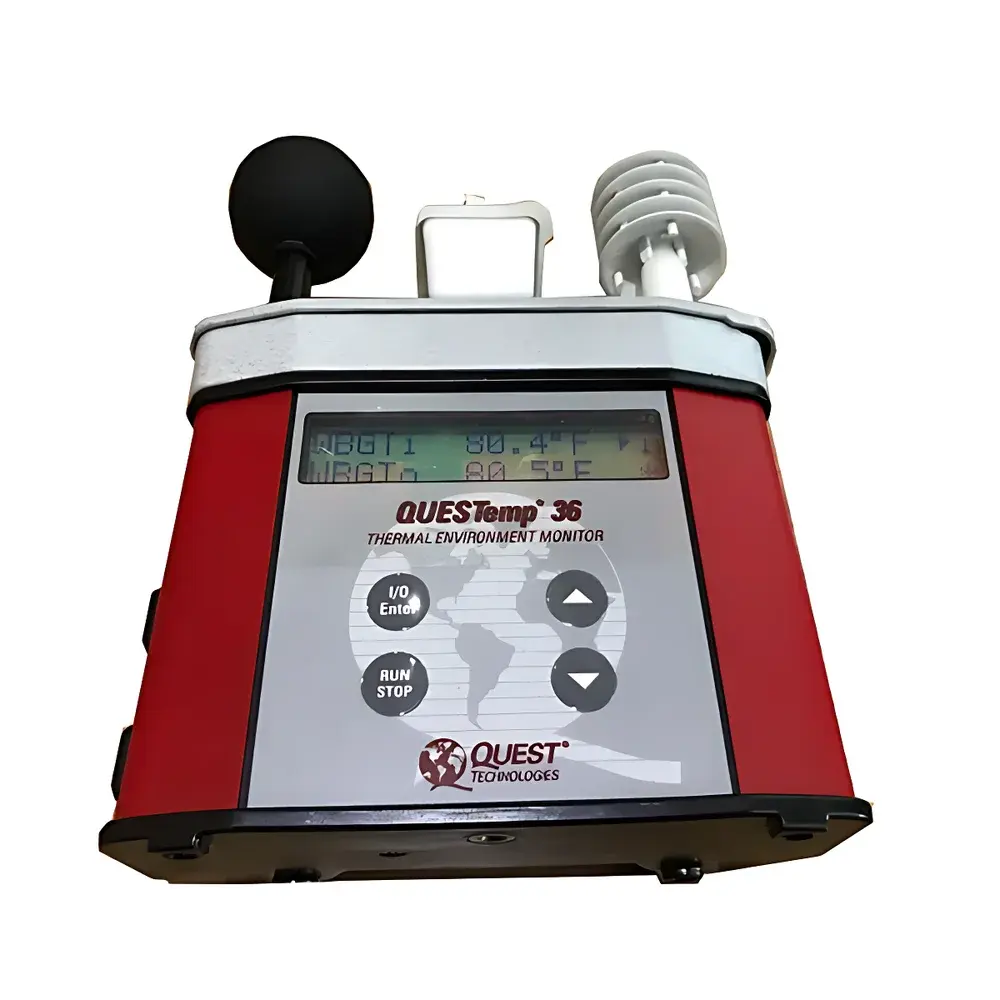
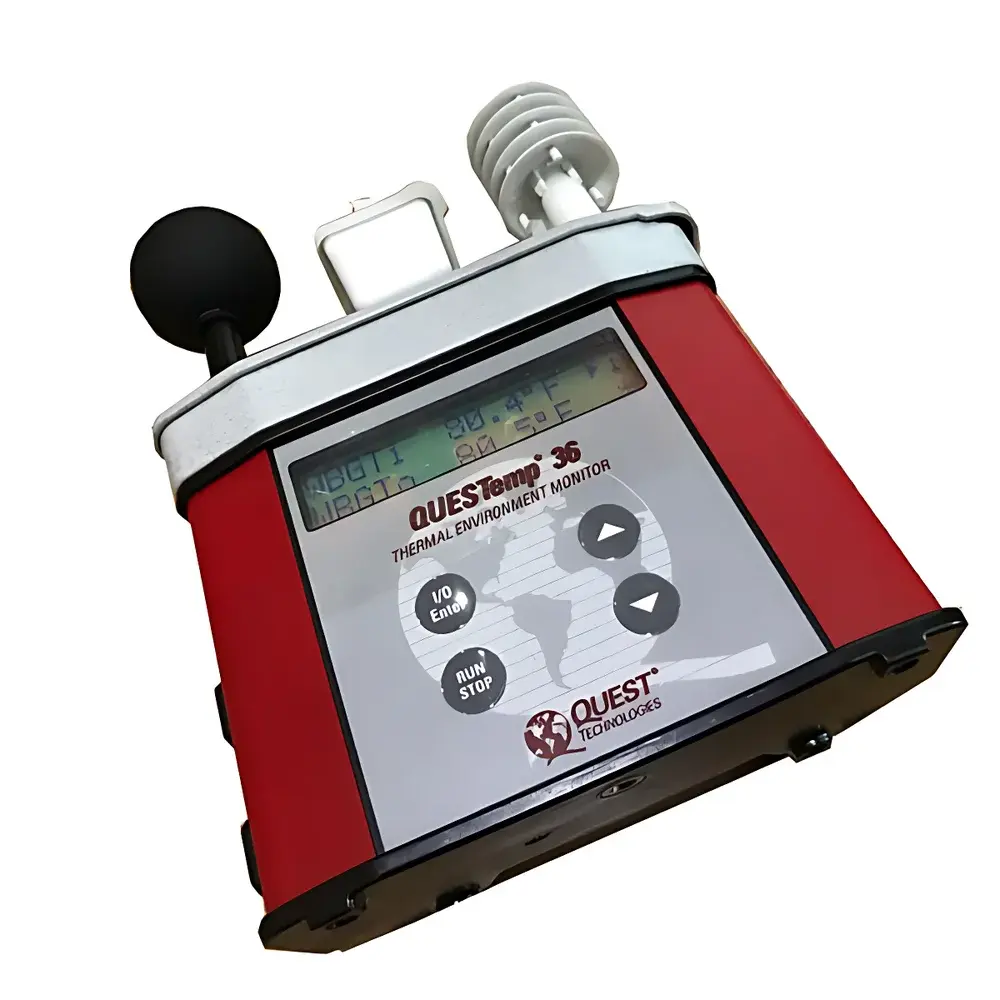
3M QUEST QT-36 WBGT Heat Stress Monitor
| Brand | 3M |
|---|---|
| Origin | USA |
| Manufacturer Type | Authorized Distributor |
| Origin Category | Imported |
| Model | QT-36 |
| Pricing | Available Upon Request |
Overview
The 3M QUEST QT-36 WBGT Heat Stress Monitor is an industrial-grade, field-deployable instrument engineered for real-time assessment of environmental heat stress risk in occupational and operational settings. It operates on the fundamental principle of Wet Bulb Globe Temperature (WBGT) — a composite thermal index standardized by ISO 7243, ACGIH TLVs®, and OSHA guidelines — which integrates dry-bulb temperature (ambient air), natural wet-bulb temperature (evaporative cooling effect), and black-globe temperature (radiant heat load) into a single, physiologically relevant metric. Unlike simple ambient thermometers, the QT-36 accounts for all four key determinants of human heat exchange: air temperature, humidity, air movement (via wet-bulb dynamics), and radiant energy from sources such as furnaces, solar exposure, or industrial heating equipment. Its architecture supports both indoor and outdoor WBGT calculation modes, automatically selecting the appropriate algorithm per ISO 7243 Annex A (indoor) or Annex B (outdoor), ensuring regulatory alignment across global industrial hygiene frameworks.
Key Features
- Simultaneous measurement of dry-bulb, natural wet-bulb, and black-globe temperatures — with independent sensor calibration traceable to NIST standards
- Dual black-globe options: 2-inch (50.8 mm) for rapid response in dynamic environments; 6-inch (152.4 mm) for enhanced thermal mass stability in high-radiation zones
- Modular sensor design: Remote sensor head connects to main unit via shielded cable up to 61 meters (200 ft), enabling safe monitoring in confined, high-temperature, or hazardous locations
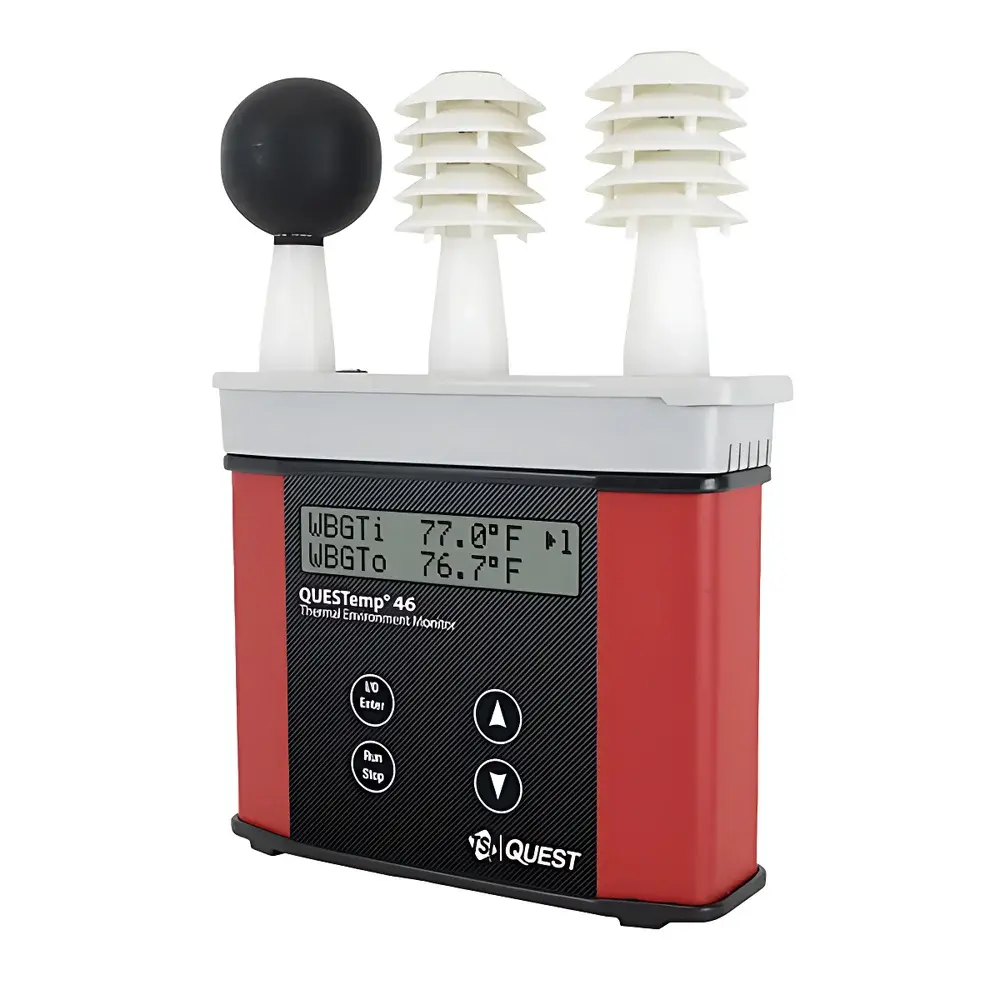
- Multi-height WBGT profiling: Optional tri-sensor configuration (head, torso, ankle) enables vertical thermal gradient analysis and ISO 7243-compliant weighted WBGT averaging
- Multi-language display interface supporting English, French, German, Italian, Spanish, Portuguese, Korean, and simplified Chinese — configurable per user preference
- Triple power options: 9 V alkaline battery (140-hour runtime), NiMH rechargeable pack, or AC adapter — optimized for continuous logging or intermittent survey use
- Intrinsically safe certification compliant with UL/CSA Class I Groups A, B, C, D; Class II Groups E, F, G; Class III; T3 temperature code; and ATEX Directive 2014/34/EU
- IP54-rated enclosure — dust-protected and resistant to water splashing from any direction
Sample Compatibility & Compliance
The QT-36 is validated for use across diverse thermal exposure scenarios, including but not limited to: naval vessel engine rooms, shipyard welding bays, nuclear plant maintenance corridors, petrochemical refinery turnaround zones, military training simulators, athletic performance conditioning facilities, and warehouse distribution centers. It meets the metrological requirements of ISO 7243:2017, ACGIH® Threshold Limit Values (TLVs®) for Heat Stress and Strain, and OSHA Technical Manual Section III: Chapter 4. Sensor accuracy specifications — ±0.5 °C over 0–120 °C for dry-, wet-, and black-bulb channels; ±5% RH (20–95% non-condensing) for relative humidity — are verified under controlled laboratory conditions per ANSI/ASHRAE Standard 114. The device’s intrinsic safety rating permits deployment in classified hazardous locations where flammable vapors, combustible dusts, or ignitable fibers may be present.
Software & Data Management
Data acquisition and reporting are supported by the 3M QUEST DMS (Data Management Software), a Windows-based application enabling time-stamped logging, export to CSV/Excel, graphical trend visualization, and customizable report generation. DMS supports audit-trail functionality compliant with GLP and GMP documentation requirements, including user login tracking, parameter change history, and timestamped data integrity verification. Raw sensor outputs and calculated WBGT values are stored with metadata (location ID, operator ID, sampling interval, sensor configuration), facilitating traceability during workplace health and safety audits or regulatory inspections per 29 CFR 1910.132 and EU Directive 89/391/EEC.
Applications
- Occupational health surveillance in foundries, glass manufacturing, and metal casting facilities
- Thermal hazard evaluation during emergency response drills and firefighter training evolutions
- Environmental validation of HVAC performance in cleanrooms and pharmaceutical production suites
- Heat strain mitigation planning for offshore oil platform crews and Arctic logistics operations
- Compliance verification for ANSI/ISEA Z89.1, NFPA 1971, and ISO 11079 cold/heat stress standards
- Research applications in ergonomics, sports physiology, and climate adaptation studies
FAQ
What is the difference between indoor and outdoor WBGT calculation modes?
The QT-36 applies distinct weighting coefficients per ISO 7243:2017 — indoor mode uses 0.7×natural wet-bulb + 0.2×black-globe + 0.1×dry-bulb; outdoor mode uses 0.7×natural wet-bulb + 0.2×black-globe + 0.1×dry-bulb, with additional solar radiation correction logic.
Can the QT-36 be used for personal heat exposure monitoring?
No — it is a zone-monitoring instrument designed for environmental assessment, not personal dosimetry. For individual physiological monitoring, pairing with physiological monitors (e.g., heart rate, core temperature) is recommended per NIOSH Publication No. 2016-107.
Is firmware update capability available?
Yes — firmware upgrades are delivered via DMS software and require USB connection; version history and release notes are documented in the official 3M QUEST Service Bulletin archive.
Does the device support real-time wireless data transmission?
No — the QT-36 does not include built-in Bluetooth or Wi-Fi. Data transfer occurs via USB or SD card (optional accessory), preserving signal integrity in electrically noisy industrial environments.
How often should sensor calibration be performed?
3M recommends annual calibration against traceable reference standards; field verification using NIST-traceable dry- and wet-bulb check points is advised before each critical measurement campaign.



