
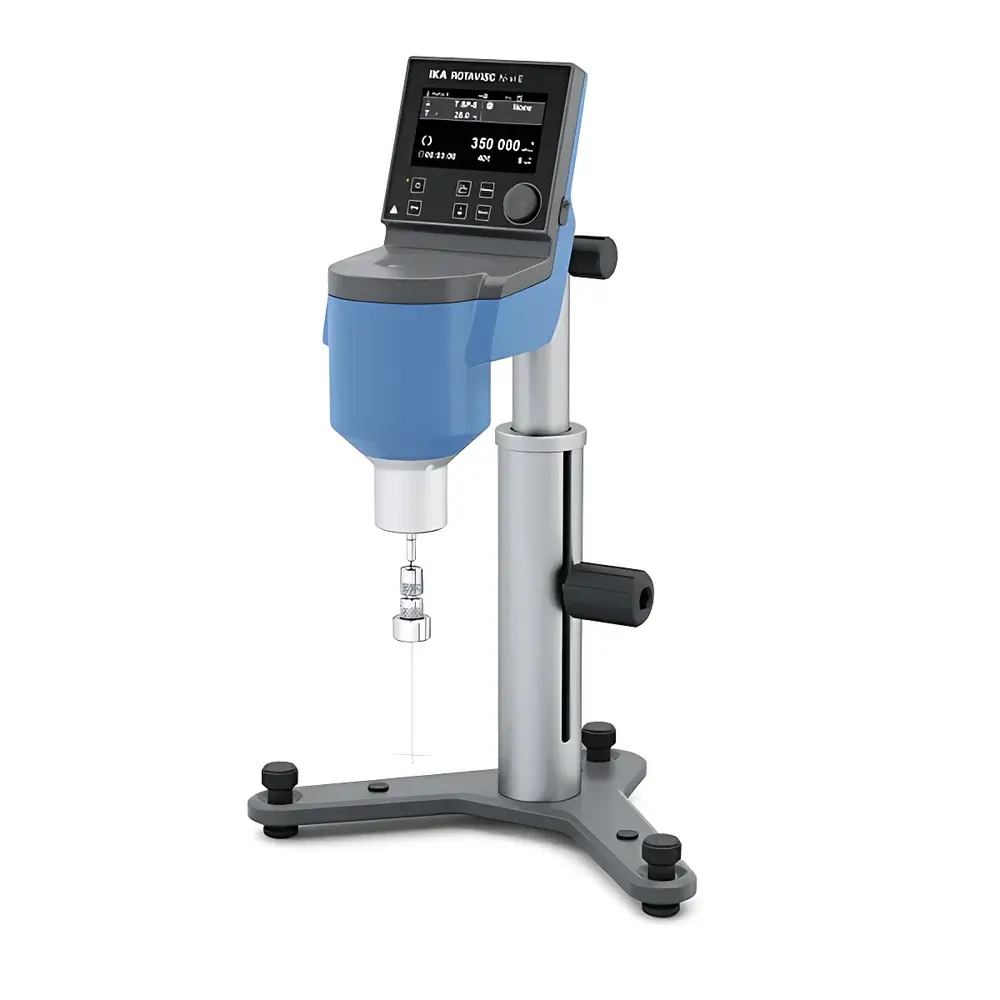
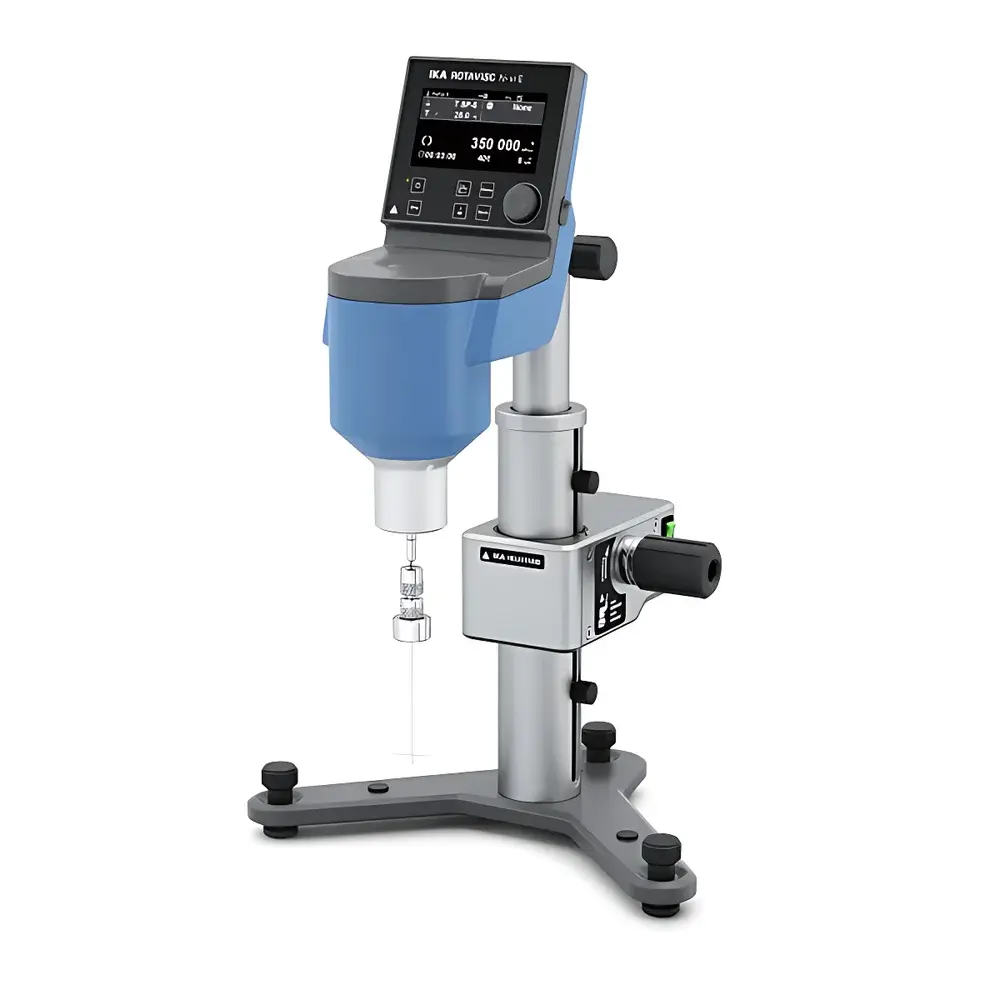
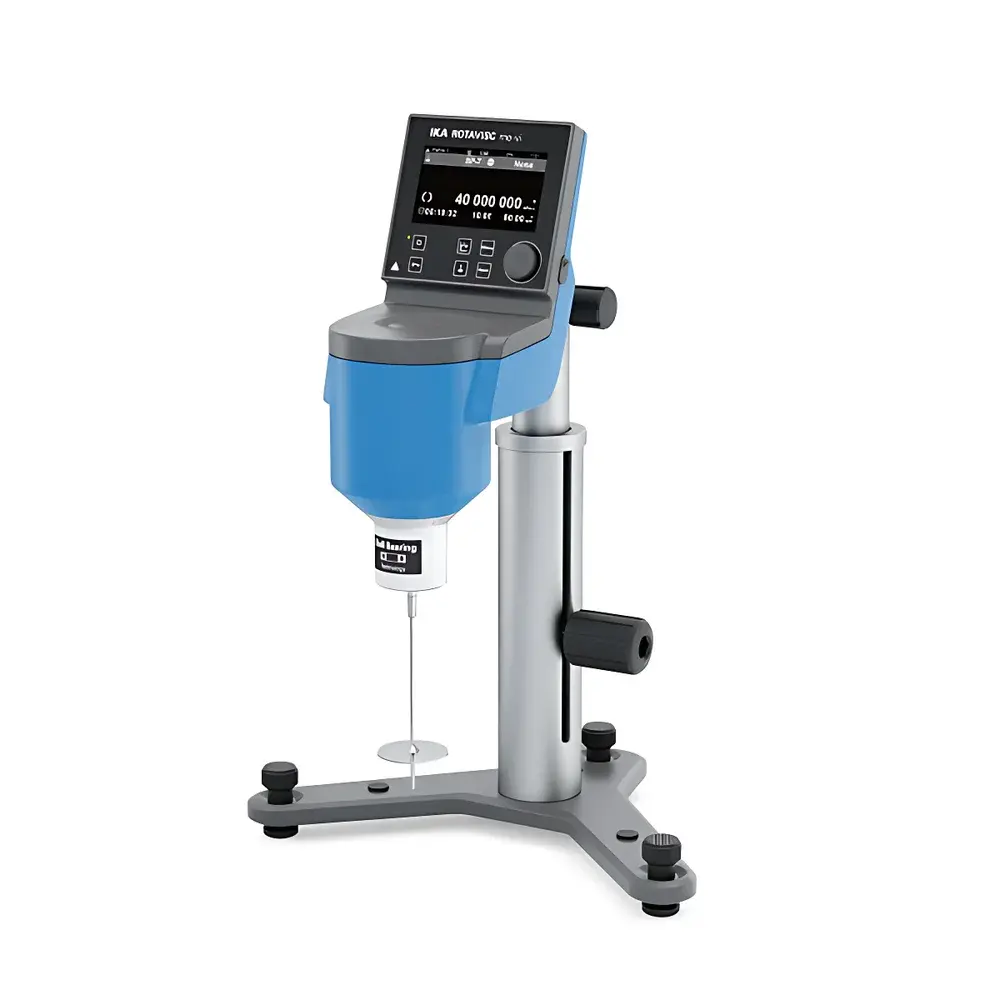
IKA ROTAVISC Series Advanced Rotational Viscometer
| Brand | IKA |
|---|---|
| Origin | Germany |
| Manufacturer Type | Original Equipment Manufacturer (OEM) |
| Product Origin | Imported |
| Model Range | ROTAVISC lo-vi / me-vi / hi-vi I / hi-vi II Complete |
| Instrument Type | Benchtop Rotational Viscometer |
| Operating Environment | Ambient Temperature |
| Viscosity Range | 1–6,000,000 mPa·s |
| Temperature Control Range | −100 °C to +300 °C |
| Temperature Resolution | 0.1 K |
| Accuracy | ±1 % of full scale |
| Repeatability | ±0.2 % of full scale |
| Speed Control | Continuously Variable (0.01–1,000 rpm) |
Overview
The IKA ROTAVISC Series is a family of high-precision benchtop rotational viscometers engineered for reliable, traceable viscosity measurement across an exceptionally broad dynamic range—from low-viscosity Newtonian fluids such as solvents and juices (1 mPa·s) to highly structured non-Newtonian materials including polymer melts, pastes, and elastomeric gels (up to 320 × 10⁶ mPa·s). Based on the Couette principle, the system measures torque generated by fluid resistance against a rotating spindle immersed in the sample, converting mechanical response into quantitative viscosity values under controlled shear conditions. Designed and manufactured in Staufen, Germany, each ROTAVISC instrument integrates metrologically validated sensor architecture, temperature-stable drive electronics, and modular mechanical design—ensuring long-term stability and compliance with international calibration standards including ISO 2555, ASTM D2196, and DIN 53019.
Key Features
- Four scalable models (lo-vi, me-vi, hi-vi I, hi-vi II Complete) optimized for distinct viscosity regimes—enabling laboratory-grade selection without over-specification or compromise.
- Continuously variable rotational speed from 0.01 to 1,000 rpm, supporting both steady-shear profiling and time-dependent rheological protocols (e.g., thixotropy recovery, creep compliance).
- Integrated Peltier-based or external circulation temperature control compatibility (−100 °C to +300 °C), with 0.1 K resolution and active thermal feedback for ISO/IEC 17025-compliant thermal management.
- High-resolution torque transduction with ±1 % full-scale accuracy and ±0.2 % repeatability—certified per manufacturer’s internal metrology protocol aligned with DKD/DAkkS traceability requirements.
- Modular accessory ecosystem: interchangeable spindles (SS, LV, RV, HA, HB geometries), Heli-series lift stands with programmable Z-axis travel (200–400 mm stroke), dynamic load compensation modules, and PT100/PT1000 probe interfaces.
Sample Compatibility & Compliance
The ROTAVISC platform accommodates diverse sample forms—including liquids, suspensions, emulsions, thermosets, and semi-solids—without requiring dilution or pre-conditioning. Its spindle geometry library supports both standard cone-plate and coaxial cylinder configurations, enabling direct correlation with ASTM D445 (kinematic viscosity), ISO 3219 (polymer solution rheology), and USP (pharmaceutical viscosity testing). All instruments comply with IEC 61000-6-3 (EMC), IEC 61010-1 (safety), and are CE-marked for use in GLP and GMP-regulated environments. Optional software validation packages support 21 CFR Part 11 audit trails, electronic signatures, and IQ/OQ documentation for regulated QC laboratories.
Software & Data Management
Control and analysis are executed via IKA Labworldsoft™ v4.x—a validated, multi-user Windows application supporting method-driven workflows, real-time viscosity vs. shear rate plotting, yield stress estimation (Bingham/Casson models), and automated data export to CSV, PDF, or LIMS-compatible XML formats. The software includes built-in calibration wizards, uncertainty propagation calculators per GUM (JCGM 100), and configurable report templates compliant with ISO/IEC 17025 clause 7.8. Data integrity safeguards include password-protected user roles, timestamped version history, and encrypted local database storage with optional network backup.
Applications
- Quality control of coatings, adhesives, and inks in industrial R&D labs (ASTM D1084, ISO 2557)
- Rheological characterization of food matrices (ketchup, chocolate, dairy gels) per ISO 11047
- Viscosity monitoring of pharmaceutical suspensions, ointments, and injectables per USP
- Thermal stability assessment of lubricants and heat-transfer fluids across wide temperature sweeps
- Evaluation of curing kinetics in epoxy and silicone formulations using time-temperature superposition (TTS)
FAQ
What spindle geometries are supported across the ROTAVISC model range?
All models accept standardized SS, LV, RV, HA, and HB spindles per DIN 53019; optional cone-plate and ultra-low-volume micro-spindles are available for specialized applications.
Can ROTAVISC be integrated into automated production line QC systems?
Yes—via RS232, USB, or optional Ethernet interface, supporting SCADA-level command scripting (SCPI) and PLC handshake protocols for inline batch verification.
Is temperature calibration traceable to national standards?
Temperature modules are factory-calibrated against NIST-traceable reference cells; on-site verification kits (±0.05 K uncertainty) are available upon request.
Does the warranty cover extended calibration intervals?
The 2+8 year extended warranty includes biennial performance verification services and free firmware updates—subject to registration and annual maintenance contract enrollment.
How does ROTAVISC handle non-Newtonian shear-thinning behavior?
By combining continuous speed ramping, real-time torque logging, and post-acquisition curve fitting (Power Law, Herschel-Bulkley), it delivers robust apparent viscosity profiles at defined shear rates.



