
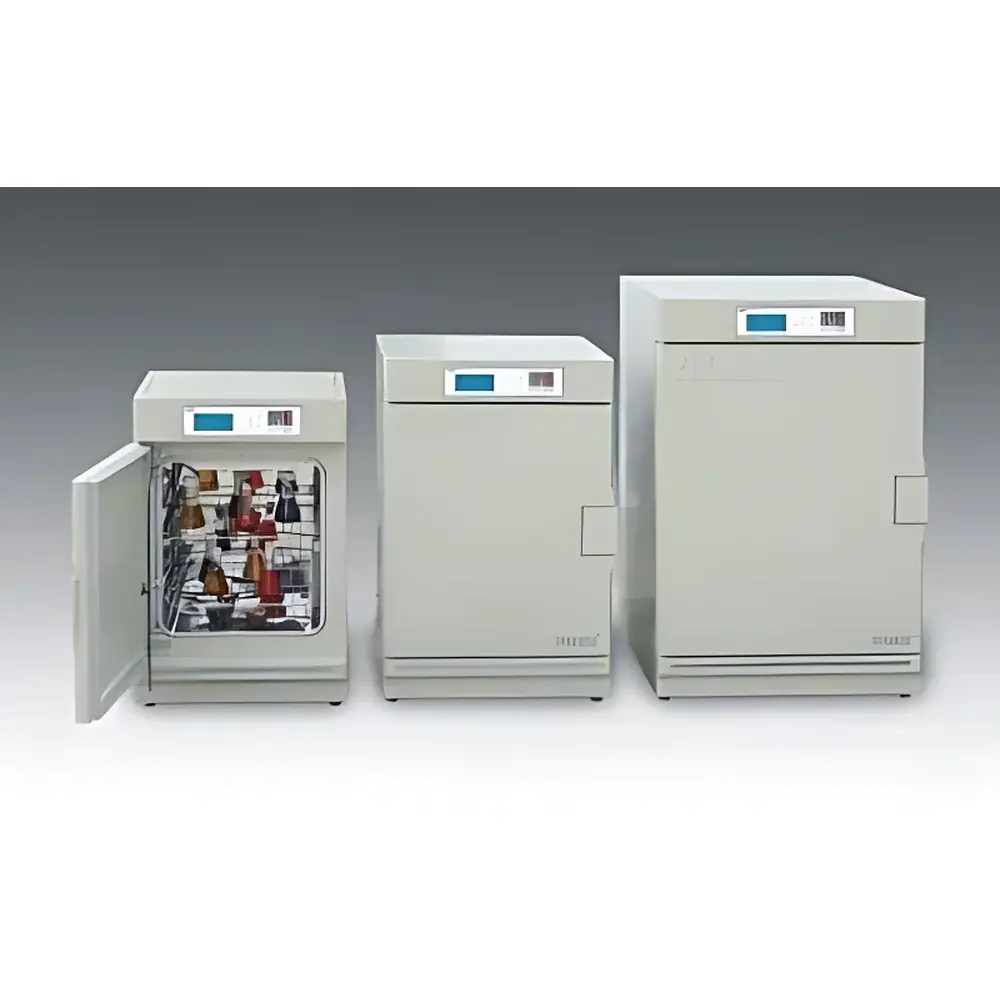
Zhicheng ZXGP-A2050 Water-Jacketed Programmable Incubator with 10-Stage Temperature Profile Control
| Brand | Zhicheng |
|---|---|
| Origin | Shanghai, China |
| Manufacturer Type | Direct Manufacturer |
| Product Category | Domestic |
| Model | ZXGP-A2050 |
| Quotation | Available Upon Request |
| Heating Method | Water-jacketed |
| Temperature Range | Ambient +5°C to 60°C |
| Temperature Resolution | 0.1°C |
| Temperature Uniformity | ≤ ±1.0°C (at 37°C) |
| Temperature Fluctuation | ≤ ±0.5°C |
| Chamber Capacity | 50 L |
| Internal Dimensions (W×D×H) | 350 × 350 × 410 mm |
| External Dimensions (W×D×H) | 510 × 475 × 780 mm |
| Net Weight | 35 kg |
| Power Supply | AC 220 V, 50/60 Hz |
| Rated Power | 510 W |
| Control System | Fuzzy Logic Microprocessor |
| Display | LCD |
| Air Circulation | Top-mounted micro-airflow circulation |
| Door Configuration | Dual-door (outer insulated door + inner tempered glass observation door) |
| Programmability | 10 segments / 18 steps, segment time adjustable from 1–999 minutes |
| Safety Features | Independent overtemperature cut-off (adjustable 30–80°C), independent overheat prevention device, leakage current protection, overcurrent circuit breaker, power failure alarm, sensor fault detection, upper/lower temperature limit alarms |
| Data Interface | RS-232 serial port |
| Optional Output | Embedded thermal mini-printer |
| Shelving | 2 standard stainless steel electropolished shelves (expandable to 4) |
| Interior Material | Mirror-finish 304 stainless steel |
| Compliance | Designed for GLP-compliant laboratory environments |
Overview
The Zhicheng ZXGP-A2050 is a precision-engineered water-jacketed programmable incubator designed for stable, uniform, and traceable thermal control in regulated life science laboratories. Unlike forced-air incubators, its water-jacketed architecture provides superior thermal inertia and insulation—minimizing internal temperature fluctuations during ambient disturbances or door openings. The system employs fuzzy logic microprocessor control to dynamically adjust heating output based on real-time feedback from high-response platinum resistance thermometers (PT100-class sensors), ensuring robust setpoint maintenance across the full operating range of ambient +5°C to 60°C. With a 50 L chamber volume and mirror-polished 304 stainless steel interior, the ZXGP-A2050 delivers both mechanical durability and microbiological cleanliness—critical for cell culture, microbial growth, and stability testing applications requiring long-term environmental consistency.
Key Features
- 10-stage programmable temperature profiling: Supports up to 18 discrete steps across 10 user-defined segments, enabling complex thermal protocols such as ramp-hold-cool cycles, diurnal simulation, or multi-phase incubation without manual intervention.
- Independent dual-safety architecture: Features three redundant thermal safeguards: an adjustable independent overtemperature limiter (30–80°C), a fixed overheat prevention device, and a separate overcurrent/leakage circuit breaker—each certified to IEC 61010-1 safety standards.
- Micro-airflow circulation system: Top-mounted low-velocity air distribution ensures laminar, non-turbulent airflow—reducing desiccation risk for open culture vessels while maintaining ≤ ±1.0°C uniformity at 37°C (per ISO 15189 Annex B validation guidance).
- Full diagnostic self-monitoring: Real-time fault detection includes sensor failure, power interruption, door-open duration exceedance, and upper/lower limit breaches—with audible/visual alerts and automatic logging to internal memory.
- GLP-ready operational integrity: Built-in parameter password protection, power-loss recovery, calibration offset adjustment, and persistent parameter memory ensure continuity and compliance during extended unattended runs.
- Expandable data connectivity: RS-232 interface enables bidirectional communication with LIMS or SCADA systems; optional embedded thermal printer provides immediate hard-copy record of temperature logs and alarm events.
Sample Compatibility & Compliance
The ZXGP-A2050 accommodates standard microbiological and cell culture formats—including Petri dishes, multi-well plates, flasks (T25–T175), and serum bottles—within its 350 × 350 × 410 mm chamber. Its dual-door configuration (outer insulated door + inner tempered glass door) minimizes radiant heat loss and condensation, preserving sample integrity during visual inspection. The electropolished stainless steel shelving (2 included, expandable to 4) resists corrosion and facilitates sterilization via autoclaving or chemical wipe-down. The unit is engineered to meet foundational requirements for ISO/IEC 17025-accredited testing labs and supports documentation practices aligned with FDA 21 CFR Part 11 when paired with validated software solutions. It complies with electromagnetic compatibility (EMC) per EN 61326-1 and electrical safety per EN 61010-1.
Software & Data Management
While the ZXGP-A2050 operates autonomously via its onboard LCD interface, its RS-232 port enables integration into centralized laboratory informatics infrastructure. Third-party software (e.g., LabVIEW, MATLAB, or custom Python-based DAQ tools) can poll real-time temperature values, download historical trend data, and trigger external actions upon alarm conditions. All logged events—including temperature deviations, door openings, and safety interventions—are timestamped and stored in non-volatile memory for ≥30 days. When used with the embedded thermal printer, users receive immediate, tamper-evident printouts compliant with ALCOA+ principles (Attributable, Legible, Contemporaneous, Original, Accurate, Complete, Consistent, Enduring, Available).
Applications
- Bacterial and fungal cultivation under controlled thermal profiles (e.g., E. coli growth kinetics, yeast fermentation optimization)
- Mammalian and insect cell line maintenance where humidity-independent temperature stability is prioritized
- Stability studies of biologics, vaccines, and diagnostic reagents per ICH Q5C guidelines
- Environmental simulation for agricultural seed germination or soil microbiome assays
- Pre-incubation conditioning of media, sera, and enzymatic reagents prior to assay execution
- Long-duration storage of temperature-sensitive biological standards and reference materials
FAQ
What is the difference between water-jacketed and air-jacketed incubation?
Water-jacketed designs use a surrounding layer of heated water to buffer chamber temperature against ambient variation—offering higher thermal mass and lower energy consumption over extended cycles. Air-jacketed units rely on convection heating and respond faster to setpoint changes but exhibit greater sensitivity to room temperature shifts.
Can this incubator be validated for GMP use?
Yes—the ZXGP-A2050 supports IQ/OQ/PQ protocol execution. Its programmable profiles, alarm logging, and parameter traceability align with Annex 15 of the EU GMP Guide and ASTM E2500-21 for equipment qualification in pharmaceutical settings.
Is the temperature uniformity specification verified at all setpoints?
Uniformity is specified at 37°C per ISO 15189 Annex B methodology. Users performing qualification at other temperatures should conduct mapping per ISO/IEC 17025 Section 5.10.4 using calibrated thermocouples placed at 9 defined spatial locations.
Does the unit support remote monitoring via Ethernet or Wi-Fi?
No native Ethernet or Wi-Fi module is integrated; however, RS-232-to-Ethernet gateways (e.g., Moxa NPort series) are compatible and widely deployed in networked lab environments.
How often does the temperature sensor require recalibration?
Annual verification against a NIST-traceable reference thermometer is recommended. The unit’s built-in temperature display correction function allows user-adjusted offsets within ±2.0°C to compensate for minor drift without hardware service.






