
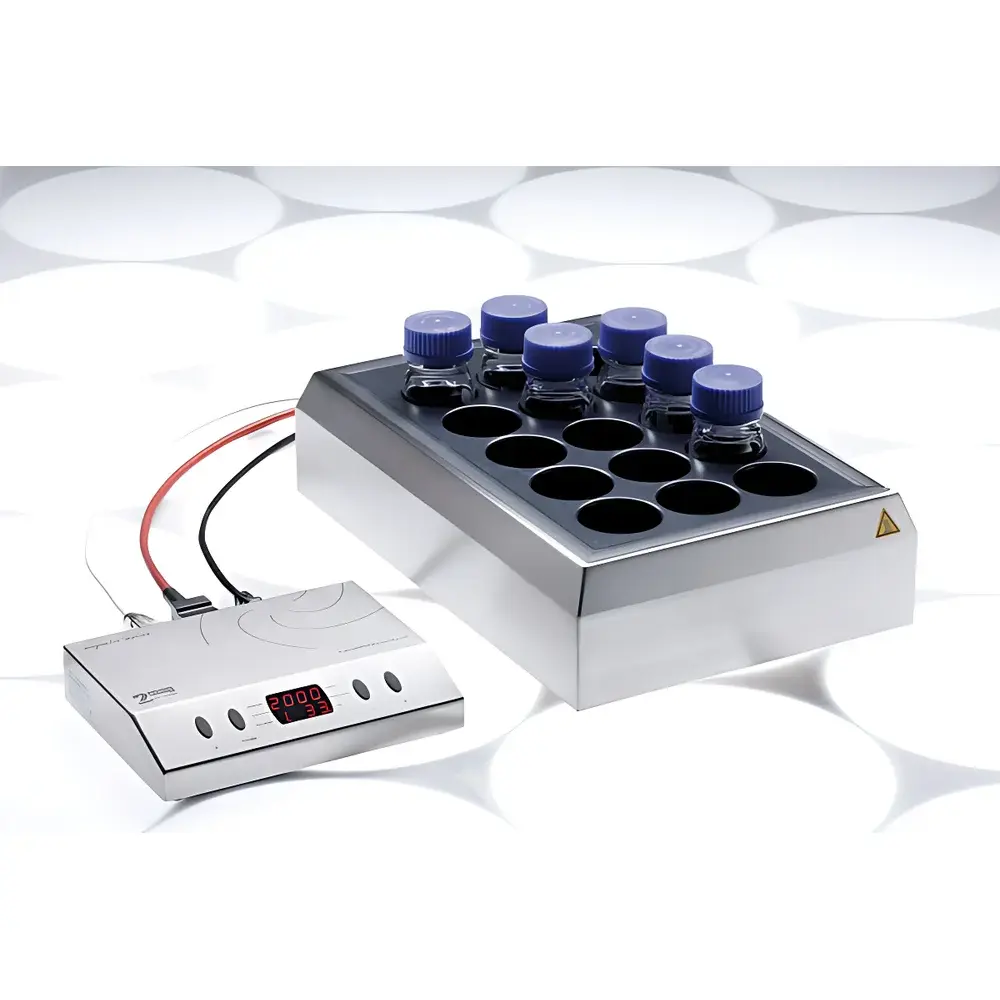
2mag DRYBATH 15-100 Multi-Position Induction Magnetic Stirring Dry Bath
| Brand | 2mag |
|---|---|
| Origin | Germany |
| Model | DRYBATH 15-100 |
| Stirring Points | 15 |
| Max. Stirring Volume per Position | 250 mL |
| Speed Range | 100–2000 rpm |
| Temperature Range | 40–200 °C |
| Heating Power | 1000 W |
| Input Voltage | 230 V AC |
| Protection Class | IP20 |
| Dimensions (W × D × H) | 280 × 430 × 120 mm |
| Weight | ~20 kg |
Overview
The 2mag DRYBATH 15-100 is a precision-engineered multi-position dry bath system integrating induction-based magnetic stirring with PTFE-coated aluminum heating blocks. Unlike conventional hotplate stirrers, it eliminates mechanical drive shafts and carbon brushes—relying instead on contactless electromagnetic coupling to rotate stir bars within vessels placed directly on thermally optimized heating zones. This architecture ensures zero mechanical wear, silent operation, and long-term stability under continuous laboratory use. Designed for parallel sample processing in QC, synthesis, enzymatic assays, and dissolution testing, the unit supports simultaneous thermal control and agitation across 15 independent positions—each with individually regulated speed and power delivery. Its operational envelope spans from gentle mixing of sensitive biological buffers at 100 rpm to vigorous homogenization of viscous reaction mixtures up to 2000 rpm, while maintaining temperature uniformity ±1.5 °C across the block surface at steady state.
Key Features
- Contactless induction stirring technology—no moving parts, no maintenance, no cross-contamination risk
- 15 identical stirring positions with 57.5 mm diameter × 48 mm depth wells, optimized for standard 100 mL Erlenmeyer flasks and 150 mL wide-mouth glass beakers
- Digital dual-display interface showing real-time setpoints and actual values for speed (rpm), power (%), and block temperature (°C)
- SoftStart function enables controlled acceleration of stir bars—preventing splashing or vortex instability during startup
- PTFE-coated anodized aluminum heating block offers superior chemical resistance and ease of decontamination
- PowerDetect algorithm dynamically compensates for torque loss at elevated temperatures—maintaining consistent rotational performance even when thermal load reduces magnetic coupling efficiency by up to 40%
- Dual independent safety controllers: one governs stirring electronics, the other manages heating circuitry—both include redundant overtemperature cutoffs (hardware-limited to 220 °C)
- Stainless steel housing with IP20-rated enclosure meets standard laboratory environmental requirements for dust resistance and operator protection
Sample Compatibility & Compliance
The DRYBATH 15-100 accommodates standard borosilicate glassware including round-bottom flasks (up to 150 mL), flat-bottom vials, and polypropylene tubes compatible with magnetic stir bars (e.g., PTFE-coated, elliptical, or cross-shaped designs). It complies with IEC 61010-1:2010 for electrical safety in laboratory equipment and conforms to EN 60529 for ingress protection (IP20). While not certified for hazardous area use, its sealed electronics and thermal isolation structure support deployment in ISO Class 5–7 cleanrooms when operated under validated SOPs. The system supports GLP-compliant workflows through traceable parameter logging when integrated with external data acquisition systems via analog output (0–10 V) or optional RS-485 interface.
Software & Data Management
The DRYBATH 15-100 operates as a standalone instrument with embedded firmware—no proprietary software required for basic operation. All setpoints and real-time measurements are accessible via front-panel controls and LED display. For automated process documentation, optional analog voltage outputs allow connection to PLCs, SCADA systems, or LIMS platforms. When used in regulated environments (e.g., pharmaceutical manufacturing), users may implement external audit trails using time-stamped CSV exports from connected DAQ hardware. The device does not natively support FDA 21 CFR Part 11 electronic signatures but can be incorporated into compliant workflows through validated third-party data capture solutions.
Applications
- Parallel dissolution testing of solid dosage forms under USP <711> conditions
- Enzyme kinetics studies requiring precise temperature control and low-shear mixing
- Synthesis of metal-organic frameworks (MOFs) and nanoparticle dispersions where oxygen exclusion and reproducible agitation are critical
- Cell culture media preparation with heat-sensitive additives (e.g., growth factors, antibiotics)
- Calibration of viscometers and rheometers using standardized Newtonian fluids across multiple temperatures
- Accelerated stability testing per ICH Q1A(R3) guidelines using synchronized thermal and mechanical stress profiles
FAQ
What types of stir bars are recommended for optimal performance?
Elliptical or cross-shaped PTFE-coated stir bars with diameters between 8–12 mm are ideal for stable rotation across the full speed range; avoid oversized or magnetically unbalanced bars that may cause vibration at high rpm.
Can the unit maintain temperature uniformity across all 15 positions simultaneously?
Yes—the heating block’s thermal mass and insulation design ensure ≤ ±1.5 °C spatial deviation at 150 °C after thermal equilibrium (typically reached within 12 minutes from ambient).
Is the DRYBATH 15-100 suitable for use with organic solvents?
The PTFE coating provides broad compatibility with alcohols, ketones, esters, and chlorinated hydrocarbons; however, prolonged exposure to strong oxidizers (e.g., concentrated nitric acid) or halogenated solvents above 180 °C is not advised.
Does the system support programmable ramp-and-soak temperature profiles?
No—this model features fixed-point temperature control only; programmable profiles require integration with external PID controllers or custom automation scripts.
What is the expected service life of the induction coils under continuous operation?
Rated for >50,000 hours of operation at nominal load; coil degradation is negligible due to absence of thermal cycling stress and mechanical fatigue mechanisms inherent in brushed motor systems.



