
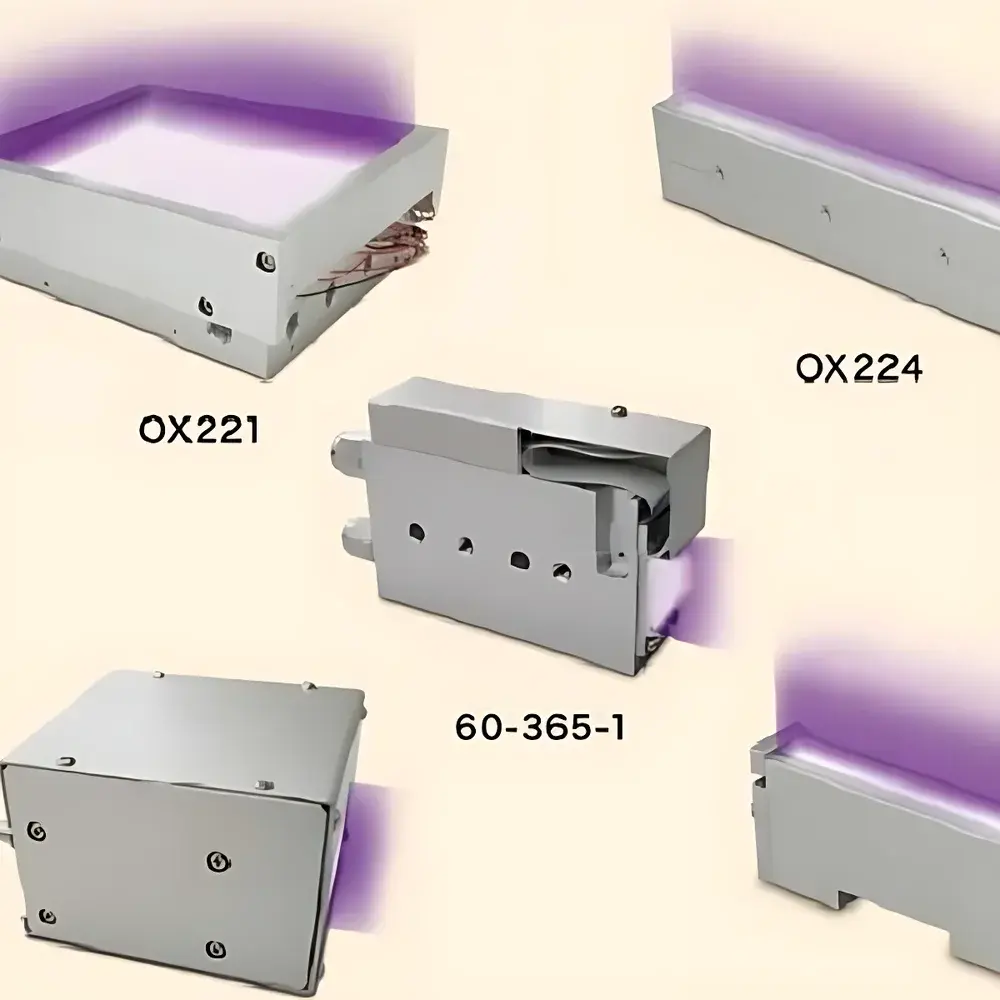
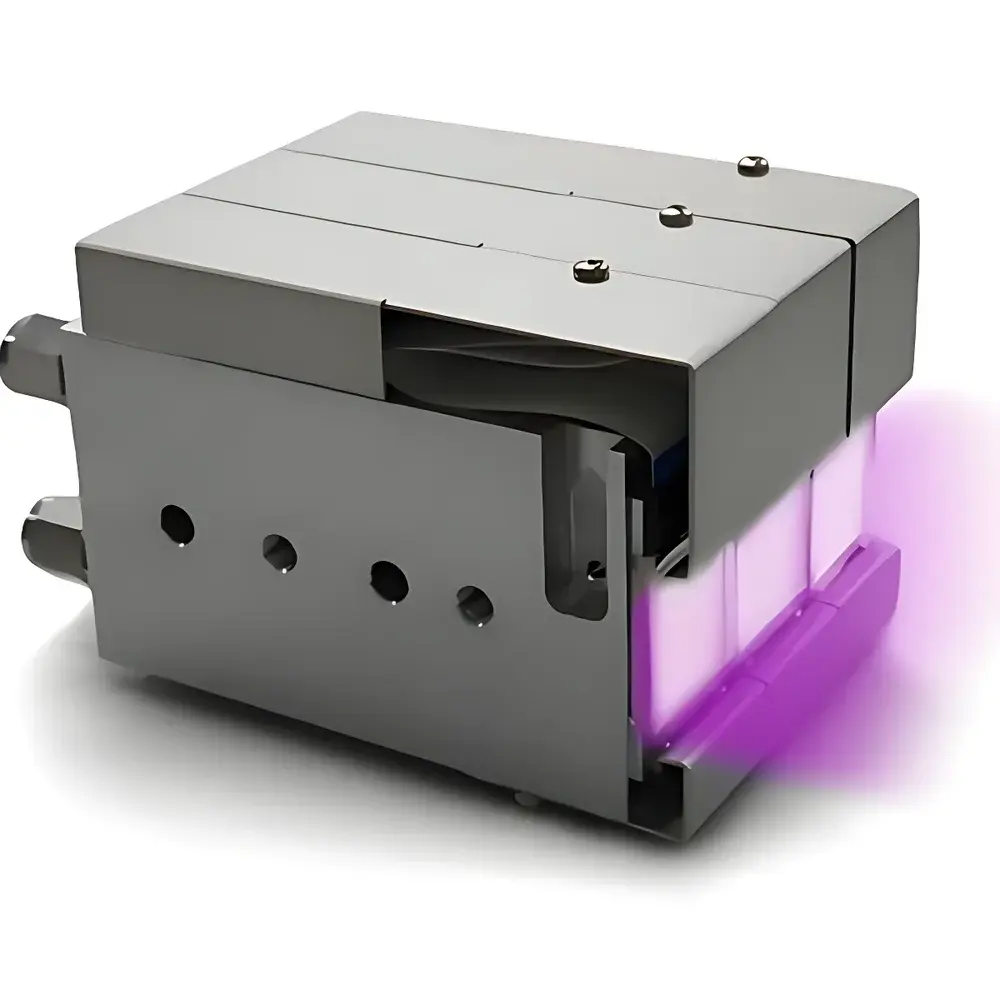
AcroEdge Uvira UV-LED Irradiation System
| Brand | AcroEdge |
|---|---|
| Origin | Imported (Non-China) |
| Manufacturer Type | Authorized Distributor |
| Model | Uvira |
| Light Source Type | High-Efficiency UV-LED Array |
| Cooling Options | Selectable Air Cooling / Forced-Air Cooling / Integrated Water-Cooling Module |
| Instant On/Off Capability | Yes |
| Design Form Factor | Ultra-Thin, Low-Profile, Modular Mounting |
| Typical LED Lifetime | >20,000 hours (L70) |
| Operating Wavelength Range | 365 nm, 385 nm, 395 nm, and 405 nm variants available |
| Power Density Range | 1–20 W/cm² (configurable per module) |
| Uniformity (within 100 mm × 100 mm area) | ≥92% |
| Control Interface | Analog 0–10 V / RS-485 / Optional EtherCAT |
Overview
The AcroEdge Uvira UV-LED Irradiation System is an engineered solution for precision ultraviolet photopolymerization, photochemical activation, and surface functionalization in R&D laboratories and pilot-scale manufacturing environments. Unlike conventional mercury or xenon arc lamps, the Uvira employs high-radiance, narrow-band UV-LED emitters—available in 365 nm, 385 nm, 395 nm, and 405 nm peak wavelengths—to deliver stable, repeatable irradiance without spectral drift, ozone generation, or warm-up delays. Its core architecture follows a modular photonic platform principle: individual irradiation units can be tiled or arrayed to cover areas from <1 cm² (micro-patterning) to >500 cm² (large-area coating curing), while maintaining radiometric uniformity ≥92% across defined fields. The system operates on a solid-state photonics paradigm—eliminating electrode degradation, mercury disposal concerns, and broadband IR emission—thereby enabling low-thermal-load processing critical for heat-sensitive substrates including flexible electronics, biomedical polymers, and thin-film optics.
Key Features
- Modular irradiation architecture supporting scalable coverage—from micro-spot (≤5 mm Ø) to macro-area (≥300 × 300 mm) configurations via standardized mechanical and electrical interconnects.
- Integrated thermal management system with three selectable cooling modes: passive convection, forced-air convection, and closed-loop water cooling—each optimized for specific duty cycles and ambient conditions.
- Proprietary water-cooling manifold design developed over 10+ years of thermal modeling and empirical validation; achieves sub-5 °C junction temperature rise under continuous 100% drive current, directly extending LED L70 lifetime beyond 20,000 hours.
- Instantaneous on/off switching (<100 µs response time) with no preheat or cooldown period—enabling precise dose control via pulse-width modulation (PWM) or timed exposure protocols.
- Low-profile mechanical form factor (≤25 mm total height, excluding mounts); compatible with XYZ stages, vacuum chucks, and curved-surface fixtures via adjustable-angle brackets and conformal mounting kits.
- Radiometric calibration traceable to NIST-traceable reference detectors; delivered with individual unit calibration report specifying irradiance (W/cm²), uniformity map, and spectral power distribution (SPD).
Sample Compatibility & Compliance
The Uvira accommodates diverse sample geometries—including planar wafers, cylindrical lenses, injection-molded plastic housings, and flexible PET or PI substrates—without requiring optical reconfiguration. Its low-IR output (<5% radiant flux in >700 nm band) minimizes substrate heating, limiting ΔT to <3 °C during 60 s exposure at 15 W/cm²—critical for acrylate-based adhesives, photoresists, and bio-ink crosslinking. From a regulatory standpoint, the system complies with IEC 62471 (Photobiological Safety of Lamps), EN 61000-6-3 (EMC Emission Limits), and RoHS 2015/863/EU. Optional documentation packages support GLP-compliant lab environments, including IQ/OQ templates, audit-ready calibration logs, and 21 CFR Part 11–compatible electronic signature modules for controlled exposure records.
Software & Data Management
The Uvira integrates with AcroEdge’s AcroControl Suite—a Windows-based application supporting real-time irradiance monitoring, exposure dose logging (J/cm²), and multi-channel synchronization with motion controllers or environmental chambers. All operational parameters—including drive current, PWM frequency, cooling mode status, and thermistor readings—are timestamped and exportable as CSV or HDF5 files. For integration into automated production lines, the system provides native RS-485 Modbus RTU and EtherCAT slave profiles compliant with SEMI E54 and OPC UA PubSub standards. Audit trails retain user actions, parameter changes, and calibration events for ≥18 months—fully aligned with FDA 21 CFR Part 11 requirements for electronic records and signatures.
Applications
- UV-curable adhesive bonding and encapsulation in optoelectronics assembly (e.g., VCSEL packaging, fiber alignment)
- Photo-initiated polymerization of dental composites and biodegradable hydrogels under ISO 4049 and ASTM F2582 test conditions
- Surface modification of PDMS and polyolefins for improved wettability prior to plasma or inkjet printing
- Accelerated aging studies of UV-stabilized polymers per ASTM G154 Cycle 1 (UV-A + condensation)
- Maskless photolithography development using near-UV LED sources in academic cleanroom facilities
- Photodynamic therapy (PDT) light source qualification and dosimetry validation in preclinical research
FAQ
What wavelength options are available for the Uvira system?
Standard configurations include 365 nm (UVA-I), 385 nm (UVA-II), 395 nm, and 405 nm (violet). Custom center wavelengths between 350–420 nm are available upon request with minimum order quantity.
Can the Uvira be integrated into a Class 100 cleanroom environment?
Yes—the water-cooled variant features sealed coolant pathways and stainless-steel housing compatible with ISO 14644-1 Class 5 protocols; all electrical interfaces meet IP54 ingress protection when properly mated.
Is radiometric recalibration required, and how often?
Annual recalibration is recommended for GMP/GLP workflows; AcroEdge offers certified on-site or return-to-factory services with NIST-traceable reference standards and full uncertainty budgets.
Does the system support synchronized triggering with external equipment?
Yes—via TTL-compatible trigger input (rising-edge active) with ≤1 µs jitter, configurable for single-shot, burst-mode, or externally gated exposure sequences.
What safety interlocks are built into the Uvira?
Integrated hardware-level interlocks include door-open detection, coolant flow sensor feedback, and overtemperature cutoff (≥85 °C junction threshold), all independently monitored by a redundant safety controller meeting SIL 2 per IEC 61508.





