
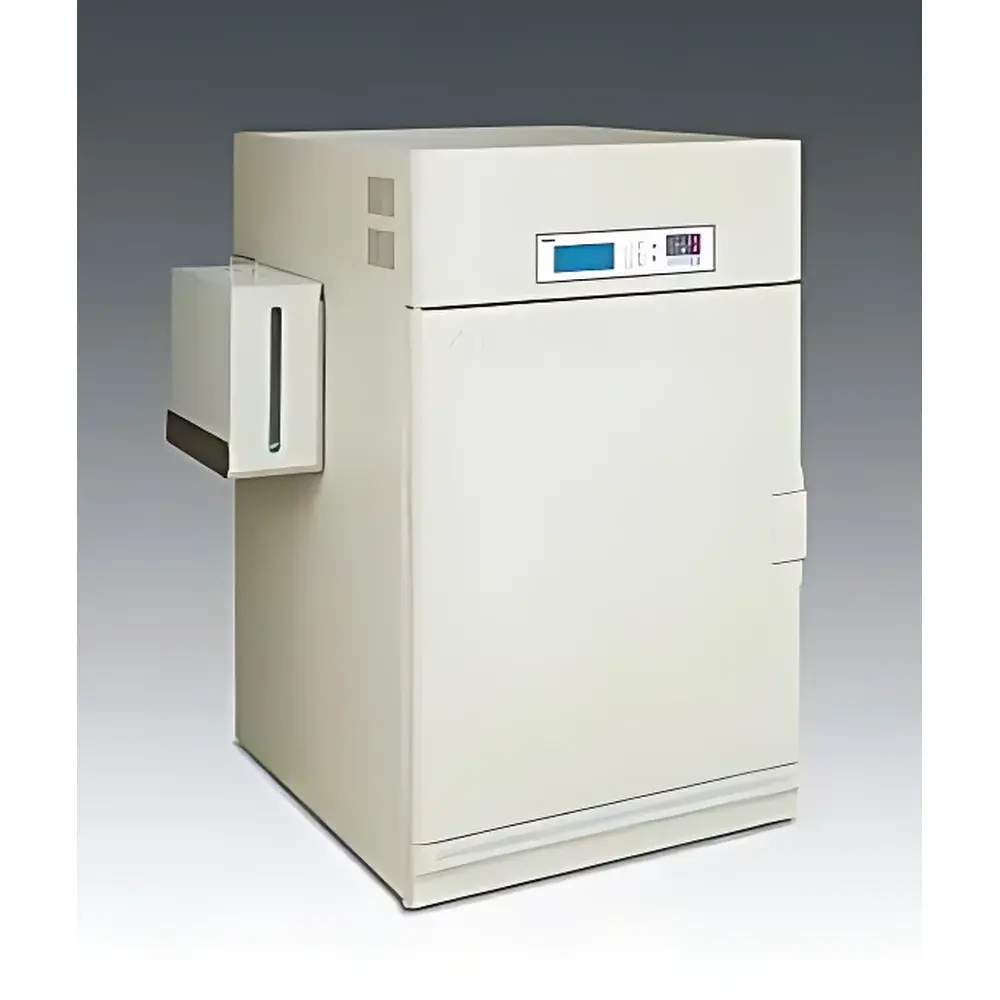
Zhicheng ZXMP-A1230 Ten-Stage Programmable Temperature and Humidity Controlled Incubator
| Brand | Zhicheng |
|---|---|
| Origin | Shanghai, China |
| Manufacturer Type | Direct Manufacturer |
| Region of Origin | Domestic (China) |
| Model | ZXMP-A1230 |
| Pricing | Upon Request |
| Capacity | 230 L |
| Temperature Range | 0–65 °C |
| Temperature Resolution | 0.1 °C |
| Temperature Uniformity | ≤ ±1 °C (at 37 °C) |
| Temperature Fluctuation | ≤ ±0.5 °C |
| Humidity Range | 40–98 %RH |
| Humidity Resolution | 0.1 %RH |
| Humidity Fluctuation | ≤ ±3 %RH |
| Humidity Uniformity | ≤ ±5 %RH |
| Control Method | Fuzzy Logic Algorithm |
| Display | LCD |
| Air Circulation | Forced Convection with Turbo Fan |
| Door Design | Double-layer Door with Insulated Inner Tempered Glass |
| Power Supply | AC 220 V, 50/60 Hz |
| Rated Power | 1000 W |
| Internal Dimensions (W×D×H) | 600 × 550 × 700 mm |
| External Dimensions (W×D×H) | 740 × 790 × 1400 mm |
| Net Weight | 130 kg |
| Shelving | 2 standard stainless steel electropolished shelves (expandable to 4) |
| Refrigerant | R134a |
| Defrosting | Frost-Free Operation |
| Water Supply | Dual-stage automatic reservoir system |
| Safety Systems | Independent overtemperature cut-off (adjustable 30–80 °C), independent overheat prevention device, leakage & overcurrent circuit breaker, compressor overload protection |
| Diagnostic Alerts | Low water level, power failure, sensor fault, upper/lower temperature limit violation |
Overview
The Zhicheng ZXMP-A1230 is a precision-engineered, ten-stage programmable temperature and humidity controlled incubator designed for reproducible environmental simulation in life science laboratories. It operates on the principle of active dual-parameter regulation—simultaneously controlling air temperature and relative humidity via integrated refrigeration, heating, humidification, and dehumidification subsystems—within a thermally stable, contamination-minimized chamber. Its core architecture employs fuzzy logic control algorithms to dynamically adjust actuator outputs (Peltier-based cooling, PID-driven heating, ultrasonic humidification, and passive desiccant-assisted dehumidification) based on real-time feedback from high-stability capacitive humidity sensors and Pt100-class temperature probes. This enables tightly coupled, low-drift environmental maintenance critical for long-term microbial culture, cell line expansion, vaccine stability testing, and BOD incubation per ISO 5815-1 and ASTM D5210 standards.
Key Features
- Ten-segment programmable control with up to 18 steps per program, supporting complex temporal profiles including ramp-hold cycles, stepwise gradients, and repeated sequences—ideal for simulating diurnal cycles or staged differentiation protocols.
- Frost-free refrigeration using R134a refrigerant and variable-speed compressor control eliminates manual defrosting and ensures uninterrupted operation during extended incubation periods.
- Two-stage automatic water supply system with sealed reservoir and capillary feed mechanism eliminates manual refilling and reduces contamination risk; compatible with distilled or deionized water sources.
- Robust safety architecture featuring three independent thermal protection layers: adjustable overtemperature limiter (30–80 °C), fixed overheat cut-off, and real-time sensor fault detection with audible/visual alarm activation.
- High-integrity chamber design with mirror-finish electropolished stainless steel interior, seamless welded corners, and tempered double-glass inner door minimizes particulate shedding and supports ISO 14644-1 Class 5 cleanroom-compatible workflows.
- LCD interface with password-protected parameter editing, clock-synchronized scheduling, auto-recovery after power interruption, and calibration offset adjustment for traceable temperature display accuracy.
Sample Compatibility & Compliance
The ZXMP-A1230 accommodates standard microbiological and tissue culture vessels—including Petri dishes, multi-well plates, Erlenmeyer flasks, and serum bottles—on two included electropolished stainless steel shelves (expandable to four). Its uniform airflow pattern, engineered via optimized vortex duct geometry and rear-mounted turbo fan, ensures ≤ ±1 °C temperature deviation and ≤ ±5 %RH spatial variation across the full 230 L working volume at 37 °C/50 %RH reference conditions. The unit complies with IEC 61010-1 for laboratory equipment safety and meets essential requirements for GLP-compliant environmental monitoring under OECD Principles of Good Laboratory Practice. Optional RS-232 serial interface enables integration into centralized lab management systems for audit-ready data logging aligned with FDA 21 CFR Part 11 electronic record requirements.
Software & Data Management
While the onboard controller provides standalone operation, the RS-232 interface supports bidirectional communication with third-party laboratory information management systems (LIMS) or custom SCADA platforms. Users may configure event-triggered data export (e.g., on alarm activation or cycle completion), schedule periodic parameter snapshots, and archive runtime logs—including timestamped temperature/humidity values, alarm status codes, and diagnostic flags—for retrospective analysis. When paired with optional embedded thermal printer, hard-copy records of start/stop times, setpoint history, and deviation alerts are generated automatically—facilitating compliance with internal QA checklists and external accreditation audits (e.g., CAP, CLIA, or CNAS).
Applications
This incubator serves as a primary environmental platform for applications demanding precise, sustained control of both thermal and hygric parameters: bacterial and fungal cultivation (including fastidious organisms requiring elevated humidity); mammalian cell culture under normoxic or hypoxic-mimetic conditions; seed germination and plant tissue culture; BOD₅ determination per APHA Standard Methods 5210B; vaccine and blood product stability studies per ICH Q5C; and environmental stress testing of biomaterials. Its wide operating range (0–65 °C / 40–98 %RH) and programmable flexibility make it suitable for method development in pharmaceutical QC labs, academic research on climate-responsive gene expression, and regulatory testing in public health institutes.
FAQ
What is the maximum number of programmable segments and steps?
The ZXMP-A1230 supports up to 10 total segments, with Segment “0” reserved for pre-set constant-mode operation and Segments 1–9 configured for time- and condition-dependent transitions—each segment accommodating up to 18 sequential steps.
Does the unit support validation documentation for GxP environments?
Yes—its parameter lockout, calibration traceability, alarm logging, and optional RS-232 data export meet foundational requirements for IQ/OQ documentation; users should perform site-specific PQ per their SOPs.
Can humidity be maintained below 40 %RH?
No—the minimum specified humidity control range is 40 %RH, achieved via integrated desiccant-assisted dehumidification; sub-40 %RH operation is not supported.
Is the internal chamber volume verified per ISO 12777?
Chamber capacity (230 L) is calculated from nominal internal dimensions (600 × 550 × 700 mm) and conforms to industry-standard volumetric labeling conventions for incubators; actual usable volume may vary slightly depending on shelf configuration.
What type of maintenance is required for long-term reliability?
Routine tasks include quarterly inspection of water reservoir seals, biannual cleaning of condenser coils, annual verification of sensor calibration against NIST-traceable references, and replacement of humidifier wicks per manufacturer guidelines (typically every 6–12 months under continuous use).
Related Products



