
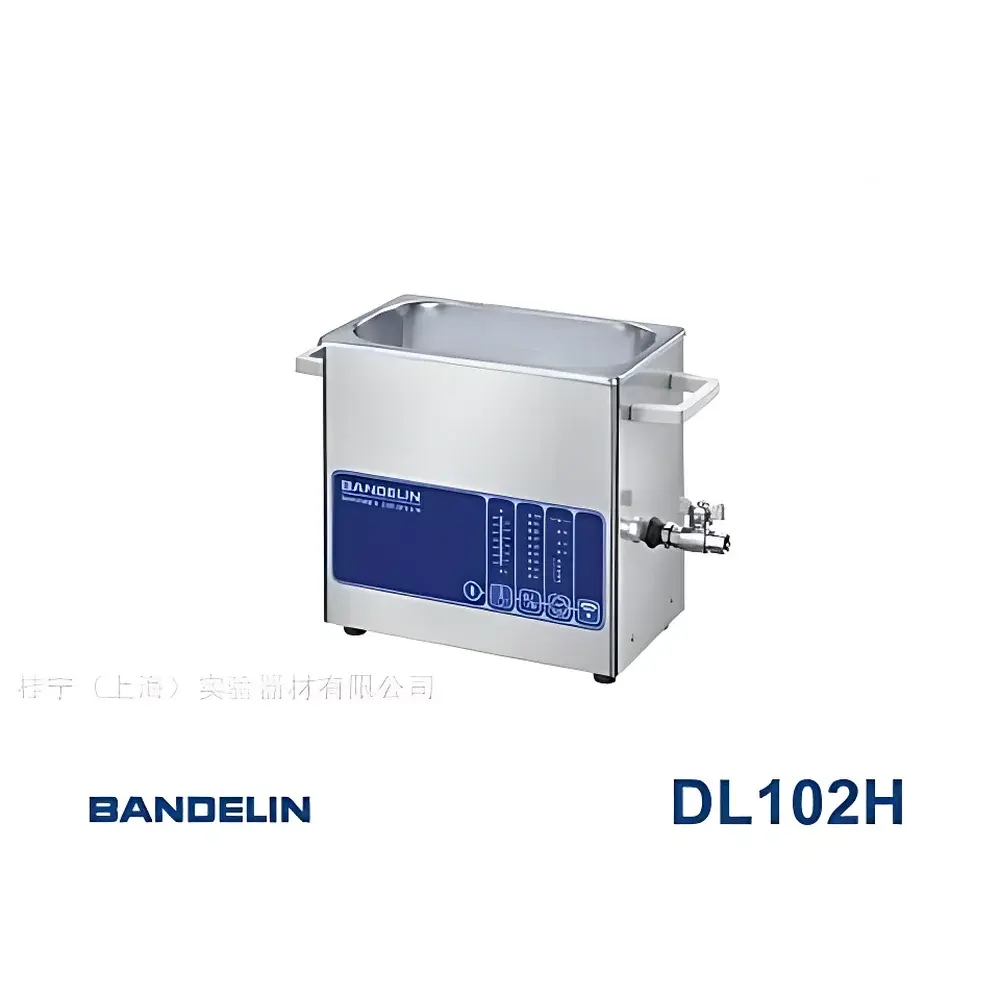
Bandelin SONOREX DL102H Ultrasonic Cleaner
| Brand | Bandelin |
|---|---|
| Origin | Germany |
| Model | DL102H |
| Chamber Volume | 3 L |
| Heating Power | 120 W |
| Operating Temperature | Ambient (non-heated mode) |
| Cleaning Solution Compatibility | Single-solution compatible |
| External Dimensions (L×W×D) | 260 × 160 × 250 mm |
| Ultrasonic Peak Power | 480 W |
| Nominal Ultrasonic Power | 120 W |
| Drain Valve | Integrated ball valve |
| Front Panel Material | Anodized aluminum foil |
Overview
The Bandelin SONOREX DL102H Ultrasonic Cleaner is a precision-engineered laboratory-grade cleaning system designed for reproducible, non-invasive removal of particulate contaminants, organic residues, and adsorbed films from delicate instrumentation, glassware, and analytical components. It operates on the principle of controlled cavitation—generating high-frequency acoustic energy (typically 35 kHz) that induces transient microbubbles in the cleaning medium; upon collapse, these bubbles release localized energy sufficient to dislodge sub-micron debris without mechanical abrasion. Unlike thermal or chemical-intensive methods, ultrasonic cleaning delivers consistent surface decontamination while preserving dimensional integrity and functional surface properties—critical for HPLC components, pipettes, filtration membranes, and sensor elements subject to strict GLP/GMP handling protocols.
Key Features
- Robust stainless-steel tank with welded integral drain outlet and integrated brass ball valve for leak-free fluid evacuation
- Anodized aluminum front panel—chemically inert, non-porous, and easily sanitized between batches
- Adjustable ultrasonic power output (0–100% range) to accommodate sensitive substrates such as coated optics, MEMS devices, or polymer-based consumables
- Dedicated ambient-mode operation: no built-in heater activation by default—ensures thermal stability for temperature-sensitive samples (e.g., enzymatic assays, volatile solvents)
- Fixed mains cable with reinforced strain relief—minimizes risk of accidental disconnection or insulation damage in high-traffic lab environments
- Compact footprint (260 × 160 × 250 mm) optimized for benchtop integration in QC labs, analytical service centers, and regulated R&D facilities
Sample Compatibility & Compliance
The DL102H accommodates standard laboratory vessels including volumetric flasks (up to 1 L), culture dishes, sieve meshes, titration burettes, and microcentrifuge tubes. Its 3 L chamber supports immersion of multi-component assemblies—such as respirator facepieces, tablet punches, or filter housings—without compromising acoustic field uniformity. The unit complies with IEC 61000-6-3 (EMC emission standards) and meets CE marking requirements for Class II medical device support equipment. While not certified as a sterilizer, it is routinely deployed in pre-sterilization cleaning workflows aligned with ISO 13485 and FDA 21 CFR Part 820 guidelines. For regulated applications involving residual solvent analysis or elemental testing (e.g., Sn in canned foods per AOAC 992.17), users must validate cleaning efficacy using ATP bioluminescence or gravimetric residue recovery protocols.
Software & Data Management
The DL102H is a stand-alone analog-controlled unit without embedded firmware or digital interface. All operational parameters—including timer (0–30 min), power level, and cycle initiation—are managed via tactile rotary dials and illuminated push-button controls. This architecture eliminates software validation overhead and ensures deterministic behavior under ISO/IEC 17025-accredited test environments where audit trails for electronic records are not required. For laboratories requiring documentation of cleaning cycles, external time-stamped loggers or PLC-integrated relay modules may be interfaced via the unit’s dry-contact auxiliary output (optional accessory).
Applications
- Pre-HPLC solvent degassing and mobile phase conditioning
- Deaeration of beer and fruit juice samples prior to alcohol, pH, and colorimetric analysis
- Extraction of quaternary ammonium compounds (QACs) from wood preservatives and antimicrobial coatings
- Microbial cell lysis from herbal matrices and soil hydrocarbon extraction (EPA Method 3550C)
- Homogenization of vegetarian food samples for pesticide residue screening (EN 15662)
- Liposome formulation in cosmetic and pharmaceutical development (USP )
- Cleaning of analytical sieves, tablet tooling, and breath mask components per ASTM F2100
- Surface decontamination of GC injectors, electrophoresis combs, and microfluidic chips
FAQ
Does the DL102H include a built-in heater?
No—the DL102H operates exclusively in ambient-temperature mode. A separate heating option is available in the DL102 model variant.
What cleaning solutions are compatible with this unit?
Aqueous alkaline, neutral, or mild acidic formulations are recommended. Avoid halogenated solvents or strong oxidizers unless verified for compatibility with stainless-steel tanks and transducer bonding materials.
Can the unit be used for sterilization?
No—ultrasonic cleaning removes bioburden but does not achieve sterility assurance levels (SAL 10⁻⁶). It serves as a prerequisite step before autoclaving or ethylene oxide treatment.
Is the transducer sealed against moisture ingress?
Yes—the piezoelectric elements are potted and hermetically bonded to the tank base, meeting IP65-rated protection against splashing and condensation during routine operation.
How often should the cleaning bath be replaced?
Bath replacement frequency depends on load composition and contamination severity; typical practice is every 8–12 hours of cumulative operation or after processing high-residue samples such as soil extracts or lipid-rich biological fluids.



