
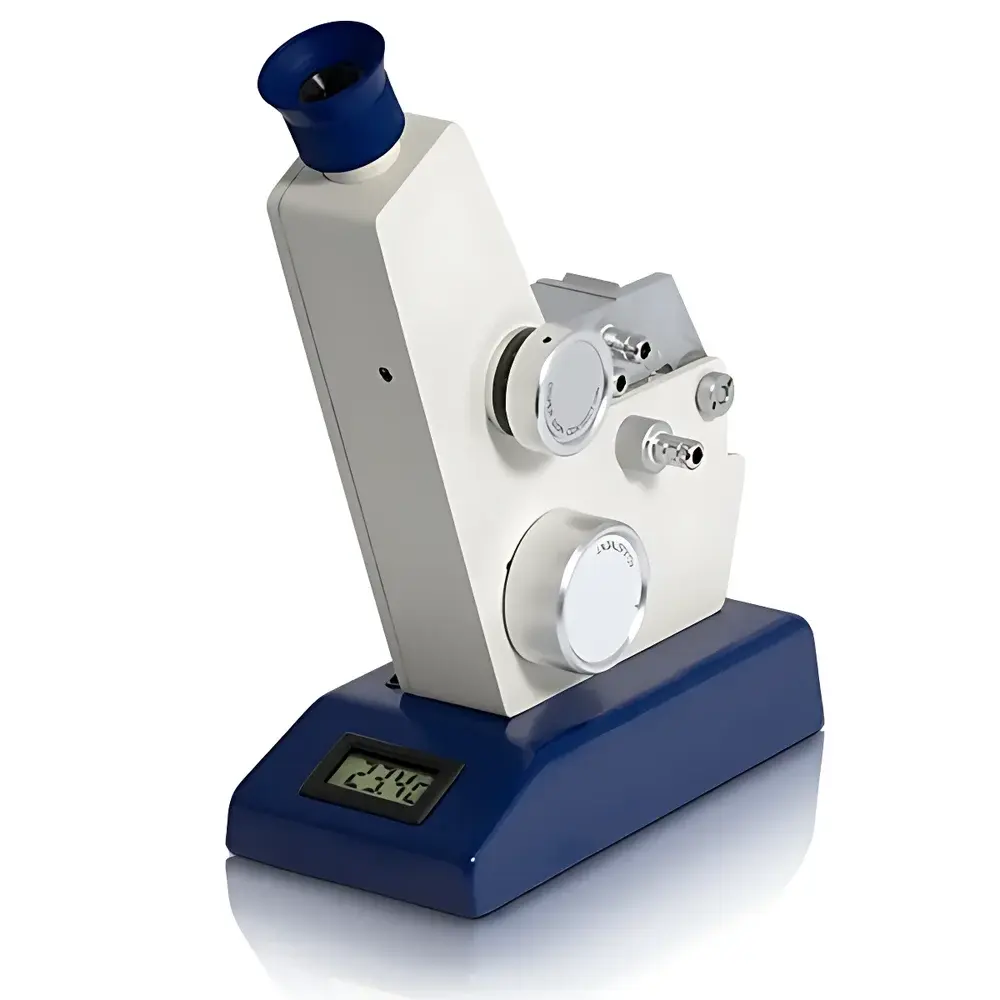
A.KRÜSS AR4 Abbe Refractometer
| Brand | A.KRÜSS / A.KRÜSS Optronic |
|---|---|
| Origin | Germany |
| Manufacturer Type | Authorized Distributor |
| Import Status | Imported |
| Model | AR4 |
| Product Type | Benchtop Abbe Refractometer |
| Temperature Control | Yes |
| Digital Display | No |
| Measurement Range | 1.3000 – 1.7000 nD |
| Accuracy | ±0.0002 nD |
Overview
The A.KRÜSS AR4 Abbe Refractometer is a precision optical instrument engineered for accurate and repeatable determination of refractive index (nD) and related parameters such as Brix concentration in liquid, semi-solid, and solid samples. Based on the classical Abbe principle—first introduced by Ernst Abbe in 1869—the instrument operates on total internal reflection at the interface between a high-refractive-index glass prism and the sample. The critical angle of this interface is directly correlated to the sample’s refractive index, which is optically resolved via a calibrated scale viewed through an eyepiece. Unlike digital refractometers, the AR4 retains the mechanical robustness and metrological transparency of traditional Abbe design while integrating modern thermal management and illumination systems. Its fixed-wavelength LED light source (589 nm), compliant with the sodium D-line standard, ensures spectral consistency essential for traceable measurements. The instrument is not intended for automated process integration but serves as a primary reference tool in QC laboratories where regulatory adherence, long-term stability, and operator-controlled calibration are paramount.
Key Features
- High-precision Abbe optical system with temperature-stabilized measuring and illuminating prisms, enabling stable nD readings under controlled thermal conditions
- Integrated Peltier-based thermostat (–40 °C to +120 °C range) coupled directly to both prisms for minimal thermal gradient and drift
- Long-life 589 nm LED illumination source (>100,000 h lifetime), eliminating mercury-vapor lamp hazards and spectral drift over time
- Manual eyepiece reading with dual-scale view: refractive index (nD) from 1.3000 to 1.7000 (resolution 0.0005 nD) and Brix from 0 to 95% (resolution 0.25% Brix)
- Adjustable ocular focus and scale alignment mechanism for consistent operator interpretation across shifts and users
- Compliant with ASTM D1218 for calibration verification using certified reference plates; supports GLP-compliant manual recordkeeping
- Compact benchtop footprint (140 × 100 × 235 mm) and lightweight aluminum housing (4.4 kg) for easy relocation within lab environments
Sample Compatibility & Compliance
The AR4 accommodates a broad spectrum of sample types—including aqueous solutions, oils, syrups, polymers, gels, and solids—when used with appropriate contact liquids (e.g., bromonaphthalene or monobromonaphthalene for high-nD solids). Its wide measurement range (1.3000–1.7000 nD) covers common industrial materials from ethanol (nD ≈ 1.361) to sulfuric acid (nD ≈ 1.429) and optical resins (up to ~1.68). Coloration, turbidity, or minor surface contamination does not interfere with measurement integrity due to the total internal reflection principle. The instrument meets fundamental requirements for ISO/IEC 17025-compliant testing laboratories when operated within documented SOPs. While it lacks electronic data export or audit trail functionality, its manual operation supports full traceability when paired with paper-based or LIMS-integrated logbooks adhering to FDA 21 CFR Part 11 principles for non-electronic records.
Software & Data Management
The A.KRÜSS AR4 operates without embedded firmware or software interfaces. All measurements are recorded manually via eyepiece observation and transcribed into laboratory notebooks or electronic spreadsheets. This analog architecture eliminates cybersecurity risks, firmware obsolescence, and validation overhead associated with digital instruments. Calibration is performed using certified ASTM D1218 reference plates, with verification logs maintained per internal quality procedures. For labs requiring digital archiving, optional third-party image-capture adapters (e.g., USB eyepiece cameras) may be integrated externally—though such configurations fall outside A.KRÜSS’s factory validation scope and require user-level qualification per GxP guidelines.
Applications
- Quality control of sucrose concentration in beverage, juice, and confectionery production (Brix % reporting)
- Concentration monitoring of glycols, ethylene glycol, and antifreeze formulations in automotive and HVAC sectors
- Purity assessment of solvents and reagents in pharmaceutical synthesis (e.g., ethanol, isopropanol, acetone)
- Process verification in pulp and paper manufacturing (e.g., black liquor solids content)
- Raw material screening in textile dye baths and finishing agents
- Wastewater analysis for dissolved organic load estimation via refractive index correlation
- Research-grade characterization of polymer solutions, adhesives, and coating formulations
FAQ
Does the AR4 support automatic temperature compensation (ATC)?
No—it features active temperature control via integrated Peltier elements, not passive ATC. Users must set and stabilize the desired prism temperature before measurement.
Can the AR4 measure opaque or highly viscous samples?
Yes, provided appropriate contact fluid is applied for solids or gels; viscosity does not impede optical measurement as long as a uniform film forms between prism and sample.
Is the 589 nm LED source replaceable by the user?
Yes—the LED module is field-serviceable using standard A.KRÜSS replacement parts (Order No. LED-AR4); no recalibration is required post-replacement.
What is the recommended calibration frequency?
Per ASTM D1218, daily verification with certified reference plates is advised for regulated environments; weekly calibration suffices for routine QC use.
Does the AR4 comply with pharmacopeial standards (e.g., USP )?
It satisfies the optical and operational requirements of USP for refractometric assays when used with validated procedures and traceable references.




