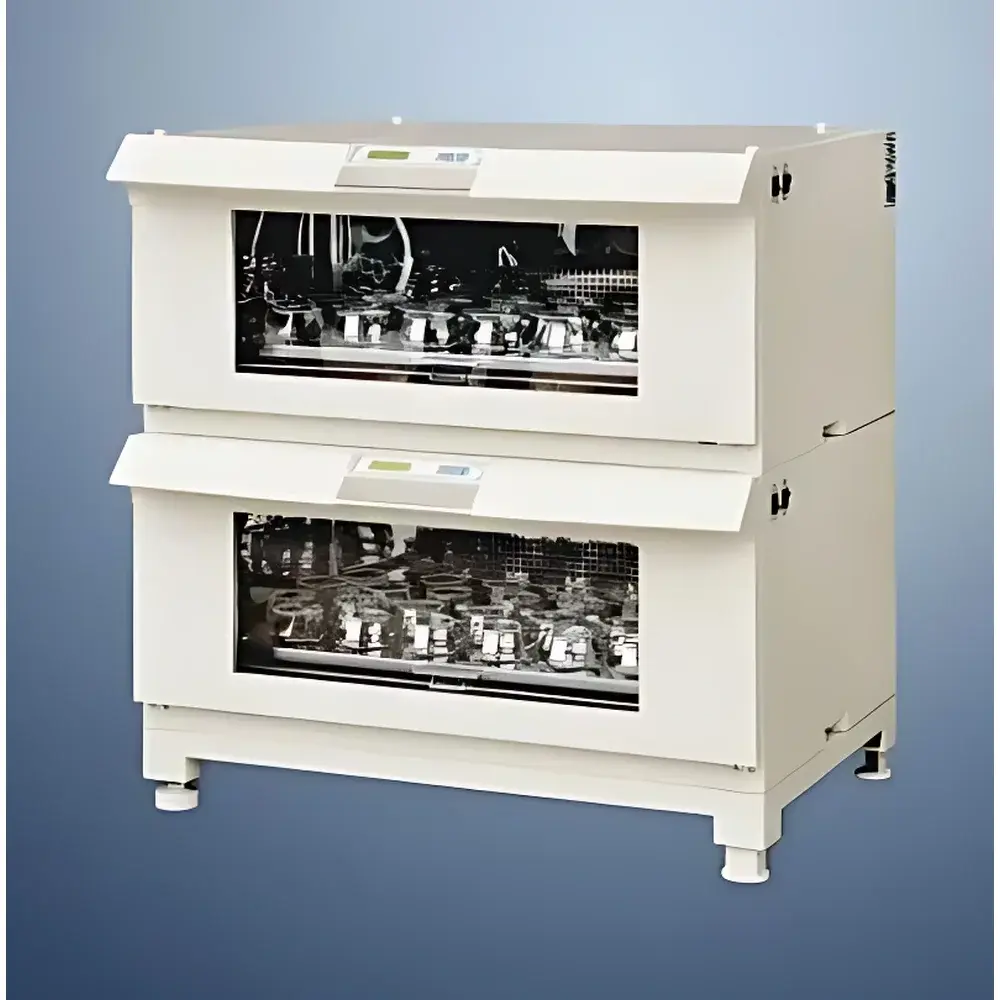
ZWYY-C2402 Intelligent Stackable Dual-Chamber Incubated Orbital Shaker
| Origin | Shanghai, China |
|---|---|
| Manufacturer Type | Authorized Distributor |
| Origin Category | Domestic (PRC) |
| Model | ZWYY-C2402 |
| Pricing | Available Upon Request |
| Control Algorithm | PID with Environmental Scan Microprocessor |
| Display | 7-inch Full-Color Touchscreen |
| Air Circulation | Forced Convection |
| Oscillation Mode | Orbital (Circular) |
| Drive Mechanism | Single-Axis Brushless AC Induction Motor |
| Door Operation | Manual Downward-Pull Damped Opening |
| Ambient Temp. Range | 10–35 °C |
| Chamber Count | 2 Independent Chambers |
| Temp. Range | 4–60 °C |
| Temp. Resolution | 0.1 °C |
| Temp. Stability | ±0.5 °C at 37 °C |
| Temp. Uniformity | ±1.0 °C at 37 °C |
| Humidity Range | 40–85 %RH |
| Humidity Resolution | 0.1 %RH |
| Humidity Stability | ≤±2 %RH |
| Humidity Uniformity | ≤±6 %RH |
| Programmable Profiles | 9 Segments / 18 Steps |
| Timer Range | 0.1–99.9 h |
| Speed Range | 0–300 rpm |
| Speed Accuracy | ±1 rpm |
| Orbit Diameter | Φ0–50 mm (Infinitely Adjustable) |
| Acceleration Profile | Soft-Start Ramp Control |
| Shelf Quantity | 2 Removable Stainless Steel Trays |
| Tray Dimensions | 800 × 430 mm |
| Chamber Volume per Layer | 182 L |
| Interior Dimensions per Chamber | 920 × 532 × 373 mm |
| External Dimensions | 1100 × 910 × 1330 mm |
| Packaging Dimensions | 1220 × 1030 × 1500 mm |
| Net Weight | 390 kg |
| Gross Weight | 440 kg |
| Power Consumption | 2400 W |
| Electrical Supply | AC 220 V, 50/60 Hz |
| Cooling System | Dual-Stack Air-Cooled Refrigeration (R134a), Frost-Free, Power-Modulated |
| Humidification | Steam-Based Generator |
| Safety Certifications | Compliant with IEC 61010-1, EN 61326-1 (EMC), and GB/T 14710 (Chinese Environmental Adaptability Standard) |
Overview
The ZWYY-C2402 Intelligent Stackable Dual-Chamber Incubated Orbital Shaker is an engineered platform for precision-controlled, long-duration cell culture, microbial growth, enzymatic assays, and biochemical reaction monitoring under tightly regulated thermal, humid, and mechanical conditions. Designed around a dual-chamber architecture, it enables independent parameter control across two physically isolated workspaces—each equipped with orbital shaking, programmable temperature/humidity profiles, and integrated refrigeration. Its operational principle combines forced-air convection for uniform thermal distribution, brushless AC induction motor-driven orbital motion (0–300 rpm, Φ0–50 mm amplitude), and steam-based humidification to maintain physiological moisture levels. The system employs a PID-based microprocessor with environmental scanning capability—continuously sampling sensor feedback from multiple thermistors, capacitive humidity sensors, and speed encoders—to deliver real-time closed-loop regulation. This architecture supports reproducible cultivation of sensitive mammalian cells, aerobic bacteria, yeast, and hybridoma lines where oscillatory shear stress, thermal drift, or desiccation must be minimized.
Key Features
- Dual independent incubation chambers (182 L each), enabling parallel experiments with distinct temperature, humidity, speed, and timing protocols
- Full-color 7-inch capacitive touchscreen interface with intuitive icon-driven navigation and multilingual UI support (English, German, French, Spanish)
- Advanced 9-segment × 18-step curve programming—supporting ramp-hold cycles, stepwise gradients, multi-stage incubation, and recovery sequences
- Brushless AC induction motor with soft-start acceleration profile (programmable ramp time) to prevent sample splashing or cell detachment
- Frost-free dual-stack refrigeration system using R134a refrigerant, delivering stable sub-ambient cooling down to 4 °C without condensation buildup
- Steam-based humidification module with auto-fill reservoir, low-water level detection, and audible/visual alarm with optional auto-refill integration
- Triple-layer safety architecture: personnel protection (leakage current cutoff, overcurrent trip), sample integrity (dual independent overtemperature cutouts, speed deviation lockout), and equipment longevity (compressor overload protection, sensor fault diagnostics)
- Comprehensive data logging via embedded RS-232 serial interface; real-time export to external PCs or LIMS systems; optional built-in thermal printer for GLP-compliant hardcopy traceability
Sample Compatibility & Compliance
The ZWYY-C2402 accommodates standard laboratory vessels—including Erlenmeyer flasks (up to 5 L), culture bottles, deep-well plates, and custom bioreactor sleeves—via its 800 × 430 mm electro-polished stainless steel trays with adjustable spring clamps. All wetted surfaces (interior chamber walls, trays, and humidity generator) are constructed from mirror-finish 304 stainless steel, compliant with ISO 14644-1 Class 7 cleanroom material requirements. The unit meets IEC 61010-1 for electrical safety in laboratory environments and conforms to EN 61326-1 for electromagnetic compatibility. While not FDA 21 CFR Part 11–certified out-of-box, its audit-ready data logging—featuring timestamped parameter records, operator ID fields (via password-protected access), and immutable event logs (power loss, alarm triggers, setpoint changes)—supports validation under GxP frameworks including GLP and GMP when deployed with documented SOPs and periodic calibration verification.
Software & Data Management
Data acquisition and device control are managed through the onboard embedded firmware, which stores up to 100 user-defined protocols with full parameter recall (temperature, humidity, speed, orbit, duration, ramp rates). Logged data—including real-time chamber temperature/humidity curves, motor speed traces, and alarm history—is timestamped to millisecond resolution and exportable via RS-232 to CSV or Excel-compatible formats. Optional PC software (ZW-Link v3.2) provides remote monitoring, multi-unit fleet management, statistical trend analysis (e.g., coefficient of variation for replicate runs), and automated report generation aligned with ISO/IEC 17025 documentation standards. All parameter modifications require dual-level password authentication; critical settings (e.g., max temperature limit, alarm thresholds) can be locked to prevent unauthorized changes during unattended operation.
Applications
This shaker serves as a core platform in academic research labs studying oxygen-sensitive metabolic pathways, industrial QC laboratories performing stability testing of biologics under accelerated humidity conditions, and pharmaceutical development units optimizing fed-batch fermentation kinetics. Typical use cases include: suspension culture of CHO and HEK293 cells under controlled pO₂-mimicking agitation; high-yield protein expression in E. coli BL21(DE3) with synchronized induction and cooling phases; mycelial growth profiling of filamentous fungi under variable hygrometric stress; and enzymatic hydrolysis kinetics of cellulose substrates where shear rate directly influences conversion efficiency. Its dual-chamber design further enables comparative studies—e.g., evaluating antibiotic efficacy across concentration gradients while maintaining identical mechanical and thermal baselines.
FAQ
Can the two chambers operate at different temperatures and humidity levels simultaneously?
Yes—the ZWYY-C2402 features fully independent PID controllers for each chamber, allowing concurrent operation at distinct setpoints within the specified ranges (4–60 °C, 40–85 %RH).
Is the RS-232 interface compatible with LabVIEW and Python-based automation scripts?
Yes—standard ASCII command protocol documentation is provided; native drivers exist for National Instruments LabVIEW and PySerial-compatible Python implementations.
What maintenance is required for the steam humidifier system?
The stainless steel steam generator requires quarterly descaling with 5% citric acid solution; water reservoirs must be refilled with deionized water to prevent mineral deposition.
Does the unit support validation documentation packages (IQ/OQ/PQ)?
Factory-issued IQ/OQ templates are available upon request; PQ execution requires user-defined test protocols aligned with internal quality standards.
How is temperature uniformity verified across the chamber volume?
Uniformity is validated per ASTM E145-22 Annex A3 using nine-point mapping with NIST-traceable thermocouples at 37 °C; results are supplied in the Certificate of Conformance.
Related Products