
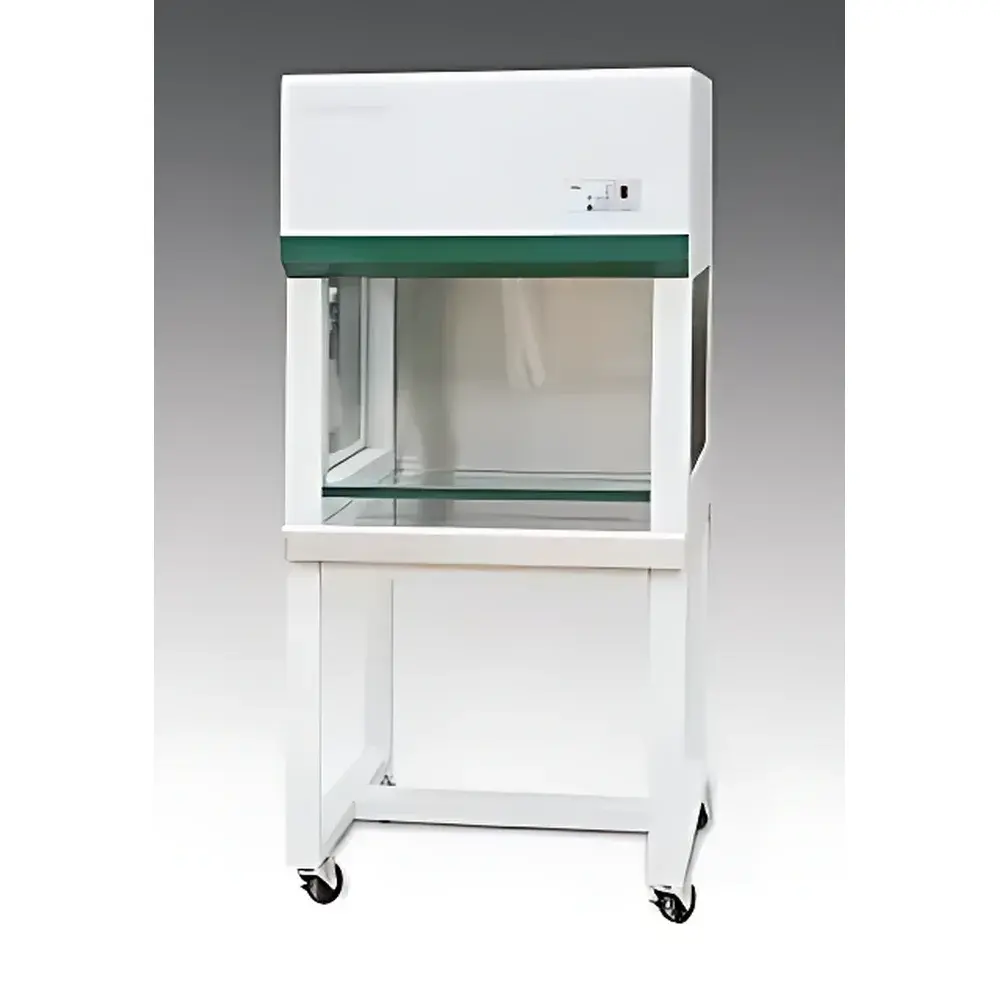
Zhicheng ZHJH-C1106B Vertical Laminar Flow Clean Bench
| Brand | Zhicheng |
|---|---|
| Origin | Shanghai, China |
| Manufacturer Type | Direct Manufacturer |
| Product Category | Domestic |
| Model | ZHJH-C1106B |
| Pricing | Available Upon Request |
| Airflow Pattern | Vertical Laminar Flow |
| Work Surface | Single Opening |
| Filtration Standard | ISO 14644-1 Class 5 (equivalent to Fed Std 209E Class 100) |
| Particle Count | ≤0.5 CFU/plate (90 mm Petri dish) |
| Adjustable Air Velocity | 0.3–0.6 m/s (7-step LED digital control) |
| Noise Level | ≤62 dB(A) |
| Vibration Peak-to-Peak | ≤6 µm |
| Illumination | ≥300 lx |
| Pre-filter Initial Resistance | ≤120 Pa (at max airflow) |
| Working Area Dimensions (W×D×H) | 600 × 625 × 645 mm |
| Overall Dimensions (W×D×H) | 720 × 740 × 1700 mm |
| Net Weight | 118 kg |
| Power Consumption | 380 W |
| Electrical Supply | AC 220 V, 50/60 Hz |
| UV Germicidal Lamp | Included (254 nm) |
| Lighting | Fluorescent Task Lamp |
| Construction | Stainless Steel Work Surface, Electrostatically Powder-Coated Steel Casing |
| Mobility | Four Swivel Casters with Locking Brakes |
| Window Mechanism | Counterbalanced Vertical Sliding Sash |
| Viewing Panels | Dual Side Tempered Glass |
| Compliance | Meets ISO 14644-1, GB/T 16292–2010, and JIS K 3800:2014 for clean bench performance verification |
Overview
The Zhicheng ZHJH-C1106B Vertical Laminar Flow Clean Bench is an ISO 14644-1 Class 5 certified laboratory containment system engineered for applications requiring unidirectional, particle-free airflow over the work surface. It operates on the principle of vertical laminar flow: ambient air is drawn through a pre-filter (G4 grade), conditioned in a plenum chamber, and then passed through a high-efficiency particulate air (HEPA) filter (H14, ≥99.995% @ 0.3 µm) before being delivered downward at a uniform, low-turbulence velocity across the entire working area. This configuration ensures continuous displacement of contaminated air away from the operator and sample zone—minimizing cross-contamination risk during aseptic procedures. Designed for structural integrity and long-term operational stability, the unit features a rigid steel frame with electrostatic powder coating, a seamless 304 stainless steel work surface resistant to corrosion and chemical exposure, and a counterbalanced vertical sash that maintains positional stability across its full travel range without drift or rebound.
Key Features
- Vertical laminar airflow architecture compliant with ISO 14644-1 Class 5 (Fed Std 209E Class 100) performance criteria
- Seven-step digitally controlled air velocity adjustment (0.3–0.6 m/s), displayed via integrated LED interface
- Dual-mode lighting system: 300+ lux fluorescent task illumination and 254 nm UV-C germicidal lamp with interlocked safety cutoff
- Counterbalanced vertical sliding sash with smooth, friction-minimized operation and precise position retention
- Tempered glass side panels providing wide-field visibility and optical clarity without distortion
- Low-noise centrifugal blower (≤62 dB[A] at 1 m), optimized for consistent static pressure delivery under variable filter loading
- Integrated vibration isolation design achieving ≤3 µm vibration half-amplitude at operating frequency
- Four swivel casters with dual-action locking brakes enabling repositioning in constrained lab spaces
- Pre-filter + HEPA H14 filtration train with real-time resistance monitoring capability (optional)
Sample Compatibility & Compliance
The ZHJH-C1106B accommodates standard microbiological culture vessels (Petri dishes, test tubes, flasks), small-scale bioreactors, microcentrifuge tubes, and electronic components requiring particulate-free handling. Its working area (600 × 625 × 645 mm) supports single-user aseptic manipulation without spatial compromise. The unit conforms to national and international clean bench validation protocols—including GB/T 16292–2010 (Chinese pharmaceutical cleanroom testing standard), JIS K 3800:2014 (Japanese clean bench performance requirements), and ISO 14644-1:2015 Annex B for airflow uniformity and particle concentration verification. All UV lamps are certified to emit ≥40 µW/cm² at 1 m distance, meeting USP and EU GMP Annex 1 recommendations for surface decontamination prior to operation. No internal recirculation occurs; 100% of air is exhausted externally or filtered and recirculated only when configured with optional ducted exhaust adapters.
Software & Data Management
While the ZHJH-C1106B operates as a standalone mechanical system with no embedded firmware or network connectivity, its LED-based control interface supports manual logging of operational parameters (air velocity setpoint, UV exposure duration, runtime hours) for GLP-compliant recordkeeping. Optional analog output modules (0–10 V or 4–20 mA) can be integrated to feed airflow velocity and filter pressure drop signals into centralized building management systems (BMS) or laboratory information management systems (LIMS). For audit readiness, users may document daily startup checks—including UV intensity verification using calibrated radiometers—and retain signed logs per FDA 21 CFR Part 11 guidelines when paired with electronic signature-capable documentation platforms.
Applications
This clean bench serves critical roles in quality control laboratories performing microbial limit testing (USP , EP 2.6.12), cell culture setup in academic and industrial biotechnology labs, sterile assembly of diagnostic kits, environmental sampling preparation (e.g., air/water filter analysis per ISO 14698), and precision handling of optoelectronic components in semiconductor R&D. Its Class 5 environment supports ISO 13485-certified medical device manufacturing processes where component cleanliness directly impacts final product sterility assurance. It is not intended for use with volatile organic solvents, radioactive materials, or human pathogens requiring biosafety level containment (BSL-2 or higher).
FAQ
What ISO classification does the ZHJH-C1106B meet?
It achieves ISO 14644-1 Class 5 (formerly Fed Std 209E Class 100) under defined test conditions, verified via particle counters calibrated per ISO 21501-4.
Can this unit be ducted to an external exhaust system?
Yes—optional top-mounted exhaust adapters enable connection to dedicated lab exhaust ducts, eliminating need for recirculation.
Is UV lamp intensity validated upon installation?
Factory calibration reports include UV irradiance measurements at 1 m; users must perform periodic verification using NIST-traceable radiometers.
Does the unit comply with electrical safety standards for export markets?
It meets IEC 61010-1:2010 for laboratory equipment and carries CE marking under the Low Voltage Directive (2014/35/EU) and EMC Directive (2014/30/EU).
What maintenance intervals are recommended for the HEPA filter?
Filter replacement is determined by differential pressure monitoring; typical service life ranges from 12–24 months depending on ambient particulate load and usage frequency.



