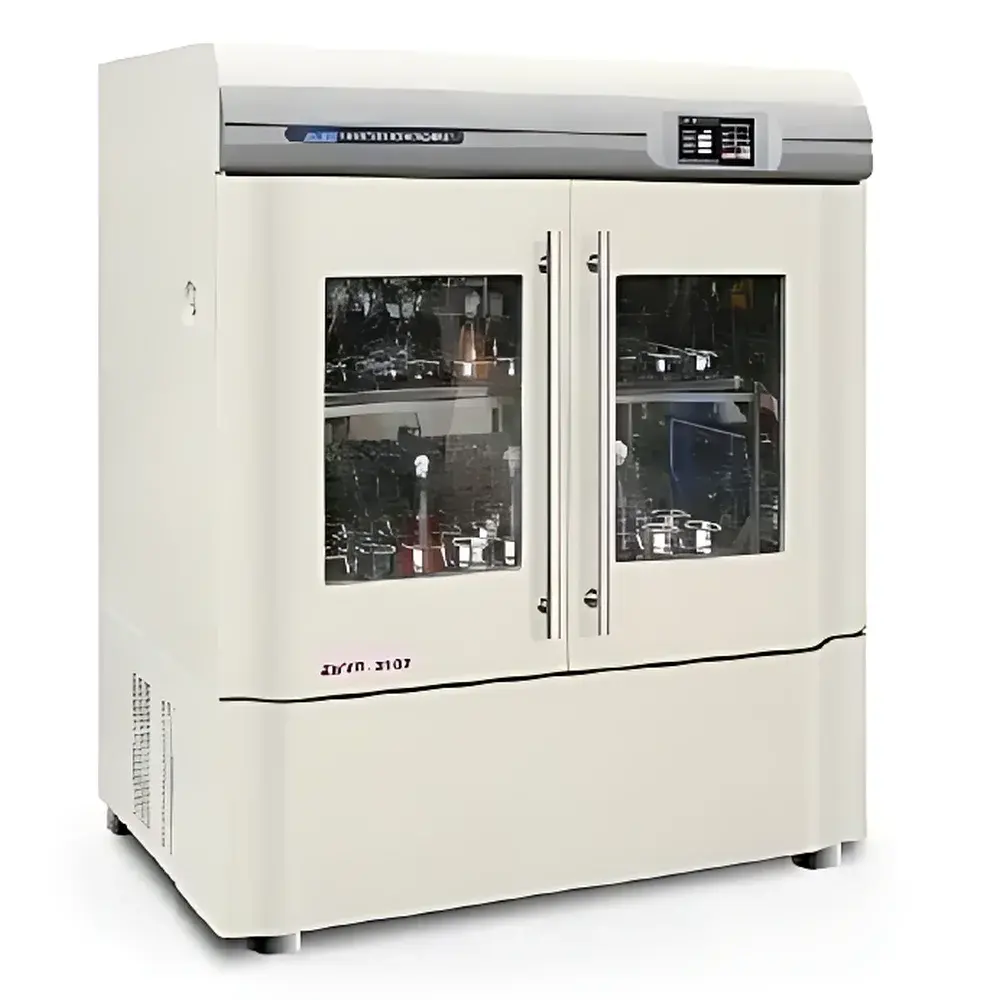
Zhicheng ZWYR-2102 Dual-Layer Full-Color Touchscreen Incubator Shaker
| Brand | Zhicheng |
|---|---|
| Origin | Shanghai, China |
| Manufacturer Type | Direct Manufacturer |
| Product Category | Domestic (China-Made) |
| Model | ZWYR-2102 |
| Instrument Type | Refrigerated Orbital Incubator Shaker |
| Display | 4.3-inch 480×272-pixel 65K-color TFT capacitive touchscreen |
| Control System | PID microprocessor with environmental scanning algorithm |
| Temperature Range | 4–60 °C |
| Temp. Resolution | ±0.1 °C |
| Temp. Uniformity | ≤±1 °C (at 37 °C) |
| Temp. Stability | ≤±0.1 °C (at 37 °C) |
| Oscillation Mode | Orbital (circular motion) |
| Speed Range | 30–300 rpm |
| Speed Accuracy | ±1 rpm |
| Orbit Diameter | Φ35 mm |
| Programmability | 9-segment / 18-step ramp-and-hold protocol (each segment: 0–999.9 min |
| Chamber Volume | 332 L |
| Dual-Shelf Capacity | 2 independent platforms (734 × 458 mm each) |
| Internal Dimensions | 837 × 543 × 797 mm (W×D×H) |
| External Dimensions | 1180 × 760 × 1530 mm |
| Cooling System | Air-cooled R134a compressor with frost-free, power-modulated operation |
| Safety Systems | Independent overtemperature cutoff, door-open stop, leakage current protection, motor overcurrent shutdown, refrigeration overload protection, dual-limit speed/temperature deviation alarms |
| Data Interface | Built-in thermal printer + RS-232 serial port |
| Power Supply | AC 220 V, 50/60 Hz |
| Rated Power | 1200 W |
| Net Weight | 235 kg |
| Gross Weight | 272 kg |
Overview
The Zhicheng ZWYR-2102 Dual-Layer Full-Color Touchscreen Incubator Shaker is an advanced, microprocessor-controlled orbital shaker engineered for precise temperature-regulated cultivation and agitation of biological samples in research and quality control laboratories. It operates on the principle of controlled orbital motion—generating uniform circular oscillation at user-defined frequencies—to ensure homogeneous suspension of cells, microbes, or reagents while maintaining a thermally stable environment. Unlike basic shakers, the ZWYR-2102 integrates active refrigeration (R134a-based, frost-free compression cooling), dual-platform architecture, and a high-fidelity 4.3-inch capacitive touchscreen interface—enabling rigorous adherence to time-temperature-speed profiles essential for reproducible cell culture, enzyme kinetics, hybridization assays, and fermentation process development.
Key Features
- Dual-layer stainless-steel chamber with 332 L total volume and two independently accessible 734 × 458 mm platforms—optimized for high-throughput parallel experiments without cross-contamination.
- Full-color 480×272-pixel 65K-color TFT touchscreen with intuitive icon-driven navigation, real-time animated status feedback, and multilingual (English/Chinese) UI support—designed for glove-compatible operation and minimal training overhead.
- PID-based microprocessor control system with environmental scanning algorithm ensures dynamic compensation for ambient fluctuations (5–25 °C ambient range), delivering ±0.1 °C temperature resolution and ≤±0.1 °C stability at 37 °C.
- Nine-segment, eighteen-step programmable protocol engine supports complex thermal and kinetic profiles—including ramped temperature gradients, cyclic oscillation sequences, and stepwise speed transitions—with per-segment timing up to 999.9 minutes and up to 99 loop repetitions.
- Comprehensive triple-tier safety architecture: (1) Personnel protection via Class I leakage current detection and fast-acting circuit interruption; (2) Sample integrity safeguard through redundant speed/temperature watchdog logic and emergency actuator override; (3) Facility protection via independent mechanical overtemperature cutoff and compressor overload monitoring.
- Integrated thermal printer and RS-232 serial interface enable direct timestamped data logging (temperature, speed, elapsed time, alarm events) and seamless integration into LIMS or ELN systems—supporting audit-ready documentation under GLP/GMP frameworks.
Sample Compatibility & Compliance
The ZWYR-2102 accommodates standard laboratory vessels—including Erlenmeyer flasks (up to 5 L), deep-well plates, culture tubes, and custom bioreactor inserts—across both shelves simultaneously. Its forced-air convection system ensures uniform heat distribution (≤±1 °C deviation at 37 °C), critical for sensitive applications such as mammalian cell expansion, bacterial growth curve analysis, and recombinant protein expression. The unit complies with IEC 61010-1 (Safety Requirements for Electrical Equipment for Measurement, Control, and Laboratory Use) and meets electromagnetic compatibility standards per EN 61326-1. While not FDA 21 CFR Part 11–certified out-of-the-box, its password-protected parameter encryption, electronic event log, and print-output traceability provide foundational elements for validation under ISO/IEC 17025 or USP analytical instrument qualification protocols.
Software & Data Management
No proprietary software installation is required—the ZWYR-2102 operates autonomously via its embedded firmware. All operational parameters (setpoints, programs, calibration offsets, user permissions) are stored in non-volatile memory with battery-backed clock retention. The built-in thermal printer generates hard-copy records of start/stop times, setpoint deviations, alarm triggers, and final cycle completion—serving as primary evidence for internal SOP compliance. RS-232 output transmits ASCII-formatted telemetry (e.g., “T=37.02°C|S=150.0rpm|t=142.8min|ALM=NONE”) at configurable intervals, enabling third-party acquisition by LabVIEW, Python-based data pipelines, or enterprise SCADA systems. Firmware updates are performed via USB-to-serial adapter using signed binary files—ensuring version control and integrity verification.
Applications
- Microbial cultivation (E. coli, yeast, Bacillus spp.) under controlled aerobic conditions with defined temperature ramps and agitation rates.
- Mammalian and insect cell line maintenance in serum-containing or chemically defined media—leveraging tight thermal uniformity to minimize shear-induced apoptosis.
- Enzymatic reaction profiling (e.g., kinase assays, ligase efficiency tests) requiring precise incubation windows and consistent mixing to prevent substrate settling.
- Nucleic acid hybridization (Southern/Northern blotting, microarray pre-hybridization) where uniform buffer exchange and temperature homogeneity directly impact signal-to-noise ratios.
- Pharmaceutical stability testing per ICH Q1A(R2), including accelerated degradation studies across multiple temperature–agitation combinations.
- Environmental microbiology workflows—such as BOD determination or bioremediation simulation—where long-duration (≥72 h), unattended operation must be guaranteed.
FAQ
Does the ZWYR-2102 support external temperature probes for chamber mapping?
No—temperature sensing is performed exclusively via calibrated PT100 sensors embedded in the chamber wall and air stream; external probe input is not supported.
Can both shelves operate at different temperatures or speeds?
No—the unit maintains a single, uniform chamber environment; temperature and oscillation parameters apply identically to both platforms.
Is the refrigeration system suitable for sub-ambient operation down to 4 °C in a 25 °C lab?
Yes—its R134a compressor delivers consistent cooling performance at rated ambient conditions (5–25 °C); sustained operation below 10 °C ambient may reduce cooling capacity and increase condensation risk.
What is the maximum flask loading weight per shelf?
Each platform supports up to 25 kg distributed load; total payload must remain within 50 kg to maintain mechanical stability and thermal response fidelity.
How is calibration traceability maintained?
The device includes factory calibration certificates for temperature and speed sensors; users may perform field verification using NIST-traceable reference thermometers and tachometers—log entries record all manual calibration actions with timestamps and operator IDs.