
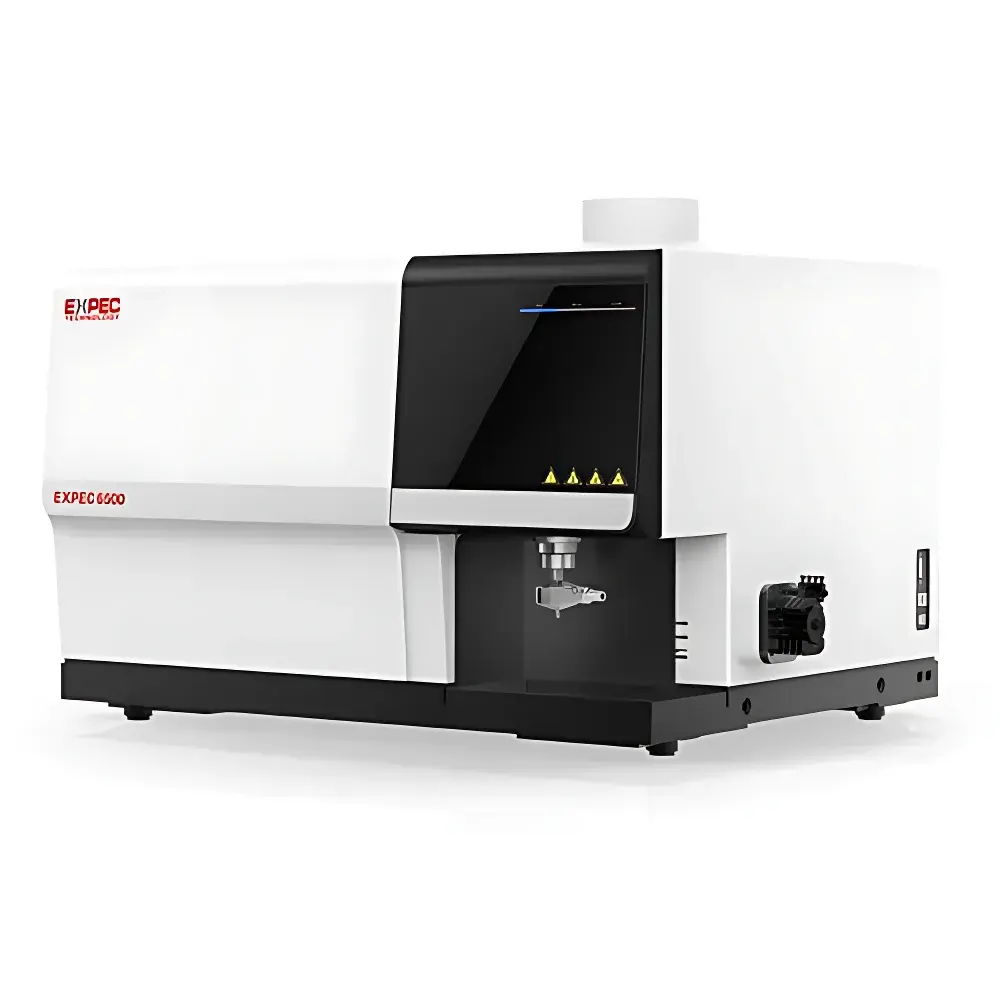
Supernova EXPEC 6500 Inductively Coupled Plasma Optical Emission Spectrometer
| Brand | Supernova / EXPEC |
|---|---|
| Origin | Zhejiang, China |
| Manufacturer Type | Authorized Distributor |
| Product Origin | Domestic (China) |
| Model | EXPEC 6500 |
| Instrument Type | Full-Spectrum Simultaneous ICP-OES |
| Detection Limit | Not Specified |
| Precision (RSD) | <1% @ 8 h |
| Wavelength Range | 160–900 nm |
| Optical Resolution | Not Specified |
| RF Power Range | 500–1600 W (Digital Self-Excited Solid-State Generator) |
| Observation Mode | Dual-View Vertical Torch (Axial & Radial) |
| Detector | Custom Large-Area E-CCD |
Overview
The Supernova EXPEC 6500 is a third-generation inductively coupled plasma optical emission spectrometer (ICP-OES), engineered for high-throughput, multi-element trace analysis in regulated and research-intensive laboratories. It operates on the fundamental principle of atomic emission spectroscopy: liquid samples are nebulized into an argon plasma (~6,000–10,000 K), where analyte atoms and ions are thermally excited and emit element-specific photons upon relaxation. These emissions are dispersed by a high-fidelity Czerny–Turner optical system and captured simultaneously across the full spectral range (160–900 nm) using a custom large-area, deep-UV-enhanced electron-multiplying charge-coupled device (E-CCD). The instrument’s vertical torch geometry—combined with dual-view axial/radial observation—enables method flexibility: axial mode delivers sub-ppt detection capability for ultra-trace elements; radial mode mitigates polyatomic interferences and matrix effects in complex, high-salt, or organic-rich samples such as digested soils, petrochemicals, or biological matrices.
Key Features
- Digital self-excited solid-state RF generator (500–1600 W), fully programmable via embedded firmware; eliminates vacuum tubes and mechanical tuning components for enhanced long-term stability and reduced maintenance intervals
- iStandby low-power mode (50% during idle periods without compromising plasma re-ignition reproducibility
- Vertically oriented plasma torch with independent axial and radial viewing optics—minimizes salt deposition, extends torch lifetime, and improves robustness for high-TDS samples (e.g., seawater, brines, metallurgical leachates)
- Proprietary large-format E-CCD detector featuring back-illuminated architecture, thermoelectric cooling (−45 °C), and anti-blooming circuitry; enables true simultaneous full-spectrum acquisition with 25% at 165 nm)
- Thermally optimized optical bench with precision-machined aluminum housing, active airflow management validated via computational fluid dynamics (CFD), and multi-zone thermal stabilization to maintain spectral calibration stability under ambient fluctuations (±5 °C)
Sample Compatibility & Compliance
The EXPEC 6500 accommodates aqueous solutions (0.1–5% HNO₃, up to 25% v/v organic modifiers), acid-digested solids (EPA Method 3050B/3052), and laser-ablation aerosols when interfaced with compatible sample introduction systems. Its hardware and firmware architecture supports audit-ready operation in GLP and GMP environments: data integrity is enforced through electronic signatures, immutable audit trails, and time-stamped method logs compliant with FDA 21 CFR Part 11 requirements. Routine performance verification aligns with ASTM D1976 (water), ISO 11885 (wastewater), and USP (elemental impurities in pharmaceuticals). Optional IQ/OQ documentation packages are available for laboratory validation workflows.
Software & Data Management
Controlled by Supernova ICP-Analyzer v4.x software, the system provides intuitive method development, automated wavelength selection, interference correction (including internal standardization and background correction algorithms), and quantitative analysis via calibration curves or standard addition. All raw spectra, processed results, and metadata are stored in a secure SQLite database with role-based access control. Export formats include CSV, PDF analytical reports, and XML-compliant outputs for LIMS integration. Software updates are delivered via signed firmware packages with SHA-256 hash verification to ensure supply-chain integrity.
Applications
The EXPEC 6500 serves environmental monitoring labs performing EPA 200.7/6020B analyses on drinking water, wastewater, soil extracts, and airborne particulate filters. It meets ISO 17294-2 requirements for multi-element profiling in industrial effluents and supports ASTM E1920 for rare-earth element quantification in magnets and catalysts. In food safety, it enables rapid screening of toxic elements (As, Cd, Pb, Hg) per EU Commission Regulation (EU) No 2023/915. For metallurgy and geochemistry, its dual-view configuration ensures accurate analysis of high-concentration base metals (Fe, Cu, Zn) alongside trace REEs and PGEs in ore concentrates and refinery streams.
FAQ
What plasma gas configuration does the EXPEC 6500 support?
It operates with high-purity argon (≥99.996%) for plasma generation and auxiliary gas flow; optional nitrogen sheath gas is supported for organic solvent analysis.
Is the instrument compatible with automated sample introduction systems?
Yes—it features standardized RS-232 and Ethernet interfaces for seamless integration with autosamplers (e.g., CETAC ASX-560), ultrasonic nebulizers, and laser ablation systems.
Does the software support compliance with pharmaceutical elemental impurity guidelines?
Yes—ICP-Analyzer includes preconfigured USP and ICH Q3D templates, automatic limit checking, and report generation meeting regulatory submission standards.
What maintenance intervals are recommended for routine operation?
Torch inspection every 500 hours; nebulizer cleaning after each batch; E-CCD dark current calibration weekly; RF generator performance verification quarterly per manufacturer’s PM checklist.
Can the EXPEC 6500 be upgraded for hyphenated techniques?
Yes—its optical interface and synchronization ports support coupling with HPLC for speciation analysis (e.g., As(III)/As(V), Cr(III)/Cr(VI)) using post-column reaction or direct UV detection modules.





