
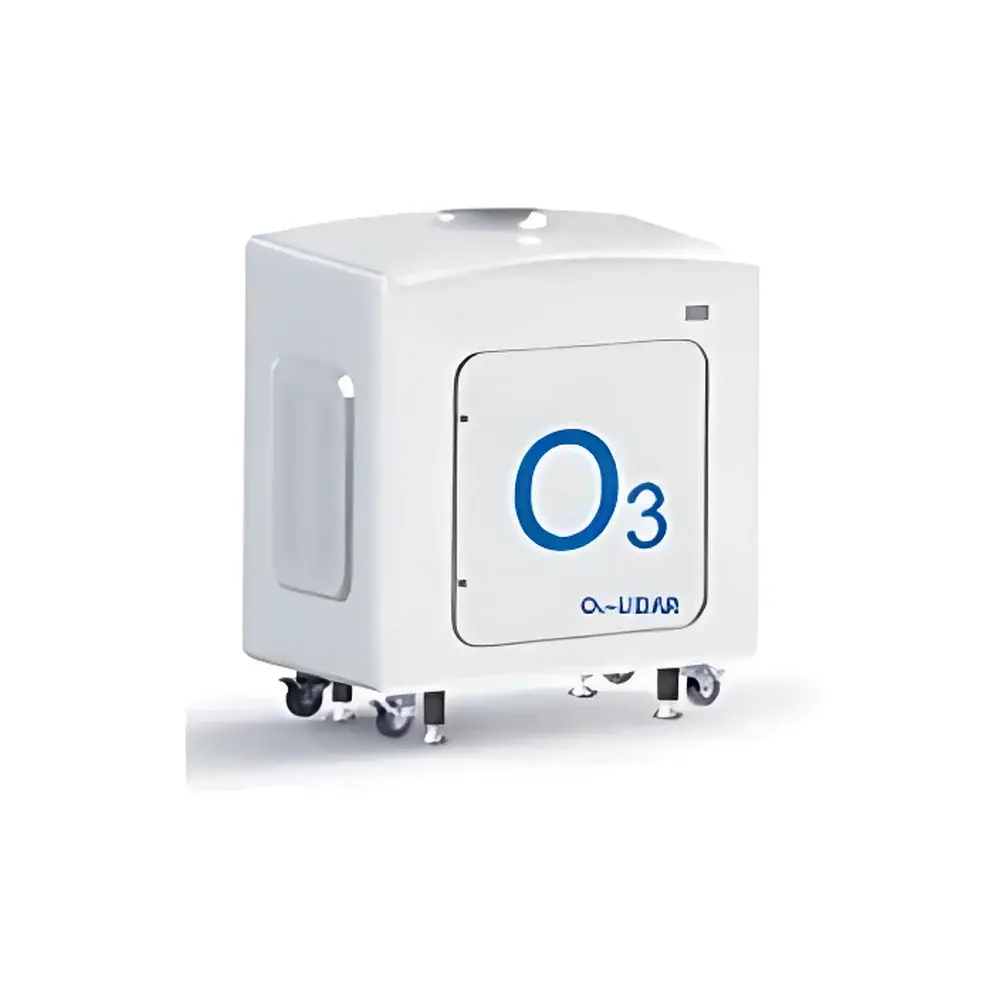
O3-LIDAR Atmospheric Ozone Profiling Lidar
| Origin | USA |
|---|---|
| Manufacturer Type | Authorized Distributor |
| Origin Category | Imported |
| Model | O3-LIDAR |
| Laser Source | Nd:YAG-based UV laser system (266 nm fundamental, 289 nm & 316 nm Raman-shifted) |
| Detector | High-quantum-efficiency photomultiplier tubes (PMTs) with solar-blind UV response |
| Operating Wavelengths | 289 nm and 316 nm (DIAL pair) |
| Maximum Detection Altitude | Up to 25 km (dependent on atmospheric conditions) |
| Pulse Repetition Frequency | 20–50 Hz |
Overview
The O3-LIDAR Atmospheric Ozone Profiling Lidar is a ground-based differential absorption lidar (DIAL) system engineered for high-resolution, vertically resolved measurement of tropospheric and lower stratospheric ozone (O₃) concentration. It operates on the well-established DIAL principle: two closely spaced ultraviolet wavelengths—289 nm (on-ozone-absorption line) and 316 nm (off-line reference)—are simultaneously transmitted into the atmosphere via a co-axial transmitter-receiver optical path. Backscattered photons from molecular Rayleigh scattering and aerosol Mie scattering are collected by a large-aperture Newtonian telescope and detected by solar-blind photomultiplier tubes optimized for UV spectral response. The logarithmic ratio of the two wavelength-resolved return signals enables quantitative retrieval of ozone number density as a function of altitude, yielding continuous vertical profiles with temporal resolution down to 1–5 minutes and vertical resolution configurable between 75 m and 300 m.
Key Features
- Co-axial transceiver architecture minimizes near-range blind zone (< 300 m), enabling boundary-layer ozone profiling critical for urban and industrial emission studies.
- High-power, frequency-quadrupled Nd:YAG laser (266 nm) coupled with deuterium-filled Raman shifter generates stable, spectrally pure 289 nm and 316 nm output—ensuring precise DIAL wavelength separation and long-term calibration stability.
- 1.2-meter primary mirror telescope provides high photon collection efficiency, supporting reliable signal detection up to 25 km under typical mid-latitude clear-sky conditions.
- Dual-mode signal acquisition: simultaneous photon counting and analog integration ensures linear dynamic range spanning six orders of magnitude—critical for resolving weak stratospheric returns alongside strong boundary-layer signals.
- Integrated real-time data processing unit computes ozone mixing ratio profiles using validated DIAL inversion algorithms compliant with standard atmospheric radiative transfer models (e.g., MODTRAN).
- Modular mechanical design supports permanent installation, mobile trailer deployment, or shipboard operation—facilitating coordinated multi-site campaigns and networked observation strategies.
Sample Compatibility & Compliance
The O3-LIDAR system is designed for unattended, continuous operation in ambient outdoor environments across diverse climatic zones (−20 °C to +45 °C, IP55-rated enclosure). It requires no consumables or sample introduction—measurements are fully non-invasive and based on atmospheric backscatter. System calibration follows traceable protocols aligned with ISO 17025-accredited laboratories, including regular lamp-based spectral verification and cross-comparison with ozonesonde launches per WMO/GAW guidelines. Data outputs comply with CF-net and NetCDF-4 standards, supporting interoperability with national air quality monitoring networks (e.g., U.S. EPA AQS, China’s CNEMC platform) and international databases such as NDACC (Network for the Detection of Atmospheric Composition Change).
Software & Data Management
The embedded control and analysis software suite (O3-LIDAR v4.x) runs on a real-time Linux OS and provides full remote operation via secure SSH or TLS-enabled web interface. Key modules include: (1) automated daily self-calibration sequence with internal shutter and reference cell checks; (2) real-time profile visualization with overlay of meteorological model data (e.g., ECMWF IFS); (3) batch processing of raw photon counts using Savitzky-Golay smoothing, Poisson noise correction, and pressure/temperature normalization; (4) export of Level 2 ozone profiles in standardized formats (CF-compliant NetCDF, ASCII columnar), with optional metadata embedding per ISO 19115. Audit trails, user access logs, and electronic signatures meet GLP and FDA 21 CFR Part 11 requirements for regulated environmental monitoring applications.
Applications
- Quantifying diurnal and seasonal ozone vertical structure in polluted megacities to distinguish local photochemical production from regional transport.
- Validating chemical transport model (CTM) simulations—particularly CMAQ, GEOS-Chem, and CAMS—at vertical resolution unmatched by passive satellite sensors.
- Supporting health impact assessments by correlating high-ozone layers with surface exposure metrics and epidemiological datasets.
- Long-term trend analysis (>5 years) of upper-tropospheric ozone—serving as an indicator of stratosphere-troposphere exchange (STE) variability.
- Integration into multi-instrument supersites for synergistic analysis with NOₓ, VOC, PM₂.₅, and lidar-derived aerosol extinction profiles.
- Real-time input for ozone forecasting systems, especially during high-impact events such as heatwaves or biomass burning plume intrusions.
FAQ
What is the minimum detectable ozone concentration and its altitude-dependent uncertainty?
Detection limit is approximately 1 ppbv at 1 km altitude (1-hour integration), with relative uncertainty ≤ ±5% below 10 km and ≤ ±12% above 15 km, as validated against ECC ozonesondes.
Can the system operate autonomously for extended unattended periods?
Yes—designed for 24/7 operation with redundant power supplies, climate-controlled enclosure, and remote diagnostics; mean time between failures exceeds 6,000 hours.
Is the system compatible with existing air quality monitoring infrastructure?
Fully compatible: supports Modbus TCP, MQTT, and RESTful API interfaces for integration with SCADA platforms, EPA AQS gateways, and cloud-based environmental data lakes.
Does the system require annual factory recalibration?
No—on-site spectral verification and geometric overlap assessment suffice annually; full factory recalibration recommended every 3 years or after major optical component replacement.
How is laser safety ensured during field deployment?
Class 4 laser system complies with ANSI Z136.1 and IEC 60825-1:2014; includes interlocked beam shutter, real-time power monitoring, automatic shutdown on misalignment, and certified exclusion zone signage.







