
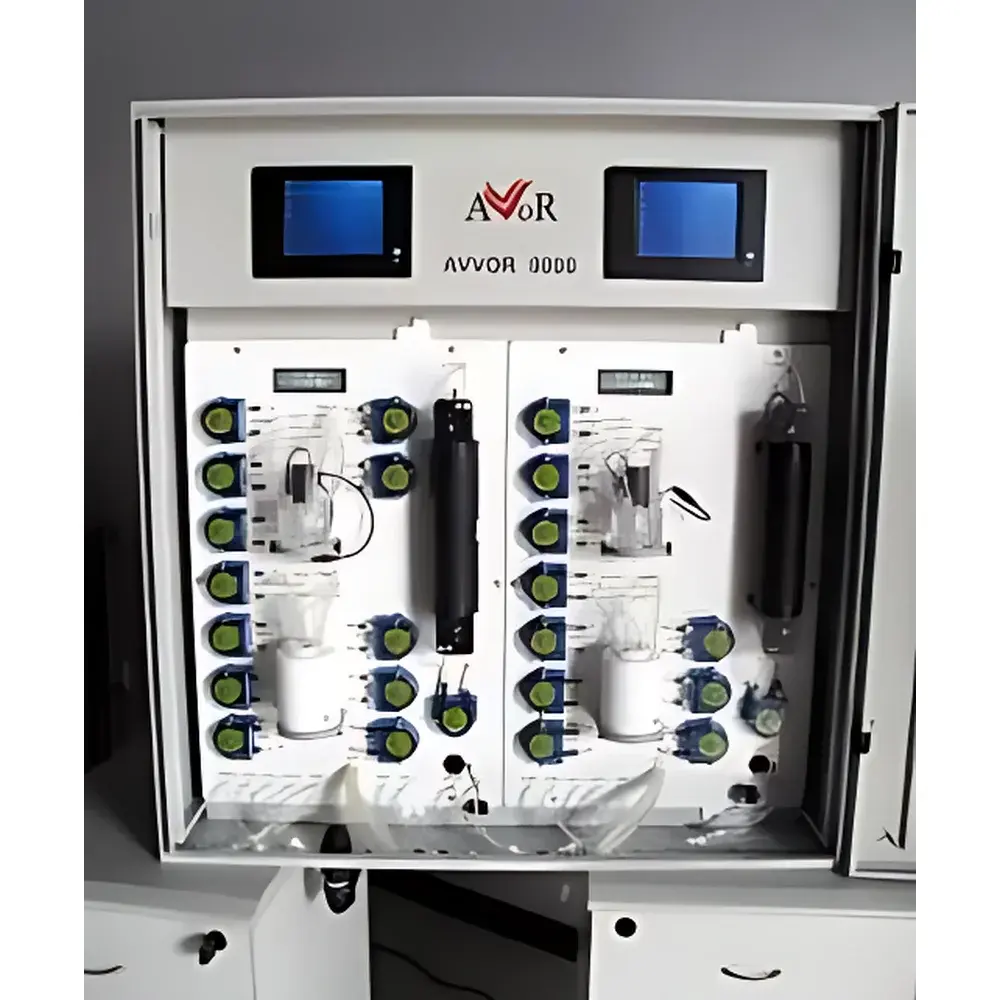
AVVOR 9000 Online Heavy Metal Analyzer
| Brand | AVVOR |
|---|---|
| Origin | Canada |
| Manufacturer Type | Authorized Distributor |
| Origin Category | Imported |
| Model | AVVOR 9000 |
| Pricing | Upon Request |
Overview
The AVVOR 9000 Online Heavy Metal Analyzer is an industrial-grade, electrochemical-based continuous monitoring system engineered for real-time quantification of trace heavy metal ions in aqueous matrices. It operates on the well-established principle of Anodic Stripping Voltammetry (ASV), a standardized electroanalytical technique recognized by ASTM D3559, ISO 11969, and EPA Method 7063. In ASV, target metal ions are first preconcentrated (electrodeposited) onto a working electrode under controlled potential and time conditions, followed by oxidative stripping—where the accumulated metals are re-oxidized, generating current peaks proportional to their concentration. This method delivers sub-ppb (ng/L) detection sensitivity for most target analytes without requiring hazardous reagents or complex sample digestion. Designed for unattended operation in demanding environmental and industrial settings, the AVVOR 9000 meets the functional requirements of ISO/IEC 17025-accredited laboratories and supports regulatory compliance for wastewater discharge (e.g., EU Industrial Emissions Directive, US Clean Water Act), drinking water safety (WHO Guidelines, US EPA Lead and Copper Rule), and source water surveillance.
Key Features
- Modular architecture supporting up to two independent analytical modules per instrument chassis—enabling flexible configuration for site-specific multi-metal monitoring needs.
- Dual communication interface: RS-485 (Modbus RTU) and RS-232 for integration with SCADA, DCS, or PLC systems; optional wireless telemetry (LTE/4G) available via external gateway.
- Eight isolated 4–20 mA analog outputs—each configurable in software to transmit any measured parameter (e.g., Pb²⁺, Cr⁶⁺, As³⁺) or diagnostic signal (e.g., flow status, calibration flag).
- Automated onboard calibration using certified standard solutions; scheduled calibration intervals programmable from 6 to 168 hours.
- Integrated sample conditioning unit with filtration (5 µm), pH adjustment (±0.2 accuracy), and UV digestion (optional) to minimize organic interference and matrix effects.
- IP65-rated sealed enclosure with internal humidity control and temperature stabilization (15–35 °C operational range), suitable for outdoor cabinet or shelter installation.
- Self-diagnostic firmware with event logging, fault code reporting, and automatic recovery protocols for power interruption, flow loss, or electrode fouling.
Sample Compatibility & Compliance
The AVVOR 9000 is validated for use with raw and treated water samples across diverse matrices: municipal wastewater effluents, industrial process streams (e.g., electroplating rinse waters, mining leachates), surface and groundwater, potable water distribution systems, and seawater (with salinity compensation). Sample introduction requires minimal pretreatment—typically only particulate filtration and optional UV oxidation for arsenic speciation (As³⁺ vs. As⁵⁺). The system complies with GLP data integrity standards through audit-trail-enabled software (user actions, calibration logs, measurement timestamps). All electrochemical measurements adhere to ISO 8466-1 for calibration curve linearity and IUPAC recommendations for ASV peak resolution and quantification uncertainty estimation. Optional 21 CFR Part 11-compliant software module available for regulated pharmaceutical or food processing applications.
Software & Data Management
The embedded Linux-based controller runs AVVOR ControlSuite™ v3.2 firmware, featuring a web-accessible GUI (HTTPS/TLS 1.2) and local touchscreen interface. Data acquisition occurs at user-defined intervals (1–240 minutes); each measurement includes raw voltammogram export, peak identification metadata, and QC flags (e.g., baseline drift >5%, signal-to-noise ratio <10). Historical datasets are stored locally (8 GB SD card, 12-month retention) and synchronized to cloud platforms (AWS IoT Core or private MQTT broker) via secure TLS tunnel. Export formats include CSV, XML (ISO/IEC 11179-compliant metadata schema), and OPC UA for enterprise-level integration. Calibration records, maintenance logs, and firmware update history are retained with digital signatures and immutable timestamps.
Applications
- Continuous compliance monitoring at NPDES or EU IPPC permit discharge points.
- Early-warning detection of accidental heavy metal releases in watershed protection zones.
- Process optimization in metal finishing, battery recycling, and semiconductor fabrication facilities.
- Long-term trend analysis for ambient monitoring networks (e.g., USGS NWIS, EEA WISE).
- Validation of point-of-use treatment systems (e.g., ion exchange, electrocoagulation) in decentralized water supply schemes.
- Research-grade speciation studies when paired with optional pH-controlled flow cells and sequential injection modules.
FAQ
What electrochemical techniques does the AVVOR 9000 employ?
It utilizes Anodic Stripping Voltammetry (ASV) with optional Square Wave (SWASV) and Differential Pulse (DPASV) modes for enhanced sensitivity and selectivity.
Which electrodes are supported, and how are they selected?
Interchangeable working electrodes include gold, mercury-film, bismuth-film, and bare carbon—selected based on target analyte(s) and matrix compatibility (e.g., Au for Hg/As, Bi for Zn/Cd/Pb).
Can the system measure hexavalent chromium (Cr⁶⁺) independently from total Cr?
Yes—via selective complexation and reduction at controlled potential using a dedicated Cr⁶⁺-optimized electrode and reagent-free protocol.
Is remote firmware update capability available?
Yes—over-the-air (OTA) updates are supported via authenticated HTTPS push, with rollback functionality and versioned release notes.
How is data integrity ensured during transmission to central servers?
All network communications use TLS 1.2+ encryption; local storage employs journaling file system (ext4) with write-caching disabled to prevent corruption during unexpected power loss.
Related Products







