
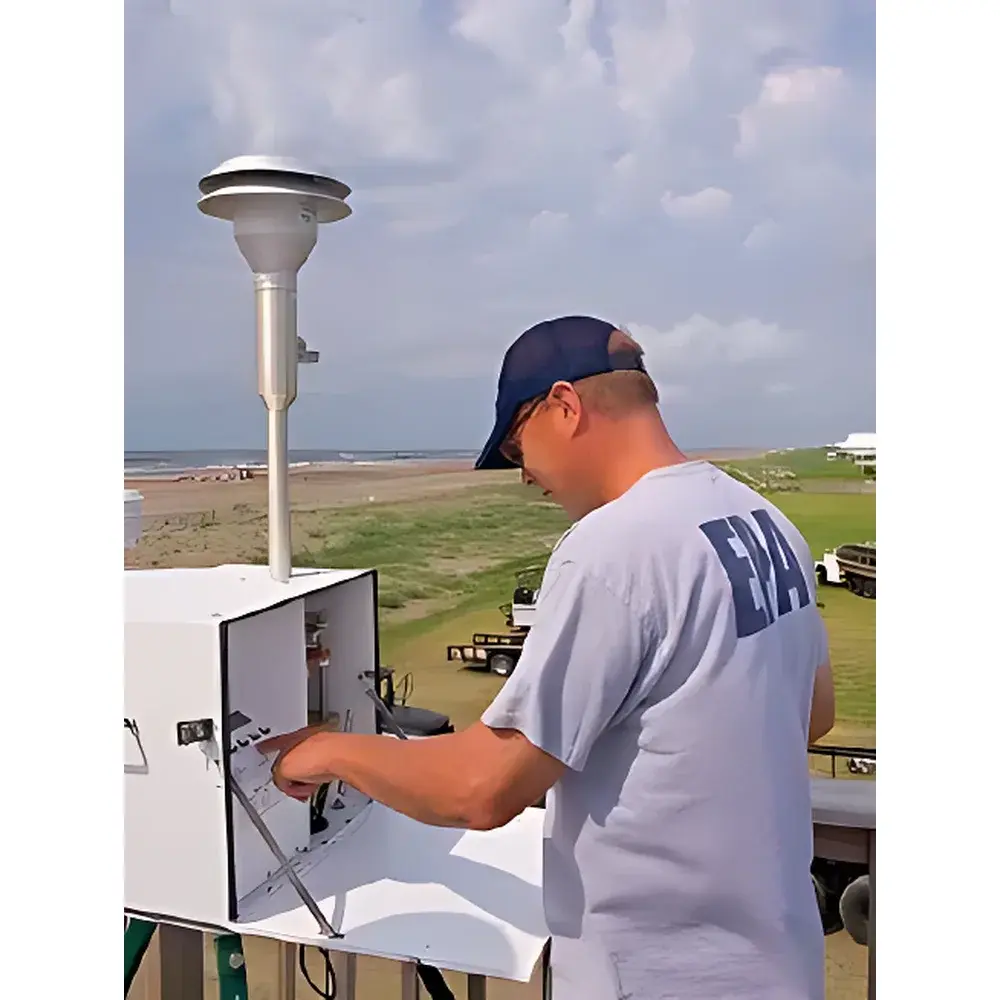
BGI PQ200 Portable PM2.5 Reference Method Sampler
| Brand | BGI |
|---|---|
| Origin | USA |
| Manufacturer Type | Authorized Distributor |
| Origin Category | Imported |
| Model | PQ200 |
| Pricing | Upon Request |
Overview
The BGI PQ200 Portable PM2.5 Reference Method Sampler is a federally designated Federal Reference Method (FRM) instrument for ambient fine particulate matter (PM2.5) monitoring, fully compliant with 40 CFR Part 50, Appendix L — the U.S. Environmental Protection Agency’s (EPA) regulatory standard for PM2.5 measurement. Engineered to meet the National Ambient Air Quality Standards (NAAQS) promulgated on July 18, 1997, the PQ200 performs continuous 24-hour integrated sampling of airborne particles with an aerodynamic diameter ≤2.5 µm at a nominal flow rate of 16.67 L/min. Its core measurement principle relies on inertial separation using two EPA-specified impactor stages, followed by gravimetric analysis of mass collected on a 47-mm polytetrafluoroethylene (PTFE) filter membrane. The system integrates real-time environmental parameter logging—including ambient temperature, barometric pressure, volumetric flow rate, and filter temperature—to enable rigorous correction of sampled volume to standard conditions (25 °C, 101.3 kPa), as required under FRM data validation protocols.
Key Features
- Single-channel, portable FRM-compliant architecture certified for field-deployable PM2.5 monitoring
- UL-listed 12-V DC rechargeable battery system enabling uninterrupted 24-hour operation without external power
- Advanced microprocessor-controlled volumetric flow regulation with closed-loop feedback and thermal mass flow compensation
- VSCC (Very Sharp Cut Cyclone) inlet—EPA-equivalent design (EQPM-0202-142) replacing traditional WINS impactors, offering extended 30-day cleaning intervals and improved aerodynamic cut-point fidelity at 2.5 µm
- Integrated environmental sensor suite logging temperature, pressure, flow, and filter temperature at 5-minute intervals
- ISO 9001-certified manufacturing and quality assurance processes
- Solar-enhanced power option available for off-grid deployment in remote or long-term monitoring networks
Sample Compatibility & Compliance
The PQ200 is validated exclusively for use with 47-mm PTFE membrane filters meeting EPA specifications for low blank variability and high particle retention efficiency (>99.9% for ≥0.3 µm). It supports both PM2.5-specific sampling and configurable PM10 operation via interchangeable inlet assemblies (RFPS-1298-125 approved). All operational parameters—including flow calibration traceability to NIST standards, pressure transducer accuracy (±0.1 kPa), and temperature sensor resolution (±0.2 °C)—are documented per EPA audit requirements. The instrument satisfies full FRM designation (RFPS-0498-116), making it suitable for regulatory-grade data submission to state implementation plans (SIPs), air quality management districts (AQMDs), and federal reporting systems such as AQS (Air Quality System).
Software & Data Management
Data acquisition and retrieval are managed via proprietary PQ200 Memory Download Software, compatible with Windows-based laptops. Raw datasets include timestamped records of instantaneous flow, corrected volume, environmental conditions, and diagnostic flags (e.g., flow deviation >5%, pressure fault, low battery warning). All stored data retain immutable metadata headers for chain-of-custody integrity. The software supports export to CSV and ASCII formats for integration with third-party statistical analysis tools (e.g., R, Python pandas) and compliance reporting templates aligned with EPA Form 50-1 and QA/QC Annexes. Audit trails and user-access logs conform to GLP principles; while not inherently 21 CFR Part 11–compliant, the system supports external validation packages for regulated laboratory environments requiring electronic signature and record retention controls.
Applications
- Regulatory compliance monitoring under U.S. Clean Air Act Section 109 and State Implementation Plans
- Long-term trend analysis in national air monitoring networks (NAMS) and near-roadway studies
- Source apportionment campaigns requiring spatially resolved, FRM-grade PM2.5 mass concentration data
- Method validation and co-location studies with beta attenuation monitors (BAMs), tapered element oscillating microbalances (TEOMs), and optical particle counters
- Short-term intensive field campaigns including mobile monitoring, community exposure assessments, and wildfire smoke characterization
FAQ
Is the PQ200 certified for official PM2.5 monitoring under U.S. federal regulations?
Yes — it holds five distinct EPA designations, including FRM (RFPS-0498-116), EQPM for VSCC inlet (EQPM-0202-142), and PM10 modification approval (RFPS-1298-125).
Can the PQ200 operate unattended for 24 hours without AC power?
Yes — its UL-certified internal 12-V DC battery enables full 24-hour FRM-compliant sampling without external power.
What filter media are compatible with the PQ200?
Only 47-mm PTFE membranes meeting EPA Method IO-3.2 specifications (low metal/mass blank, hydrophobic, ≤0.45 µm pore size) are approved for regulatory use.
Does the PQ200 support solar charging?
Yes — optional solar panel integration is available for extended off-grid deployments, maintaining battery charge during daylight hours.
How frequently must the VSCC inlet be cleaned?
Under typical urban background conditions, the VSCC inlet requires cleaning every 30 days, significantly extending maintenance intervals versus conventional impactors.







