
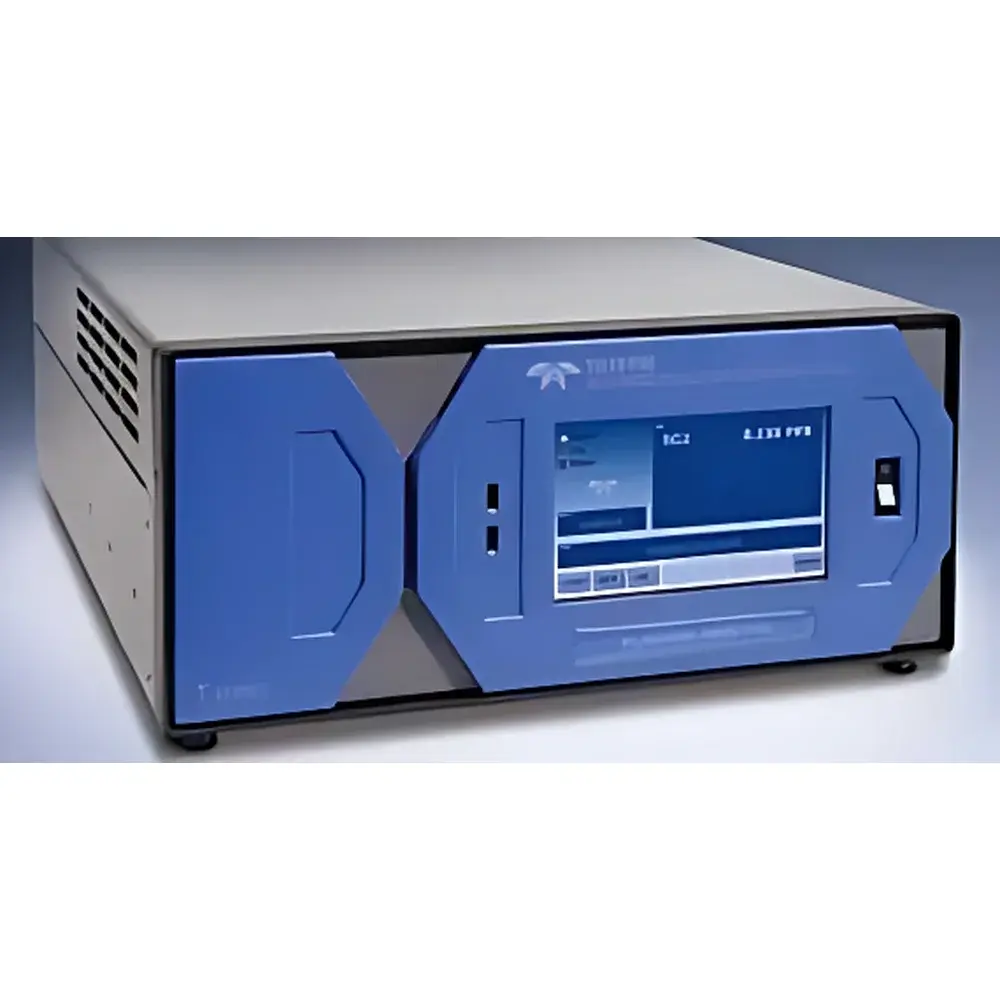
API T400 UV Absorption Ozone Analyzer
| Brand | API |
|---|---|
| Origin | USA |
| Model | T400 |
| Instrument Type | Fixed-mount |
| Measurement Range | 0–10 ppb (standard), optional dual-range 0–100 ppb / 0–10 ppm |
| LOD | <0.6 ppb |
| Response Time (T95) | <20 s |
| Zero Drift | <1.0 ppb/24 h |
| Span Drift | <1% of reading/7 days |
| Resolution | 0.1 ppb (0–50 ppb range) |
| Sample Flow Rate | 800 cm³/min ±10% |
| Operating Temperature | 5–40 °C |
| Relative Humidity | 0–95% RH (non-condensing) |
| Power Supply | 100–240 V AC, 50/60 Hz, 250 W |
| Dimensions (H×W×D) | 178 × 432 × 597 mm |
| Weight | 18 kg |
| Output Signals | 0–10 V, 0–5 V, 0–1 V, 0–100 mV, 0–20 mA, or 4–20 mA (isolated) |
Overview
The API T400 UV Absorption Ozone Analyzer is a fixed-installation, laboratory-grade ambient air monitoring instrument engineered for high-precision, continuous measurement of ozone (O₃) at trace concentrations in environmental and regulatory compliance applications. It operates on the fundamental principle of ultraviolet (UV) absorption photometry, leveraging the Beer-Lambert law to quantify ozone concentration based on its characteristic absorption peak at 254 nm. This optical method provides inherent selectivity for ozone without cross-sensitivity to common atmospheric interferents such as NO₂, SO₂, or hydrocarbons—provided appropriate optical filtering and flow-path design are maintained. The analyzer is designed for unattended operation in central air quality monitoring stations, EPA-certified reference sites, university research laboratories, and cleanroom environmental control systems where long-term stability, low detection limits, and metrological traceability are essential.
Key Features
- High-sensitivity UV photometric detection with dual-wavelength optical path design for real-time zero compensation and enhanced baseline stability
- Configurable dual-range operation: standard 0–10 ppb range optimized for background ambient monitoring; optional extended ranges (0–100 ppb or 0–10 ppm) support industrial hygiene and process control applications
- Low detection limit of <0.6 ppb (3σ) and zero noise <0.3 ppb (RMS), enabling reliable quantification near regulatory thresholds (e.g., WHO 8-hr guideline: 100 µg/m³ ≈ 51 ppb)
- Temperature- and pressure-compensated measurement algorithm compliant with EPA Method EQOA-0103 and ISO 13964:2022 requirements for ambient ozone monitoring
- Integrated microprocessor with embedded multi-tasking firmware supporting simultaneous data acquisition, diagnostics, and communication protocols
- Front-panel color touchscreen interface with intuitive navigation, local data review, and real-time status visualization
- Dual isolated RS-232 serial ports (standard); optional RS-485 or 10/100BASE-T Ethernet for SCADA integration and remote configuration
- Onboard data logging with user-selectable averaging intervals from 1 minute to 365 days; internal SD card storage supports >1 year of 1-minute averaged records
- Automated self-diagnostics including lamp intensity monitoring, optical path integrity checks, and flow rate validation with audible/visual alarm outputs
Sample Compatibility & Compliance
The T400 is validated for use with ambient air, indoor air, and filtered outdoor sampling streams meeting EPA Reference Method PS-12 and EN 14625:2012 specifications. Its stainless-steel sample manifold and PTFE-lined internal wetted surfaces minimize adsorption artifacts and ensure compatibility with humid, particulate-laden, or mildly acidic airstreams. All calibration and operational procedures align with U.S. EPA 40 CFR Part 53 requirements for Federal Equivalent Methods (FEM), and the instrument’s performance characteristics satisfy the data quality objectives outlined in ISO/IEC 17025:2017 for accredited environmental testing laboratories. Optional built-in zero/span verification modules support GLP-compliant audit trails and facilitate routine QA/QC per ASTM D5012-22.
Software & Data Management
The analyzer ships with APIcom™—a Windows-based remote management software enabling full instrument control, calibration scheduling, event log review, and real-time data streaming via TCP/IP or serial link. APIcom supports 21 CFR Part 11-compliant user access levels, electronic signatures, and immutable audit trails for regulated environments. Data export formats include CSV, XML, and netCDF, ensuring interoperability with EPA AQS, EEA AirBase, and custom LIMS platforms. Firmware updates and configuration backups are performed securely over encrypted channels, and all critical operational parameters—including lamp hours, filter status, and calibration history—are timestamped and stored locally with write protection.
Applications
- Ambient air quality monitoring networks (e.g., national reference stations, urban background sites)
- Regulatory compliance reporting under EU Directive 2008/50/EC and U.S. NAAQS (National Ambient Air Quality Standards)
- Indoor air quality assessment in hospitals, schools, and office buildings
- Process gas monitoring in semiconductor fabrication cleanrooms and pharmaceutical manufacturing suites
- Field validation of satellite-based ozone retrievals and chemical transport model outputs
- Research studies on tropospheric ozone formation, photochemical smog dynamics, and stratosphere–troposphere exchange
FAQ
What regulatory standards does the T400 comply with?
The T400 meets U.S. EPA Performance Specification PS-12 for ozone analyzers and is designated as a Federal Equivalent Method (FEM) when operated per manufacturer-recommended protocols. It also satisfies ISO 13964:2022 and EN 14625:2012 for ambient air measurement.
Can the T400 be integrated into an existing SCADA or EMS system?
Yes—via standard RS-232, optional RS-485 (Modbus RTU), or Ethernet (Modbus TCP). Analog outputs (4–20 mA, 0–10 V) provide direct interfacing with PLCs and DCS controllers.
Is temperature and pressure compensation mandatory for accurate readings?
Yes. The T400 applies real-time compensation using integrated sensors; omission invalidates traceability to NIST-traceable standards and violates ISO 13964:2022 Clause 7.3.2.
How often does the instrument require calibration verification?
Per EPA 40 CFR Part 58 Appendix A, daily zero/span checks are recommended for reference-grade operation; monthly full calibration with NIST-traceable ozone generator is required for certified data submission.
Does the T400 support remote firmware updates?
Yes—APIcom enables secure over-the-air firmware upgrades with version rollback capability and SHA-256 integrity verification.







