
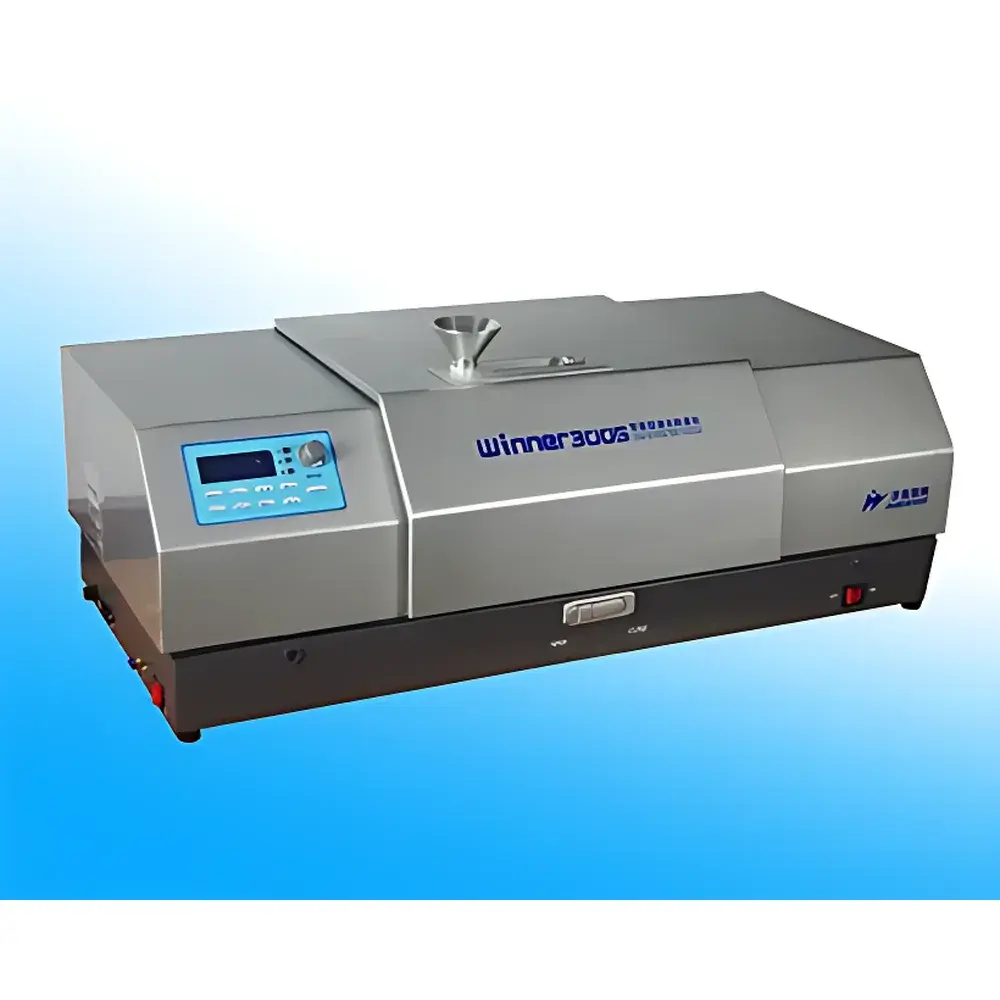
WinNano Winner3005 Dry-Dispersion Laser Particle Size Analyzer
| Brand | WinNano |
|---|---|
| Origin | Shandong, China |
| Manufacturer Type | Direct Manufacturer |
| Model | Winner3005 |
| Price Range | USD 21,000–28,000 (FOB) |
| Dispersion Method | Dry dispersion using turbulent airflow |
| Measurement Range | 0.1–500 µm |
| Repeatability | < 1% RSD (D50 of certified reference material) |
| Measurement Time | < 60 s per run |
| Laser Source | He-Ne, λ = 632.8 nm, P > 2 mW, lifetime > 25,000 h |
| Detector Channels | 40-channel annular photodetector array |
| Alignment | Motorized auto-alignment with micron-level precision |
| Feed System | Automated vibratory feeder + patented powder jet pump |
| Air Supply | Oil-free, silent compressor |
| Dimensions | 880 × 400 × 300 mm |
| Weight | 36 kg |
| Compliance | GB/T 19077.1–2008 |
| ISO 13320 | 2016 |
Overview
The WinNano Winner3005 Dry-Dispersion Laser Particle Size Analyzer is a high-precision instrument engineered for the rapid, reliable, and non-destructive characterization of dry powder materials using Fraunhofer diffraction and Mie scattering theory. Designed specifically for samples incompatible with liquid media—such as hygroscopic, reactive, or morphologically unstable powders—the system employs a robust turbulent dry dispersion mechanism powered by an oil-free, low-noise compressed air source. Its convergent-beam Fourier transform optical architecture enables full angular detection (up to 150°), ensuring accurate capture of forward- and back-scattered light across the entire 0.1–500 µm measurement range. The system integrates a stabilized He-Ne laser (632.8 nm), a 40-channel annular photodetector array, and motor-driven auto-alignment to maintain optimal beam positioning throughout operation—critical for long-term reproducibility in regulated environments.
Key Features
- Convergent-beam Fourier transform optical design with dual-zone detection (main + extended-angle auxiliary detectors) to eliminate aperture-induced angular truncation and maximize scattering signal fidelity.
- Turbulent dispersion system utilizing shock-wave shear forces, combined with a patented powder jet pump and precision vibratory feeder, ensures de-agglomeration without mechanical attrition or thermal degradation.
- Fully automated operation mode with one-click measurement sequence, supported by manual override capability via front-panel controls for method development and troubleshooting.
- Micron-precision motorized auto-alignment mechanism maintains optical centering stability over time, reducing operator dependency and minimizing drift-related uncertainty.
- Integrated air treatment unit featuring multi-stage filtration (particulate + coalescing moisture removal) and continuously adjustable pressure (0.1–0.8 MPa), compliant with ISO 8573-1 Class 3 air quality requirements for analytical instrumentation.
- High-speed data acquisition and unconstrained inverse algorithm processing enable real-time particle size distribution (PSD) reconstruction with statistical confidence intervals and residual error reporting.
Sample Compatibility & Compliance
The Winner3005 is validated for use with a broad spectrum of industrially relevant dry powders—including cement clinker, pharmaceutical actives (e.g., lactose, mannitol), ceramic precursors, catalyst supports, metal alloys (Al, Ti, Ni), graphite anodes, magnetic oxides (Fe3O4, NdFeB), and energetic materials (e.g., ammonium perchlorate). It excludes samples requiring inert atmosphere handling or cryogenic stabilization. The instrument complies with ISO 13320:2016 (Particle size analysis — Laser diffraction methods), GB/T 19077.1–2008 (Chinese national standard equivalent), and Q/0100JWN001–2013 (manufacturer’s internal verification protocol). While not inherently 21 CFR Part 11-compliant out-of-the-box, its software architecture supports audit trail logging, electronic signature integration, and user-access-tier configuration when deployed within validated GMP/GLP workflows.
Software & Data Management
The proprietary WinNano Analysis Suite provides comprehensive post-acquisition processing including D10, D50, D90, D[4,3], D[3,2], span, and relative width metrics. Users may define custom percentile thresholds (e.g., D25, D75), cumulative fractions above/below user-specified cutoffs, or mass-weighted interval distributions (e.g., % between 10–50 µm). Raw scattering intensity profiles are exportable in CSV and ASCII formats for third-party statistical modeling (e.g., PCA, clustering). Batch report generation supports PDF, Excel, and XML output with embedded metadata (operator ID, timestamp, instrument serial number, calibration status). All measurement parameters and results are stored in a relational SQLite database with optional network backup and role-based access control.
Applications
This analyzer serves quality control laboratories in cement manufacturing (fineness optimization per ASTM C114), pharmaceutical solid dosage development (API and excipient PSD qualification per USP <429>), advanced ceramics R&D (sintering behavior correlation), battery material production (anode/cathode active material grading), and specialty pigment formulation (color strength and dispersion stability prediction). Its dry-mode capability is particularly advantageous for thermolabile organics, water-reactive nitrides/carbides, and magnetically sensitive powders where wet dispersion induces oxidation, hydrolysis, or agglomeration artifacts. Routine use includes incoming raw material inspection, in-process monitoring of milling/granulation steps, and final product release testing.
FAQ
What types of powders are unsuitable for analysis on the Winner3005?
Highly fibrous, strongly cohesive (e.g., fumed silica without surface treatment), or electrostatically charged materials may require pre-conditioning (e.g., antistatic coating, controlled humidity conditioning) to ensure stable feeding and dispersion.
Does the system support method transfer from wet-dispersion instruments?
Yes—when calibrated against traceable NIST SRM standards (e.g., SRM 1963, SRM 2800), dry-mode results demonstrate strong correlation (r² > 0.995) with orthogonal wet-laser systems for monomodal, spherical reference materials.
How often does the optical alignment require verification?
The motorized auto-alignment performs self-checks at startup and every 24 hours during continuous operation; manual verification is recommended quarterly using the included alignment verification slide.
Can the instrument be integrated into a LIMS environment?
Yes—via ODBC-compliant database connectors and configurable REST API endpoints for bidirectional data exchange with major laboratory information management systems.
Is routine maintenance required for the air compression system?
Filter elements (particulate + coalescing) must be replaced every 500 operating hours or semiannually, whichever occurs first; compressor oil changes are not applicable due to oil-free piston design.



