
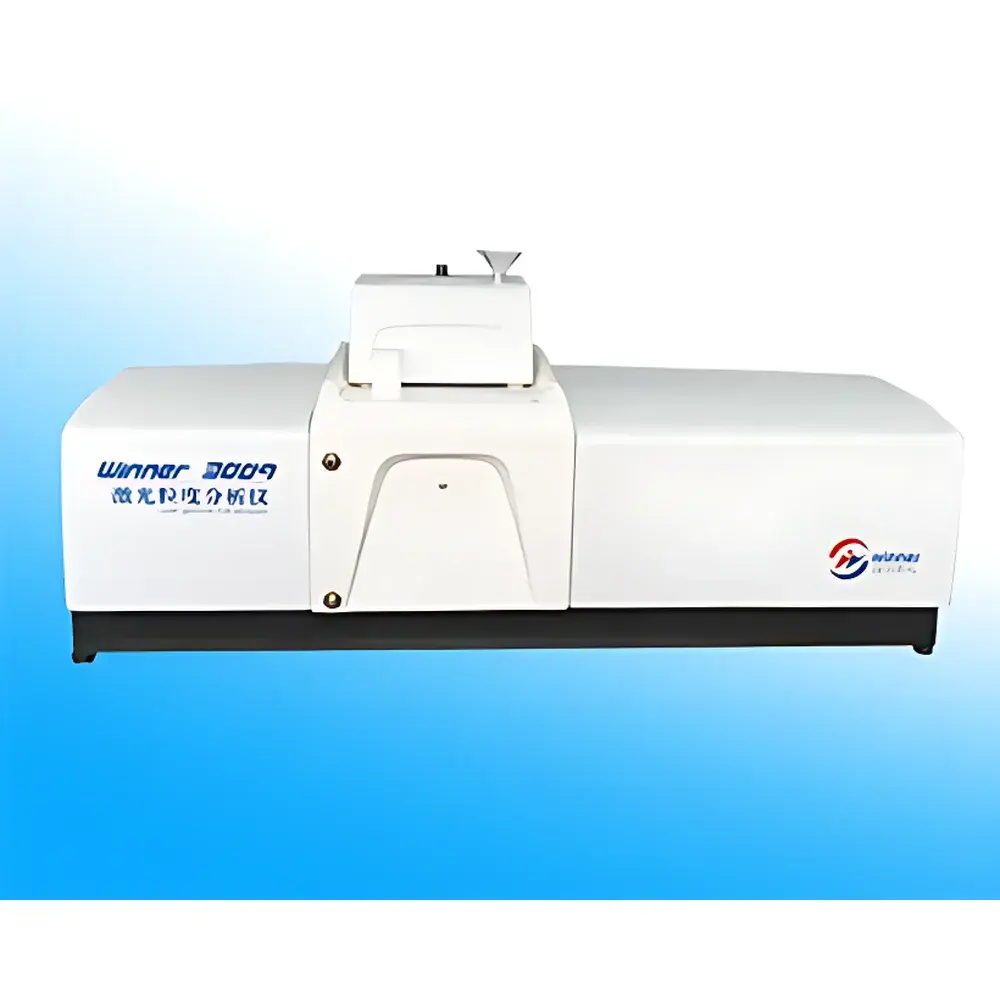
WinNano Winner3009 Dry-Dispersion Laser Particle Size Analyzer
| Brand | WinNano |
|---|---|
| Origin | Shandong, China |
| Manufacturer Type | Direct Manufacturer |
| Model | Winner3009 |
| Dispersion Method | Dry Dispersion |
| Measurement Range | 0.1–2000 µm |
| Repeatability | <1% |
| Measurement Time | <1 min |
Overview
The WinNano Winner3009 Dry-Dispersion Laser Particle Size Analyzer is a sixth-generation intelligent laser diffraction instrument engineered for high-precision, wide-range particle size distribution (PSD) analysis of dry, free-flowing powders and granular solids. It operates on the fundamental principle of Mie scattering theory and Fraunhofer diffraction, with optical design optimized to capture angular light intensity distributions across an extended solid angle range. The system integrates a convergent-beam Fourier transform optical configuration—a patented optical architecture that eliminates conventional lens aperture limitations—enabling accurate detection of forward-scattered light at large angles without truncation. This design, combined with auxiliary photodetector arrays strategically positioned to cover low-, mid-, and high-angle scattering zones, ensures full-spectrum signal acquisition from sub-micron to coarse particles (0.1–2000 µm), making it particularly suitable for materials with broad or bimodal distributions such as catalysts, metal powders, pharmaceutical excipients, ceramic precursors, and mineral aggregates.
Key Features
- Convergent-beam Fourier transform optical system with multi-zone photodetector array for enhanced angular resolution and extended dynamic range
- Dry dispersion module based on turbulent jet dispersion technology, utilizing high-velocity compressed air pulses to generate controlled shear forces—effectively de-agglomerating weakly bound particles without mechanical grinding or liquid media
- Wear-resistant ceramic components in critical dispersion pathways (e.g., feed nozzle, dispersion chamber), ensuring long-term dimensional stability and measurement consistency over thousands of cycles
- Fully automated workflow: one-touch operation initiates synchronized sequence of dust extraction, gas supply regulation, vibratory feeding control, and real-time data acquisition—minimizing operator intervention and eliminating manual variability
- Signal amplification algorithm with adaptive spectral gain correction, improving sensitivity to low-intensity scattering signals from fine fractions while maintaining linearity across the full range
- Integrated vacuum-assisted sample recovery and HEPA-filtered exhaust system compliant with ISO 14644-1 Class 8 cleanroom ambient requirements
Sample Compatibility & Compliance
The Winner3009 is validated for use with non-cohesive, thermally stable, and electrostatically neutral dry powders including but not limited to metal alloys (e.g., Ti-6Al-4V, Inconel), battery cathode materials (NMC, LFP), spray-dried silica, ground limestone, fly ash, and polymer microspheres. It is not intended for hygroscopic, fibrous, or highly cohesive samples without prior surface treatment or blending with dispersing agents. Instrument performance aligns with ISO 13320:2020 (Particle size analysis — Laser diffraction methods) for measurement principles and repeatability validation. Data handling workflows support audit-ready documentation per GLP and GMP environments; raw scattering patterns, instrument metadata, and analysis parameters are timestamped and stored in structured binary format compatible with 21 CFR Part 11-compliant data management systems when deployed with optional secure software modules.
Software & Data Management
The embedded WinNano Particle Analysis Suite (v6.x) provides real-time visualization of scattering spectra, iterative Mie/Fraunhofer inversion, and customizable reporting templates (PDF, CSV, XML). Advanced analysis options include multi-modal fitting, D10/D50/D90 statistics with confidence intervals, relative span calculation, and comparative overlay of up to eight measurements. All processing algorithms are traceable, with version-controlled core libraries and user-accessible calibration logs. Software supports networked deployment, role-based access control, electronic signatures, and automated backup to NAS or cloud storage endpoints. Firmware and application updates are delivered via authenticated HTTPS channels; perpetual license includes lifetime access to major version upgrades and security patches.
Applications
- Quality control of additive manufacturing feedstocks—verifying compliance with ASTM F3049 specifications for metal powder flowability and size distribution
- R&D screening of catalyst supports and zeolites where narrow PSD correlates directly with surface area and pore accessibility
- Batch release testing of pharmaceutical dry powder inhalers (DPIs) per USP <788> particulate matter guidance
- Process optimization in mineral beneficiation—monitoring grind size evolution during milling and classification stages
- Characterization of recycled battery black mass for downstream hydrometallurgical processing feasibility assessment
- Validation of spray drying and fluidized bed granulation endpoints in food and nutraceutical manufacturing
FAQ
What standards does the Winner3009 comply with for particle size measurement?
It adheres to ISO 13320:2020 for laser diffraction methodology, and its operational protocols can be aligned with ASTM D4294 (for elemental analysis correlation), USP <788>, and internal SOPs requiring documented repeatability ≤1% RSD.
Can the instrument be integrated into an automated production line?
Yes—the system offers RS-232, Ethernet TCP/IP, and Modbus RTU interfaces for PLC synchronization, enabling scheduled unattended measurements and direct MES/SCADA data injection.
Is wet dispersion possible with this model?
No—Winner3009 is exclusively configured for dry dispersion. For aqueous or solvent-based suspensions, refer to the WinNano Winner2000 series.
How is calibration verified and maintained?
Primary calibration uses NIST-traceable polystyrene latex (PSL) standards (e.g., 10 µm, 100 µm); daily verification employs built-in reference scatterers; full optical alignment checks are guided by onboard diagnostic routines.
What maintenance is required for long-term operational stability?
Annual inspection of ceramic dispersion components, optical window cleaning with spectroscopic-grade solvents, and verification of vacuum pump oil level and filter integrity constitute routine preventive maintenance.



