
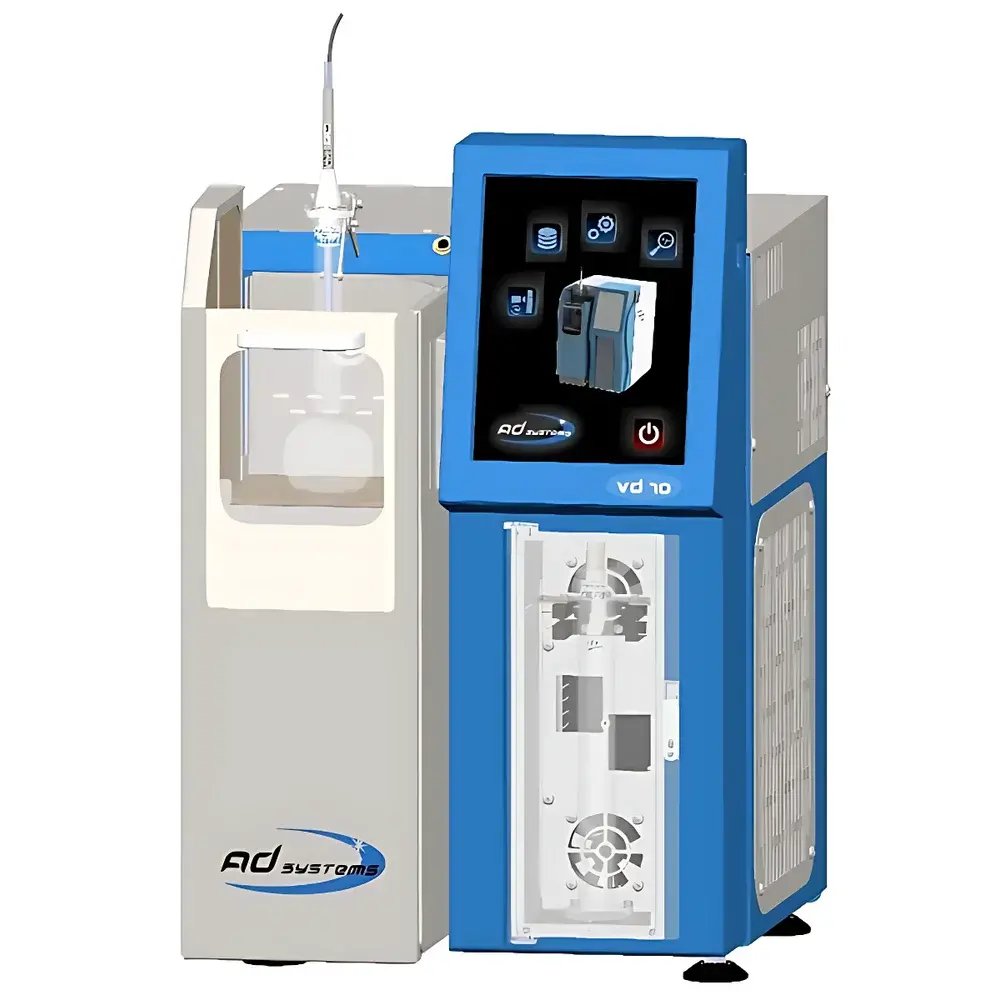
AD Systems VD10 Automated Video Distillation Apparatus
| Brand | AD Systems |
|---|---|
| Origin | France |
| Model | VD10 |
| Operating Pressure | Atmospheric |
| Temperature Range | 0–450 °C |
| Temperature Accuracy | ±0.1 °C |
| Cold Bath Temperature Range | 0–65 °C |
| Distillation Rate | 2–10 mL/min |
| Volume Detection Range | 0–100 mL |
| Volume Resolution | 0.1 mL |
Overview
The AD Systems VD10 Automated Video Distillation Apparatus is a fully integrated, vision-guided petroleum distillation system engineered for precise, repeatable, and method-compliant boiling point distribution analysis of volatile hydrocarbon mixtures. Unlike conventional distillation units relying solely on thermocouple feedback and fixed heating profiles, the VD10 employs real-time high-resolution video imaging synchronized with thermal and volumetric sensing to dynamically monitor physical phase transitions inside the distillation flask—specifically meniscus movement, bubble formation, vapor condensation onset, and distillate collection kinetics. This multimodal measurement architecture enables closed-loop, adaptive control of the heating element based on observed sample behavior—not preprogrammed time/temperature ramps—thereby eliminating operator-dependent optimization while ensuring compliance with standardized test protocols including ASTM D86, ASTM D850, ASTM D1078, ISO 3405, ISO 918, IP 123, IP 195, and GB/T 6536.
Key Features
- Real-time video analytics engine: 1080p industrial camera with programmable exposure and backlight synchronization, continuously tracking liquid level, vapor column development, and condensate flow in the receiving cylinder.
- Adaptive heating control: Microprocessor-driven power modulation adjusts heater output in response to visual cues (e.g., first drop detection, steady distillate flow, cessation of vapor rise), ensuring optimal energy delivery at initial boiling point (IBP), mid-range fractionation, and final boiling point (FBP).
- High-precision temperature monitoring: Dual Pt100 sensors—one immersed in the vapor phase near the flask neck, one in the distillate receiver—deliver traceable ±0.1 °C accuracy across 0–450 °C range.
- Automated volume quantification: Optical meniscus detection coupled with calibrated cylinder geometry yields 0.1 mL resolution over full 0–100 mL collection range, eliminating manual reading error.
- Atmospheric-pressure operation with integrated safety interlocks: Overtemperature cutoff, dry-run protection, vapor pressure anomaly detection, and emergency cooling activation if cold bath exceeds 65 °C or falls below 0 °C.
- Intuitive 7-inch capacitive touchscreen interface: Preloaded method templates, configurable report formats (PDF/CSV), and GLP-compliant audit trail logging (user actions, parameter changes, calibration events).
Sample Compatibility & Compliance
The VD10 accommodates standard ASTM/ISO/IP distillation flasks (125 mL or 200 mL) and receivers, supporting gasoline, naphtha, kerosene, diesel, light cycle oil, and other transparent to lightly colored petroleum fractions. It is not suitable for opaque, highly viscous, or thermally unstable samples prone to coking. All operational parameters—including heating rate, volume increment thresholds, and endpoint criteria—are configurable to match specific regulatory requirements. The system meets essential safety and metrological criteria for ISO/IEC 17025-accredited laboratories and supports FDA 21 CFR Part 11 compliance when deployed with optional electronic signature and audit trail modules. Routine calibration verification follows ASTM D86 Annex A1 procedures using certified reference materials.
Software & Data Management
Firmware v3.2 includes embedded distillation data acquisition software with synchronized timestamping of thermal, volumetric, and image-derived events. Raw video streams are stored as H.264-encoded clips tagged with metadata (sample ID, operator, method, ambient conditions). Processed results include IBP, 10%, 50%, 90%, and FBP temperatures; recovered volume vs. temperature curves; and deviation flags for ASTM D86 “distillation curve shape” acceptance criteria. Export options include ASTM D6300-compliant uncertainty reporting, LIMS integration via OPC UA, and automated upload to secure cloud repositories with TLS 1.3 encryption. All user interactions and configuration modifications are recorded in an immutable audit log compliant with GLP and GMP documentation standards.
Applications
- Quality control of refinery cut points in continuous process streams.
- Specification conformance testing for aviation turbine fuel (ASTM D1655), automotive gasoline (ASTM D4814), and marine distillate fuels (ISO 8217).
- Research-scale evaluation of reformulated blends containing oxygenates or bio-components.
- Distillation behavior assessment of synthetic crude derivatives and pyrolysis oils.
- Method validation and interlaboratory comparison studies under ISO 5725 guidelines.
FAQ
Does the VD10 require method programming prior to each run?
No. The system operates in “zero-configuration mode” by default, applying intelligent heuristic rules derived from ASTM D86 practice to initialize heating, detect endpoints, and terminate distillation—without user-defined ramp rates or hold times.
Can the VD10 be used for vacuum distillation?
No. The VD10 is designed exclusively for atmospheric-pressure distillation per ASTM D86 and related standards. Vacuum-capable variants are not available in the VD series.
Is video recording storage included in the base configuration?
Yes. Internal 128 GB SSD stores up to 2,000 full-resolution distillation sessions with synchronized thermal/volume logs and video clips. External USB 3.2 backup is supported.
How is temperature sensor calibration verified?
The system supports two-point calibration using NIST-traceable dry-block calibrators at 50 °C and 300 °C, with automatic drift compensation applied to all subsequent measurements.
What maintenance intervals are recommended?
Optical path cleaning every 50 runs; cold bath fluid replacement annually; full preventive maintenance (heater alignment, seal inspection, firmware update) every 12 months or 1,000 cycles—whichever occurs first.





