
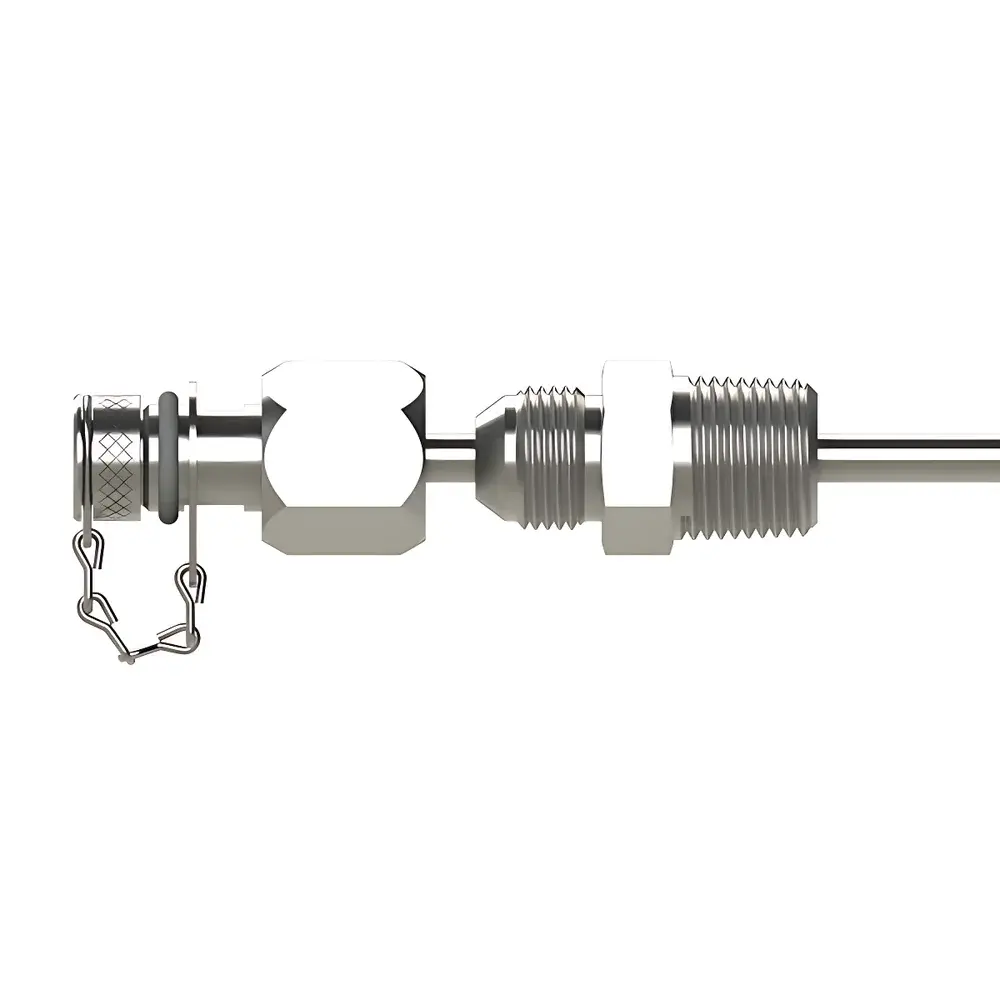
Checkfluid LTJ Oil Level Sampling Tube
| Brand | Checkfluid |
|---|---|
| Origin | USA |
| Manufacturer Type | Authorized Distributor |
| Origin Category | Imported |
| Model | LTJ |
| Pricing | Upon Request |
Overview
The Checkfluid LTJ Oil Level Sampling Tube is an engineered solution for in-service lubricant sampling and visual oil condition assessment in industrial gearboxes, hydraulic systems, and circulating oil reservoirs. Designed around the principle of *active-zone sampling*, the LTJ tube ensures representative fluid extraction exclusively from the dynamic mid-sump region—where oil remains well-mixed and thermally stabilized—avoiding stagnant layers near the sump bottom or oxidized surface films. Its mechanical architecture integrates a high-flow, flush-mount JIC 7/16″-20 straight-thread valve optimized for viscous petroleum-based fluids up to ISO VG 1500 (dynamic viscosity ≈ 1,500 cSt at 40 °C), enabling reliable operation without flow restriction or valve clogging under real-world operating pressures (up to 300 psi continuous service). Unlike conventional dip-tube or sight-glass–integrated samplers, the LTJ eliminates reliance on gravity drainage or operator-dependent positioning—delivering consistent sample integrity across shifts, maintenance cycles, and personnel skill levels.
Key Features
- Active-zone sampling geometry: Tube insertion depth and bend configuration (downward from mid-level port or upward from drain port) are calibrated to intersect the turbulent mixing zone—verified per ASTM D7891-22 guidelines for in-service lubricant representativeness.
- JIC 7/16″-20 male thread interface: Standardized aerospace-grade connection enables tool-free, torque-controlled installation onto OEM oil ports; eliminates adapter stacking, seal misalignment, and rotational stress during tube bending.
- Zinc-nickel electroplated housing (15–20 µm coating thickness): Provides ≥5× improved corrosion resistance versus standard zinc plating per ASTM B633 Type II SC3 salt-spray testing (1,000+ hours to white rust), critical for offshore, refinery, and high-humidity environments.
- Single-motion actuation: Full-open valve operation requires ≤90° handle rotation—no secondary tools, wrenches, or locking collars—reducing average sampling time by 80% compared to legacy B-series manual valves.
- Zero-downtime compatibility: Designed for hot-tap installation and sampling while equipment remains online and pressurized; validated for use with mineral oils, PAOs, and polyalkylene glycols under ISO 12176-1 operational safety protocols.
Sample Compatibility & Compliance
The LTJ sampling tube is certified for use with petroleum-based, synthetic, and semi-synthetic lubricants meeting API GL-4/GL-5, ISO-L-CKB/CKC/CKD, and DIN 51506 classifications. It complies with ISO 3722:2019 (hydraulic fluid sampling) and ASTM D4378-21 (in-service turbine oil sampling) for sample representativeness and contamination control. The zinc-nickel finish meets RoHS Directive 2011/65/EU and REACH Annex XVII restrictions. No elastomer seals contact the sampled fluid—eliminating extractable interference in subsequent FTIR, elemental spectroscopy (ASTM D5185), or particle count analysis (ISO 4406:2017).
Software & Data Management
While the LTJ is a mechanical sampling device with no embedded electronics, it is fully interoperable with digital oil analysis workflows. Its standardized sample volume (typically 30–50 mL per actuation) aligns with automated ICP-OES, RDE, and PQ index analyzers. When integrated into a structured reliability program, LTJ-collected samples are traceable via LIMS-compatible barcoded vials; each sampling event can be logged with timestamp, equipment ID, and operator credential in accordance with ISO 17025:2017 documentation requirements and FDA 21 CFR Part 11 audit-trail readiness when paired with compliant laboratory software platforms.
Applications
- Condition-based monitoring (CBM) of wind turbine gearboxes (IEC 61400-25 compliant sampling points)
- Preventive maintenance sampling in marine main propulsion engines (IMO MEPC.1/Circ.795 aligned)
- Hydraulic system health tracking in steel mill rolling stands and injection molding machines
- Transformer oil interface sampling where dielectric stability must be preserved
- Refinery lube oil blending tank homogeneity verification prior to shipment
FAQ
Can the LTJ tube be used with fire-resistant hydraulic fluids (e.g., HFD-U)?
Yes—validated for use with phosphate ester (HFD-R) and polyol ester (HFD-U) fluids per NFPA 56A and ISO 12922:2021 compatibility tables.
Is calibration required before first use?
No—LTJ is a passive mechanical device with no adjustable measurement components; however, initial installation verification per OEM port torque spec (JIC 7/16″-20 = 25–30 N·m) is mandatory.
Does the bend radius affect sample representativeness?
No—the downward or upward bend is geometrically fixed during manufacturing to maintain constant active-zone intercept geometry; field bending is prohibited to preserve ASME B16.5 flange alignment integrity.
What is the maximum allowable operating temperature?
Rated for continuous service up to 120 °C (248 °F) with standard JIC sealing surfaces; optional Viton® O-rings extend range to 200 °C (392 °F) upon request.
How does LTJ ensure compliance with ISO 55001 asset management standards?
By enabling repeatable, documented, and auditable sampling events—directly supporting Clause 8.1 (operational planning and control) and Annex A.8.1.3 (condition monitoring methodology validation).





