
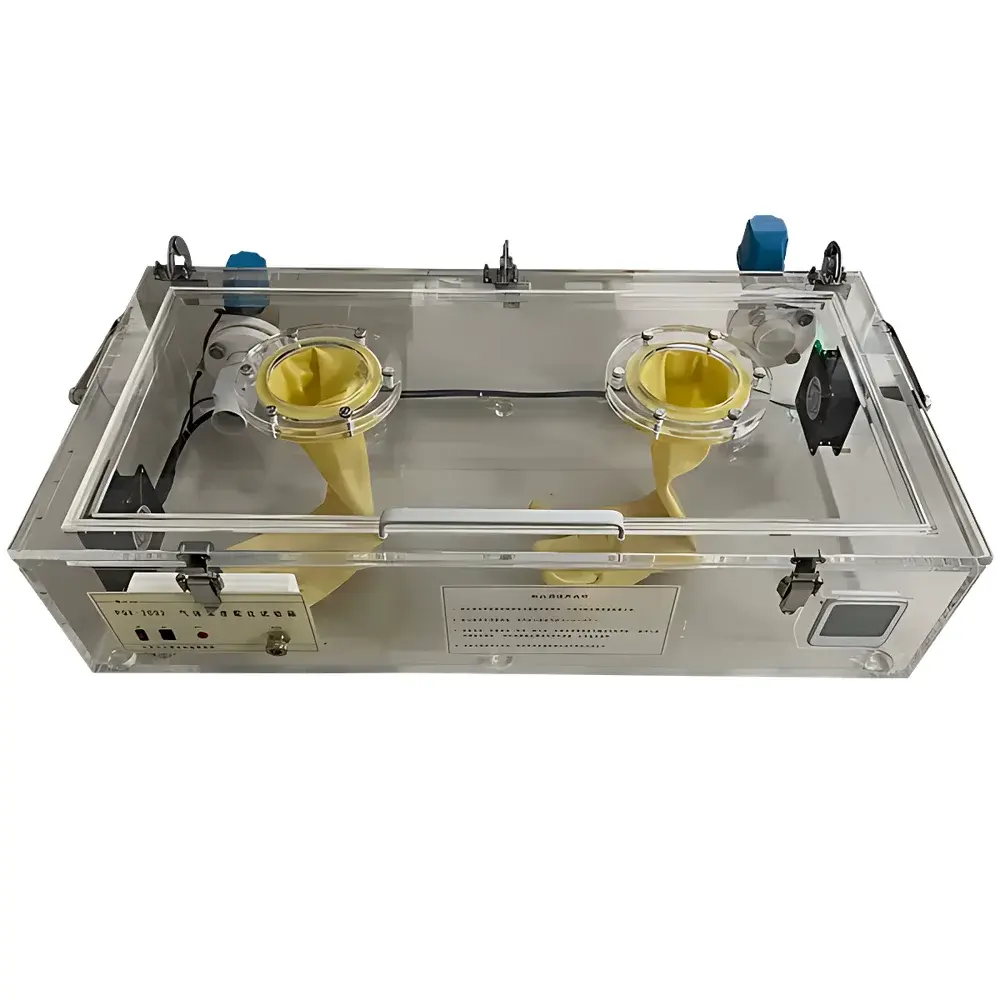
Gas Mixing Calibration Chamber PQX-2002 by Junfang Physical & Chemical
| Brand | Junfang Physical & Chemical |
|---|---|
| Model | PQX-2002 |
| Chamber Volume Options | 25 L, 50 L, 100 L (custom sizes available) |
| Dimensions (L×W×H) | 470×335×207 mm / 670×470×207 mm / 1020×520×224 mm |
| Material | Optical-grade acrylic (PMMA) |
| Power Supply | AC 220 V, 50 Hz |
| Integrated Features | Digital温-humidity display, internal fan-assisted homogenization, pure gas inlet ports, exhaust valve, glove ports (built-in rubber gloves), analytical instrument interface ports |
| Compliance | Designed to meet GB 15322–2019 requirements for alarm activation value testing of combustible and toxic gas detectors |
Overview
The PQX-2002 Gas Mixing Calibration Chamber is an engineered enclosure system designed specifically for the functional verification, calibration, and performance validation of fixed and portable gas detection instruments—including combustible gas sensors (e.g., catalytic bead, infrared), electrochemical toxic gas sensors (e.g., CO, H₂S, NO₂), and semiconductor-based detectors. Operating on the principle of controlled volume-based gas dilution, the chamber enables precise, repeatable generation of target gas concentrations within a sealed, homogeneous environment. Unlike flow-based dynamic dilution systems, the PQX-2002 relies on static volumetric mixing—where certified standard gases are introduced into a known-volume chamber, followed by mechanical homogenization via integrated axial fans—to achieve stable, traceable concentration levels suitable for alarm threshold verification per GB 15322–2019. Its optical-grade acrylic construction ensures full visual access while maintaining structural integrity and chemical resistance against common calibration gases (e.g., CH₄, CO, H₂, NH₃). The chamber is not a gas analyzer itself but serves as a metrologically sound platform for sensor response characterization under defined environmental conditions.
Key Features
- Three standardized internal volumes (25 L, 50 L, 100 L) with fully customizable configurations to accommodate diverse detector form factors—from compact personal monitors to large-area fixed transmitters.
- Dual digital display panel showing real-time ambient temperature and relative humidity—critical parameters influencing sensor baseline stability and alarm response latency.
- Integrated high-efficiency axial fan system ensuring rapid (< 90 s) and uniform gas distribution throughout the chamber volume, minimizing stratification and concentration gradients.
- Dedicated gas inlet ports compatible with standard CGA-320/CGA-660 fittings for seamless connection to certified gas cylinders or gas delivery modules; independent exhaust valve with adjustable flow control for safe venting.
- Front-mounted pair of built-in nitrile rubber gloves (EN 374-compliant), enabling hands-on manipulation of detectors during calibration without compromising chamber integrity or operator safety.
- Modular electrical interface panel with AC 220 V, 50 Hz internal busbar—providing power to connected analyzers, data loggers, or auxiliary instrumentation without external extension cords.
Sample Compatibility & Compliance
The PQX-2002 supports calibration of single- and multi-gas detectors across Class I (flammable gases), Class II (toxic gases), and hybrid configurations. Its design aligns with the test methodology specified in Clause 6.3 of GB 15322.1–2019 (“General Requirements for Combustible Gas Detectors”) and GB 15322.2–2019 (“Requirements for Independent Type Detectors”), particularly for alarm activation value testing at 25% and 50% LEL (for combustibles) or TWA/STEL thresholds (for toxics). While not certified to ISO/IEC 17025 as a standalone calibration laboratory, the chamber provides a validated physical environment suitable for in-house QA/QC procedures under GLP-aligned workflows. All acrylic components comply with ASTM D542 for refractive index consistency and UL 94 HB for flame retardancy. Sealing integrity is verified via helium leak testing (< 1 × 10⁻⁶ mbar·L/s) prior to shipment.
Software & Data Management
The PQX-2002 operates as a hardware platform without embedded firmware or proprietary software. It interfaces transparently with third-party gas analyzers (e.g., Thermo Fisher iQ Series, Siemens Ultramat, or ABB AO2020) via analog 4–20 mA or digital RS-485 outputs. Users may integrate chamber operation into existing LIMS or calibration management systems using standard Modbus RTU or OPC UA protocols—enabling timestamped logging of temperature, humidity, gas injection timing, and analyzer readings. For audit readiness, laboratories routinely configure external data acquisition units to record all operational events with NIST-traceable timestamps, satisfying documentation requirements under ISO/IEC 17025 Clause 7.7 and supporting FDA 21 CFR Part 11 compliance when paired with electronic signature-capable software.
Applications
- Factory acceptance testing (FAT) of newly manufactured gas detectors prior to shipment.
- Routine field calibration verification for maintenance technicians servicing industrial safety systems.
- Research and development of novel sensor architectures requiring controlled exposure profiles (e.g., pulsed gas dosing, humidity-coupled response mapping).
- Training environments for emergency response teams practicing detector interpretation under reproducible gas challenge conditions.
- Third-party certification labs performing conformity assessments against GB, EN 45544, or IEC 60079-29-1 standards.
FAQ
Can the PQX-2002 be used for calibrating oxygen deficiency monitors?
Yes—when configured with certified N₂ or Ar zero gas and appropriate pressure regulation, it supports O₂ depletion testing per ISO 8573-7 and GB/T 20001.4.
Is the acrylic chamber resistant to chlorine or hydrogen sulfide exposure?
Optical PMMA exhibits good resistance to H₂S at typical calibration concentrations ( 1 ppm may cause surface haze. We recommend post-test purging with dry air and periodic inspection.
Does the unit include traceable calibration certificates for its internal sensors?
Temperature and humidity sensors are pre-calibrated at the factory against NIST-traceable references; full calibration certificates (per ISO/IEC 17025) are available as an optional add-on service.
What safety interlocks are integrated?
The PQX-2002 does not incorporate active safety interlocks; users must implement external gas shutoff valves and ventilation monitoring per local occupational health regulations (e.g., OSHA 1910.120, GBZ 2.1–2019).
Can custom port layouts or additional viewing windows be added?
Yes—Junfang offers OEM engineering support for mechanical modifications, including reinforced mounting flanges, optical-grade quartz viewports, or vacuum-rated feedthroughs for specialized R&D applications.
Related Products







