
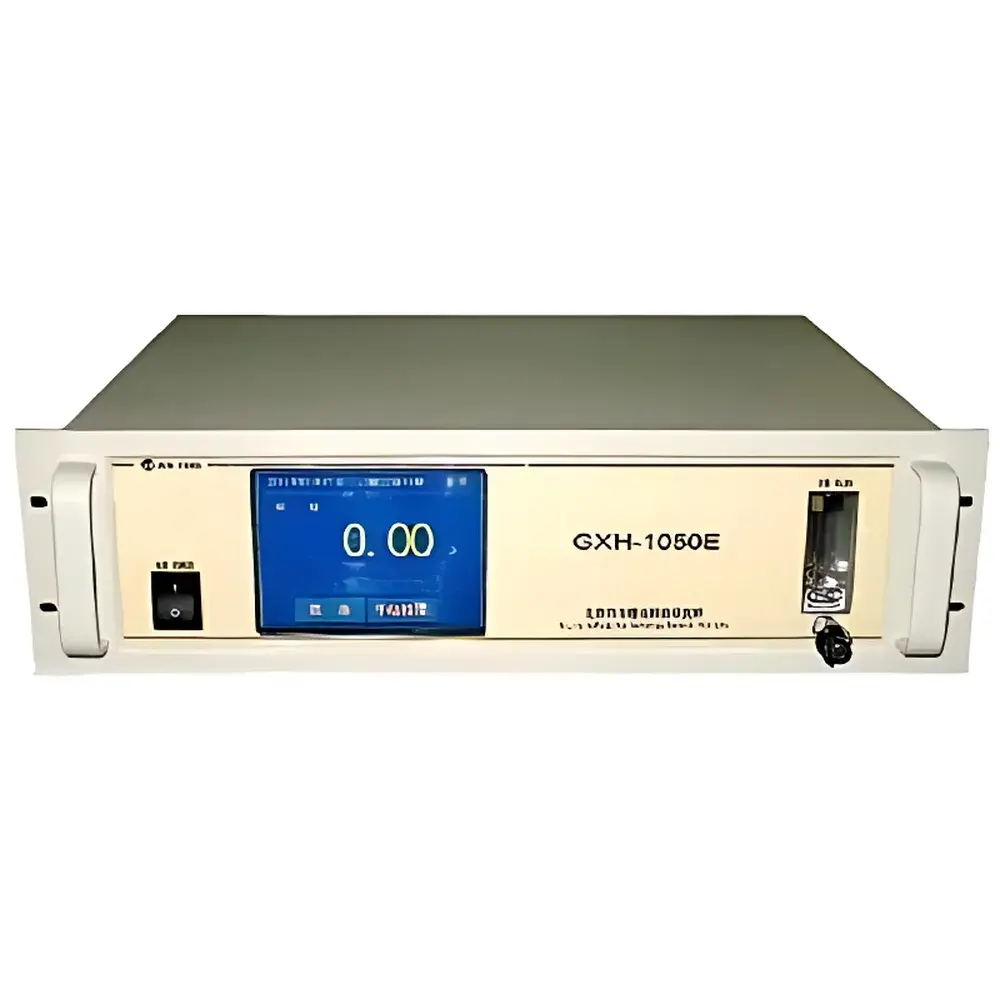
English Product Name
| Brand | Junfang Lihua |
|---|---|
| Origin | Beijing, China |
| Manufacturer Type | Authorized Distributor |
| Country of Origin | China |
| Model | GXH-1050E |
| Instrument Type | Online Process Analyzer |
| Detection Target | Multi-component Gases |
| Minimum Range | 0–50 ppm |
| Repeatability | ≤1% F.S. |
| Resolution | 0.1 ppm |
| Response Time | ≤60 s |
| Zero Drift | ≤±2% F.S./24 h |
| Span Drift | ≤±2% F.S./24 h |
| Linearity Error | ≤±1% F.S. |
| Power Supply | AC 220 V ±10%, 50 Hz ±5% |
| Output Signal | 4–20 mA analog + RS232 digital interface |
| Operating Humidity | ≤90% RH (non-condensing) |
| Warm-up Time | ≤60 min |
Overview
The Junfang Lihua GXH-1050E Multi-Component Intelligent Gas Analyzer is an online process gas analysis system engineered for continuous, real-time quantification of up to four gaseous components in complex industrial and environmental matrices. Its core measurement architecture integrates non-dispersive infrared (NDIR) spectroscopy as the primary detection principle—optimized for CO, CO₂, CH₄, C₃H₈, and other hydrocarbons with strong IR absorption bands in the 2–14 µm range. For complementary species not amenable to NDIR—including O₂, H₂, H₂S, SO₂, NH₃, and CO at sub-ppm levels—the instrument supports modular sensor integration using electrochemical (EC), thermal conductivity (TCD), and fluorescence-based detection modules. This hybrid analytical approach ensures broad spectral coverage while maintaining selectivity, minimizing cross-sensitivity from matrix interferences such as water vapor or particulate-laden streams. Designed for unattended operation in demanding environments—including stack emissions monitoring, biogas upgrading, laboratory emission studies, soil respiration assays, and catalytic reaction effluent analysis—the GXH-1050E complies with key methodological requirements outlined in GB/T 16157, HJ 75–2017, and HJ 76–2017 for stationary source flue gas monitoring in China, and aligns with functional equivalency to ASTM D6522 (for NOₓ/CO/CO₂ in combustion gases) and ISO 12039 (for CO/CO₂ in flue gases). Its embedded sampling pump, internal thermostatic control (±0.1 °C stability), and sealed optical path ensure long-term baseline integrity under variable ambient conditions.
Key Features
- Modular multi-principle detection platform: NDIR (primary), electrochemical, thermal conductivity, and fluorescence sensors—configurable per application-specific gas panel
- Embedded diaphragm sampling pump with adjustable flow rate (0.5–2.0 L/min) and integrated particulate filter and moisture trap
- High-stability optical bench with temperature-controlled NDIR detector and dual-beam referencing to suppress thermal drift
- Touchscreen LCD interface (7-inch, 800×480 resolution) supporting multilingual UI, real-time concentration plots, and alarm threshold configuration
- Auto-zero and span calibration routines with programmable schedule; optional external zero/span gas valve manifold support
- Ruggedized 19-inch rack-mount chassis (4U height) with IP54-rated front panel; operating temperature range: 0–40 °C
- Dual-output architecture: isolated 4–20 mA analog channels (per measured component) + full-duplex RS232 serial port for ASCII protocol communication
Sample Compatibility & Compliance
The GXH-1050E accommodates a wide range of sample matrices without preconditioning in most applications: ambient air, flue gas (diluted or conditioned), biogas (up to 40% CO₂, <1000 ppm H₂S), fermentation headspace, soil gas extracts, and catalytic reactor effluents. Sample inlet pressure tolerance: −5 to +5 kPa gauge; maximum particulate loading: <1 mg/m³; dew point must remain below 5 °C to prevent condensation in the optical cell. The analyzer meets electromagnetic compatibility requirements per GB/T 18268.1–2010 (IEC 61326-1) and safety standards per GB 4793.1–2007 (IEC 61010-1). While not certified for hazardous area installation (e.g., ATEX/IECEx), it is routinely deployed in Zone 2/Class I Div 2 environments when installed with appropriate barrier systems. Data integrity protocols support audit-ready operation under GLP and ISO/IEC 17025 frameworks, including timestamped event logging and user-access-level controls.
Software & Data Management
The GXH-1050E includes PC-based configuration and data acquisition software compatible with Windows 10/11 (64-bit). The software enables remote parameter setup, real-time trend visualization (with overlay of multiple components), batch export to CSV or Excel, and automated report generation per GB/T 24001–2016 environmental management requirements. All calibration events, alarm triggers, and system diagnostics are stored with UTC timestamps and user ID tags—supporting traceability for regulatory submissions. Raw sensor outputs and processed concentration values are logged at user-selectable intervals (1 s to 1 h); onboard memory retains ≥30 days of data at 1-minute intervals. The RS232 interface supports Modbus RTU protocol for seamless integration into SCADA or DCS platforms. Audit trail functionality satisfies documentation expectations aligned with FDA 21 CFR Part 11 principles—though formal electronic signature validation requires third-party middleware.
Applications
- Continuous emissions monitoring (CEMS) of CO, CO₂, and CH₄ from coal-fired boilers, waste incinerators, and cement kilns
- Biogas quality control in anaerobic digestion plants—tracking CH₄/CO₂ ratio, H₂S scavenging efficiency, and O₂ ingress
- Soil carbon flux studies via closed-chamber gas exchange measurements (CO₂, CH₄, N₂O via optional EC module)
- Pharmaceutical cleanroom environmental monitoring—real-time CO and CO₂ tracking for HVAC validation
- Automotive exhaust gas analysis during engine dynamometer testing (CO, CO₂, HC, O₂)
- Plant physiology research: leaf-level photosynthetic gas exchange (CO₂ uptake, O₂ evolution) and root-zone respiration profiling
FAQ
Can the GXH-1050E measure more than four gases simultaneously?
No—the hardware architecture supports up to four independent detection modules concurrently. Additional gases require sequential measurement or external multiplexer integration.
Is factory calibration traceable to NIST or CNAS standards?
Calibration certificates reference traceability to national primary standards maintained by the China National Institute of Metrology (CNIM); NIST-traceable gas standards can be used during field calibration upon request.
Does the instrument support automatic temperature and pressure compensation?
Yes—integrated Pt100 RTD and piezoresistive pressure sensor enable real-time correction of concentration values per ideal gas law, critical for stack gas applications.
What maintenance intervals are recommended for routine operation?
Optical path cleaning every 6 months; electrochemical sensor replacement every 12–18 months; annual verification of zero/span drift against certified gas standards.
Can raw spectral data from the NDIR module be exported?
No—the NDIR firmware performs on-board absorbance-to-concentration conversion; only calibrated concentration values and diagnostic parameters are accessible via RS232 or analog output.







