
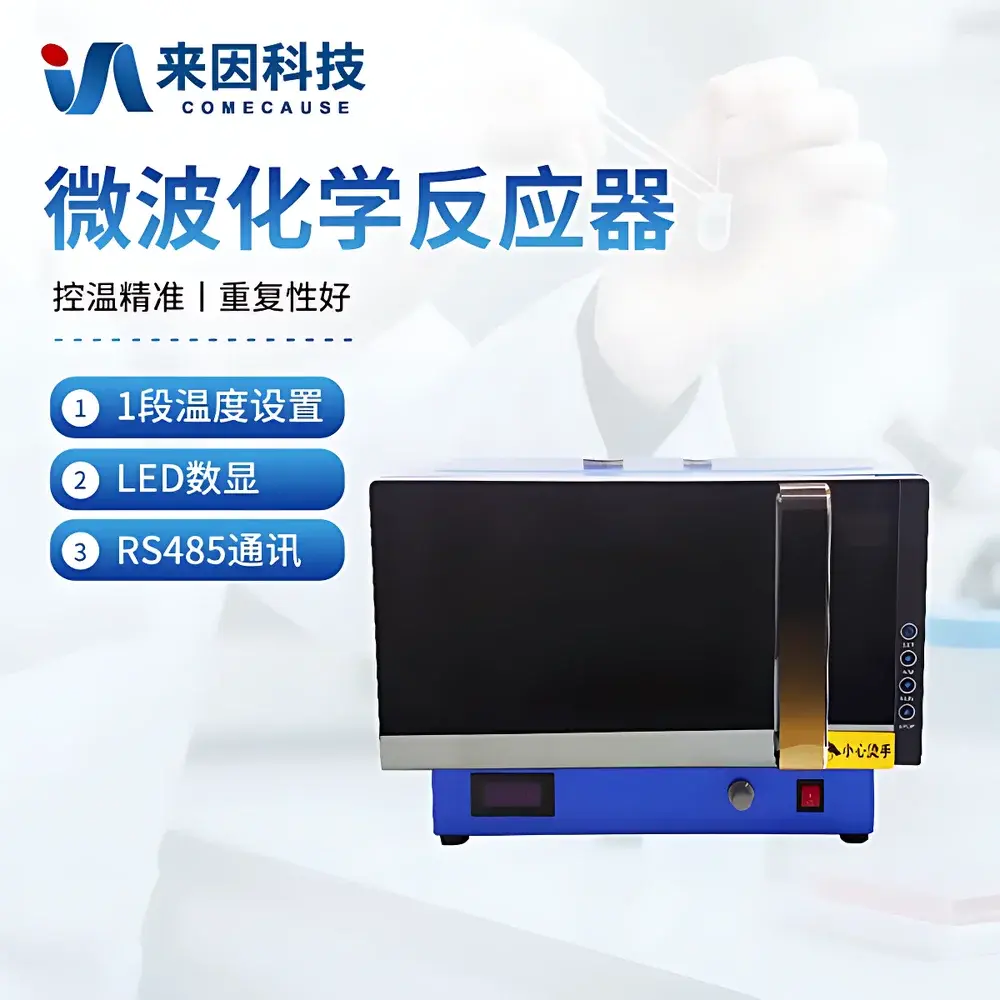
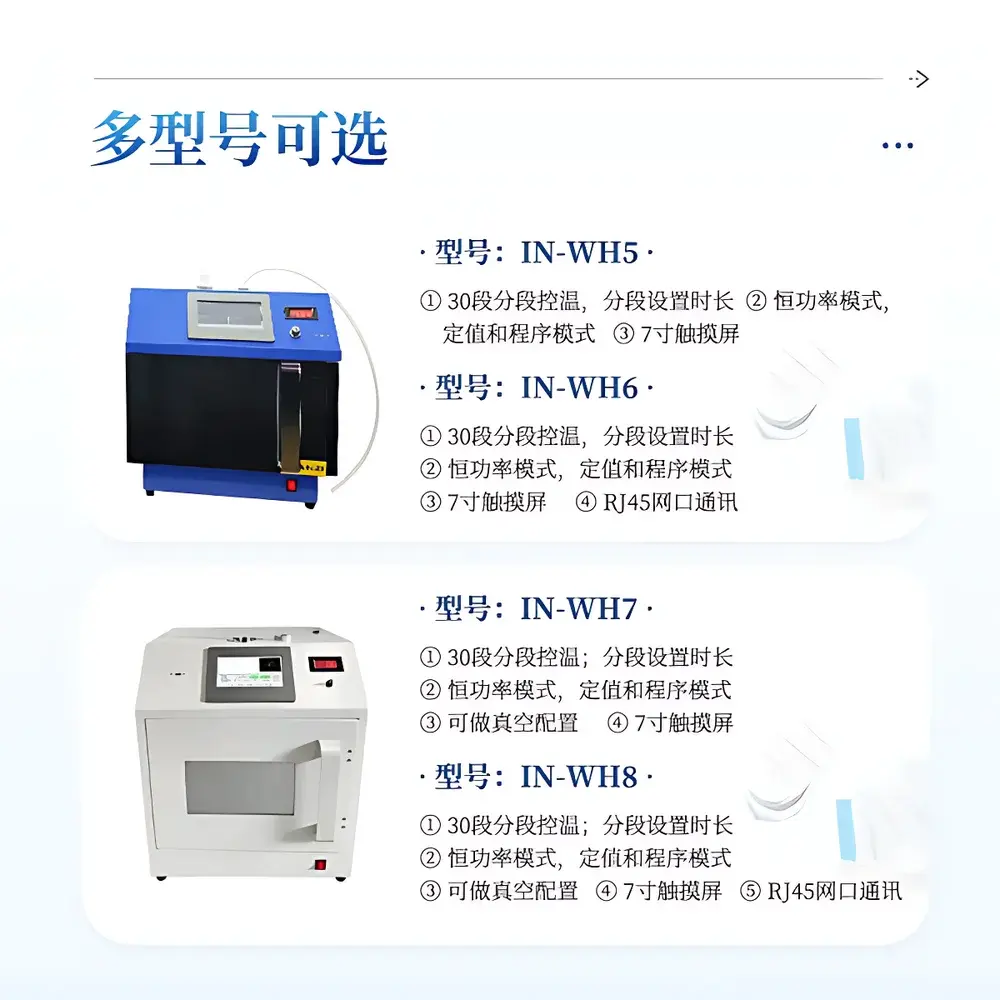
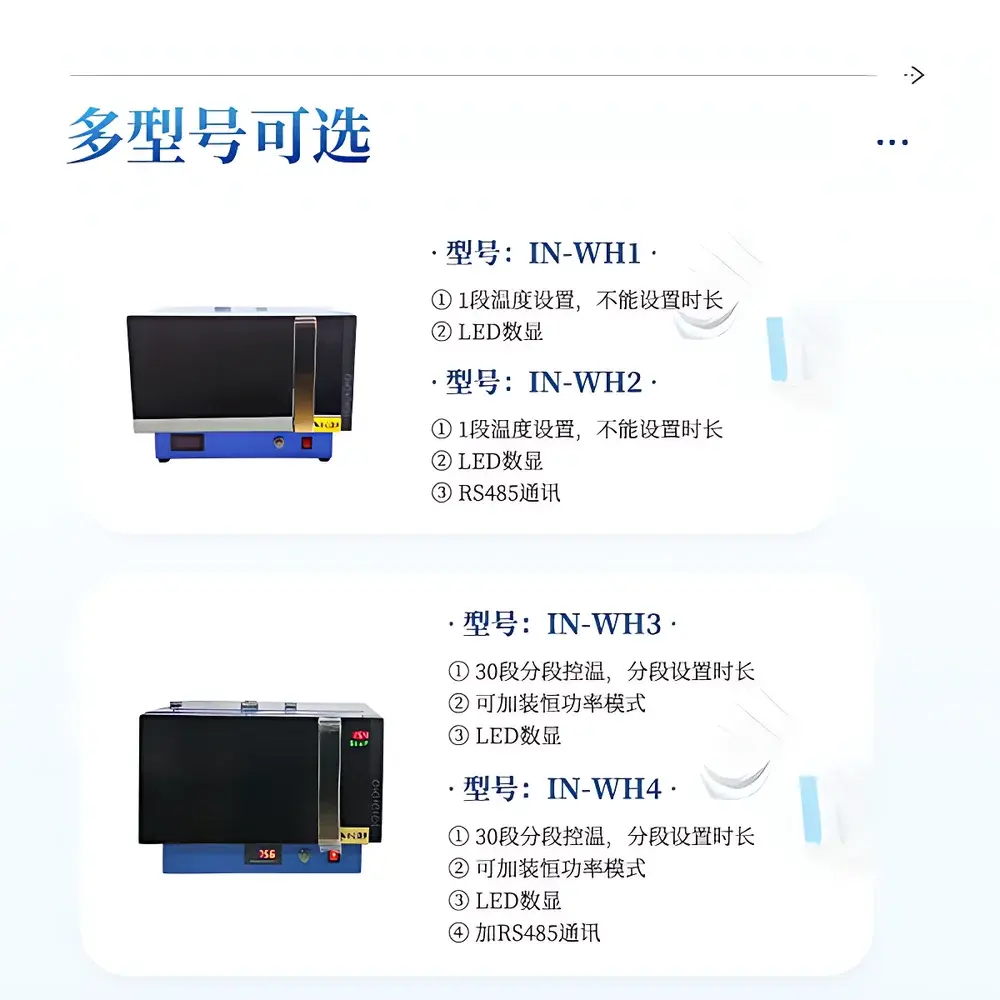
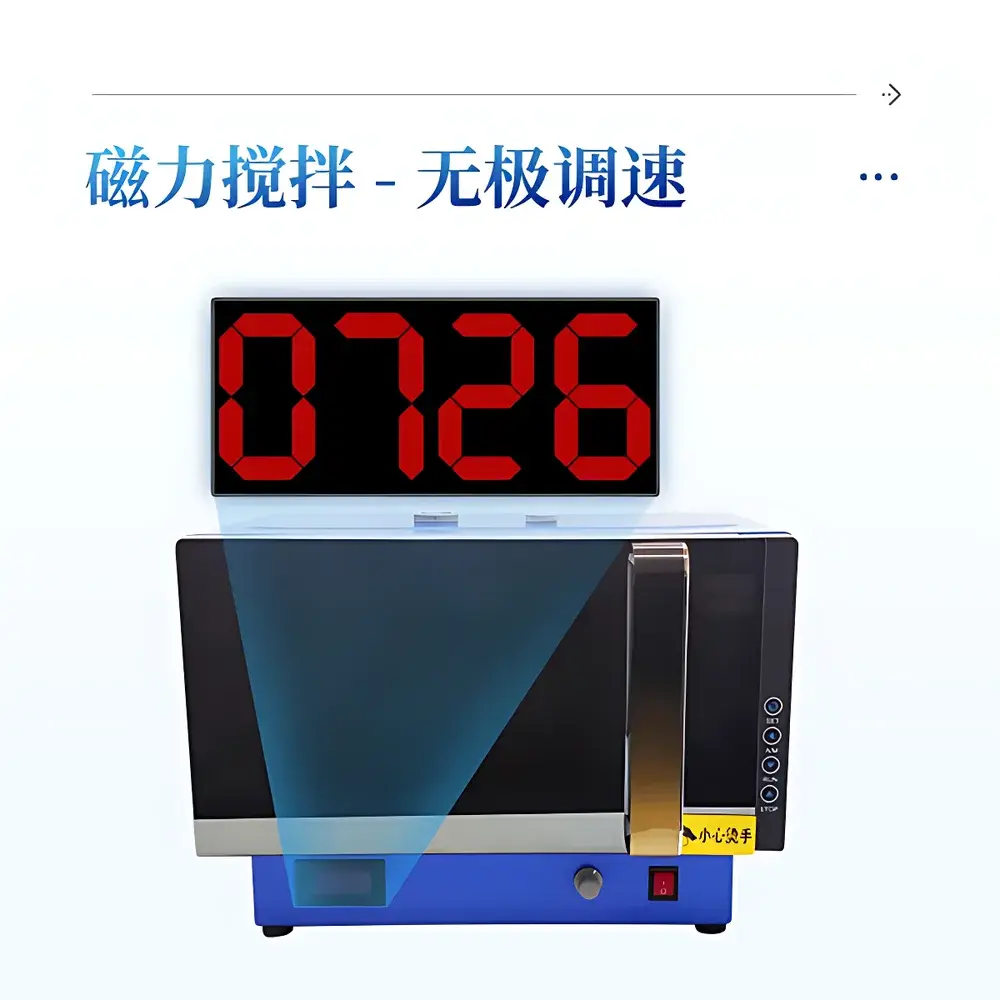
COMECAUSE IN-WH2 Microwave-Assisted Synthesis Reactor with Magnetic Stirring
| Brand | COMECAUSE |
|---|---|
| Origin | Shandong, China |
| Manufacturer Type | Direct Manufacturer |
| Model | IN-WH2 |
| Temperature Range | Ambient to 250 °C (digital display) |
| Pressure Range | Not specified in base data |
| Microwave Power | ≤900 W (0–900 W continuous automatic frequency-variable control) |
| Magnetron Frequency | 2450 MHz ± 50 Hz |
| Stirring Method | Magnetic stirring |
| Reaction Vessel Capacity | 100–500 mL |
| Input Power | 1350 W |
| Power Supply | AC 220 V ± 10%, 50 Hz |
| Temperature Resolution | 0.1 °C |
| Temperature Control Accuracy | ±1 °C (±0.5 °C under steady-state conditions) |
| Stirring Speed | 0–2000 rpm (digital display) |
| Internal Cavity Dimensions | 352 × 325 × 202 mm (L×W×H) |
| Overall Dimensions | 500 × 420 × 400 mm (L×W×H) |
| Communication Interface | RS485 |
| Interior Material | Cold-rolled steel with black nano-silver anti-corrosion coating |
| Safety Features | Overcurrent protection, magnetron overheat protection, interlocked door switch (power cutoff upon opening) |
Overview
The COMECAUSE IN-WH2 Microwave-Assisted Synthesis Reactor is an engineered platform for controlled, energy-efficient chemical synthesis under microwave irradiation. It operates on the principle of dielectric heating—where polar molecules and ionic species absorb electromagnetic energy at 2450 MHz, inducing rapid molecular rotation and frictional heat generation directly within the reaction matrix. Unlike conventional conductive heating, this volumetric energy transfer enables faster thermal equilibration, reduced thermal gradients, and improved reaction kinetics. Designed for laboratory-scale organic, inorganic, and materials synthesis, the IN-WH2 integrates real-time temperature feedback, variable-frequency microwave power modulation, and precision magnetic stirring to support reproducible, scalable reaction development. Its open-vessel architecture accommodates standard ground-glass jointed reactors (100–500 mL), enabling flexible integration of reflux condensers, addition funnels, gas inlets (e.g., N₂ or Ar), and phase-separation accessories—making it suitable for both exploratory screening and method-optimized synthesis workflows.
Key Features
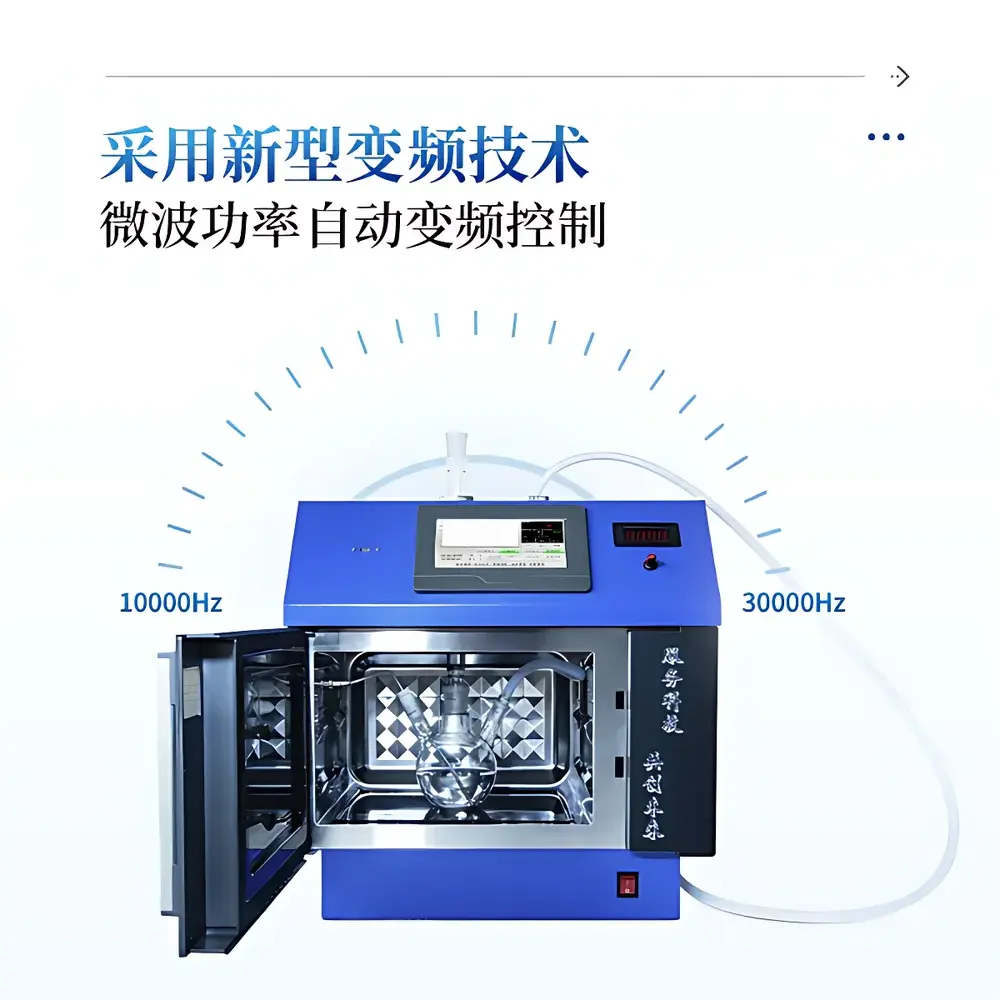
- Variable-Frequency Microwave Power Control: Replaces legacy high-voltage transformer architectures with a solid-state frequency converter (10–30 kHz output range), eliminating voltage spikes and extending magnetron service life. An embedded MCU executes adaptive PID algorithms using real-time Pt100 temperature data, reaction medium polarity estimates, and thermal mass modeling to dynamically regulate microwave output—enabling stable, low-power irradiation (down to single-digit watt levels) without duty-cycle interruption.
- Digital Precision Temperature Monitoring: High-resolution (0.1 °C) digital readout with ±1 °C accuracy across ambient to 250 °C; achieves ±0.5 °C stability during isothermal operation. Sensor placement ensures representative cavity-averaged measurement, minimizing localized hot-spot bias.
- High-Temperature Magnetic Stirring: Integrated bottom-mounted stirrer employs SmCo rare-earth magnets rated for continuous operation up to 350 °C, ensuring torque retention and non-magnetic degradation under prolonged thermal stress. Speed is continuously adjustable from 0–2000 rpm with digital feedback.
- Modular Open-System Design: No fixed cavity insert—users install standard ISO/KG/NS ground-glass vessels (e.g., 100 mL round-bottom flasks to 500 mL multi-neck reactors). Compatible with external cooling jackets, inert gas manifolds, syringe pumps, and Dean-Stark traps via standardized ports.
- Robust Safety Architecture: Dual redundant safety interlocks ensure immediate microwave cutoff when the door is unlatched. Additional protections include magnetron overtemperature cutoff, input overcurrent detection, and fail-safe thermal fusing of internal electronics.
Sample Compatibility & Compliance
The IN-WH2 supports heterogeneous and homogeneous reaction mixtures in solvents ranging from low-polarity hydrocarbons (e.g., toluene, xylene) to highly polar media (e.g., DMF, ethylene glycol, aqueous acids/bases). Its pressure-unrated open-system configuration complies with standard laboratory safety protocols for atmospheric-pressure synthesis—eliminating the need for pressure certification per ASME BPVC Section VIII or PED 2014/68/EU. While not intrinsically rated for GLP/GMP environments, its RS485 interface allows integration into validated lab networks supporting ASTM E2500-13 (verification of laboratory equipment) and FDA 21 CFR Part 11–compliant data acquisition systems when paired with compliant software. The nano-silver coated interior resists corrosion from halogenated, acidic, and oxidizing reagents common in cross-coupling, esterification, and nanoparticle synthesis protocols.
Software & Data Management
The IN-WH2 operates as a standalone instrument with front-panel digital controls and does not include proprietary PC software. However, its RS485 serial interface supports third-party SCADA or LIMS integration via Modbus RTU protocol. Users may log temperature, stir speed, and elapsed time using external data loggers compatible with ASCII-based serial output. For audit-trail compliance, timestamped parameter records can be exported to CSV or Excel formats. Firmware-level logging (non-volatile memory) retains last-run settings and fault codes for troubleshooting—facilitating root-cause analysis during QA/QC investigations or equipment qualification (IQ/OQ/PQ).
Applications
- Organic synthesis: Suzuki, Heck, and Buchwald–Hartwig couplings; heterocycle formation; esterifications and amidations under mild thermal profiles.
- Inorganic and nanomaterial preparation: Solvothermal synthesis of metal oxides (e.g., TiO₂, ZnO), perovskites, and MOFs where rapid nucleation kinetics benefit from uniform microwave heating.
- Pharmaceutical process development: Rapid screening of solvent effects, catalyst loading, and stoichiometric ratios in API intermediate synthesis—reducing development timelines versus oil-bath methods.
- Green chemistry optimization: Reduction of reaction times by 50–90% compared to conventional reflux, lowering cumulative energy demand and solvent consumption per mole of product.
- Teaching laboratories: Demonstrating kinetic isotope effects, Arrhenius parameter determination, and microwave-specific mechanistic pathways (e.g., “specific microwave effects” vs. thermal-only acceleration).
FAQ
Is the IN-WH2 certified for use in regulated GMP environments?
No—its design follows general laboratory safety standards (IEC 61000-6-3, IEC 61000-6-4) but lacks formal 21 CFR Part 11 validation documentation or GMP-compliant firmware audit trails. Integration into regulated workflows requires third-party validation and procedural controls.
Can the reactor accommodate sealed vessels or high-pressure reactions?
No—the IN-WH2 is strictly configured for open, atmospheric-pressure operation. Sealed-vessel or high-pressure synthesis requires dedicated pressurized microwave reactors with reinforced cavities and pressure-rated vessels.
What maintenance is required to sustain long-term calibration stability?
Annual verification of Pt100 sensor accuracy against NIST-traceable reference thermometers is recommended. Clean interior surfaces with deionized water after each use; avoid abrasive or chlorinated cleaners that degrade the nano-silver coating. Inspect door gasket integrity quarterly and replace if compression set exceeds 20%.
Does the unit support external temperature probes for reaction mixture monitoring?
Yes—while the built-in Pt100 monitors cavity air temperature, users may insert calibrated fiber-optic or shielded thermocouple probes directly into the reaction vessel via optional septum ports or side-arm adapters.
Is ultrasonic assistance available as a factory option?
Ultrasonic transduction is listed as an optional upgrade per manufacturer documentation, but the base IN-WH2 model does not include piezoelectric transducers or associated generator hardware. Integration would require mechanical retrofitting and separate power/control interfaces.



