
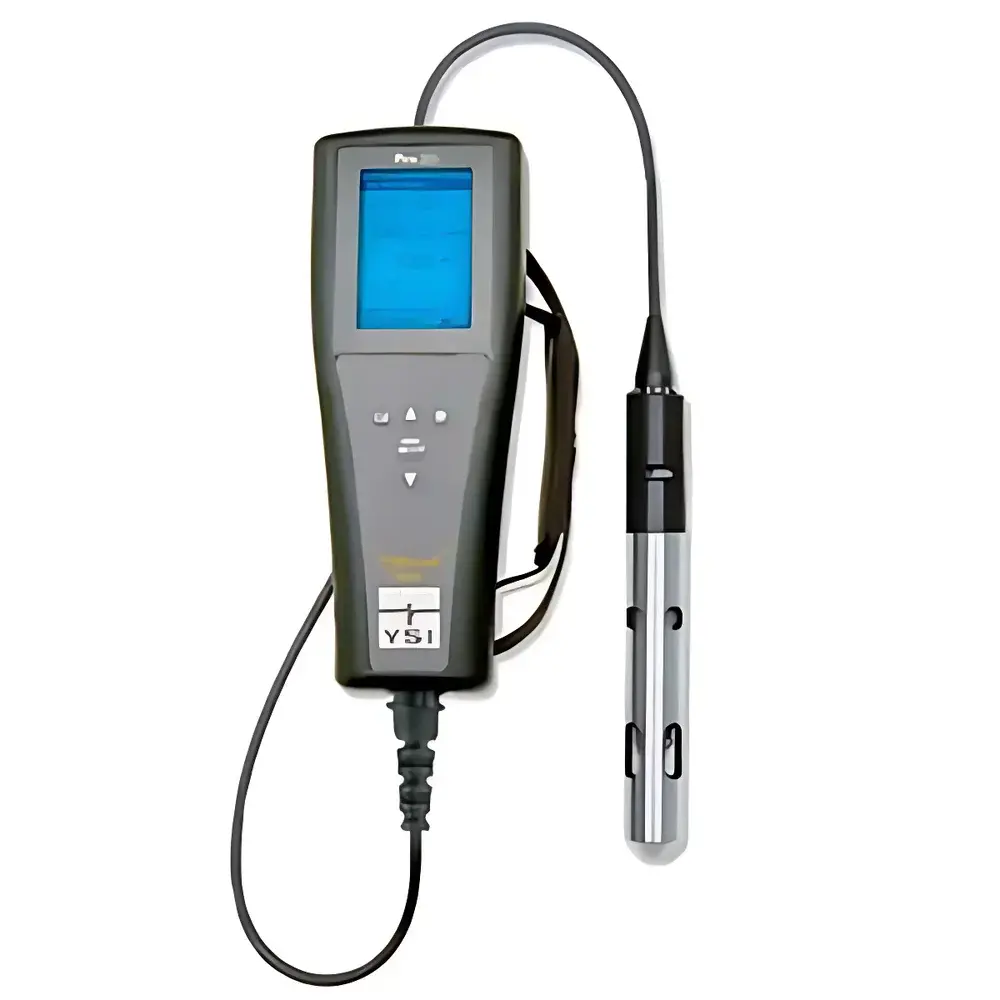
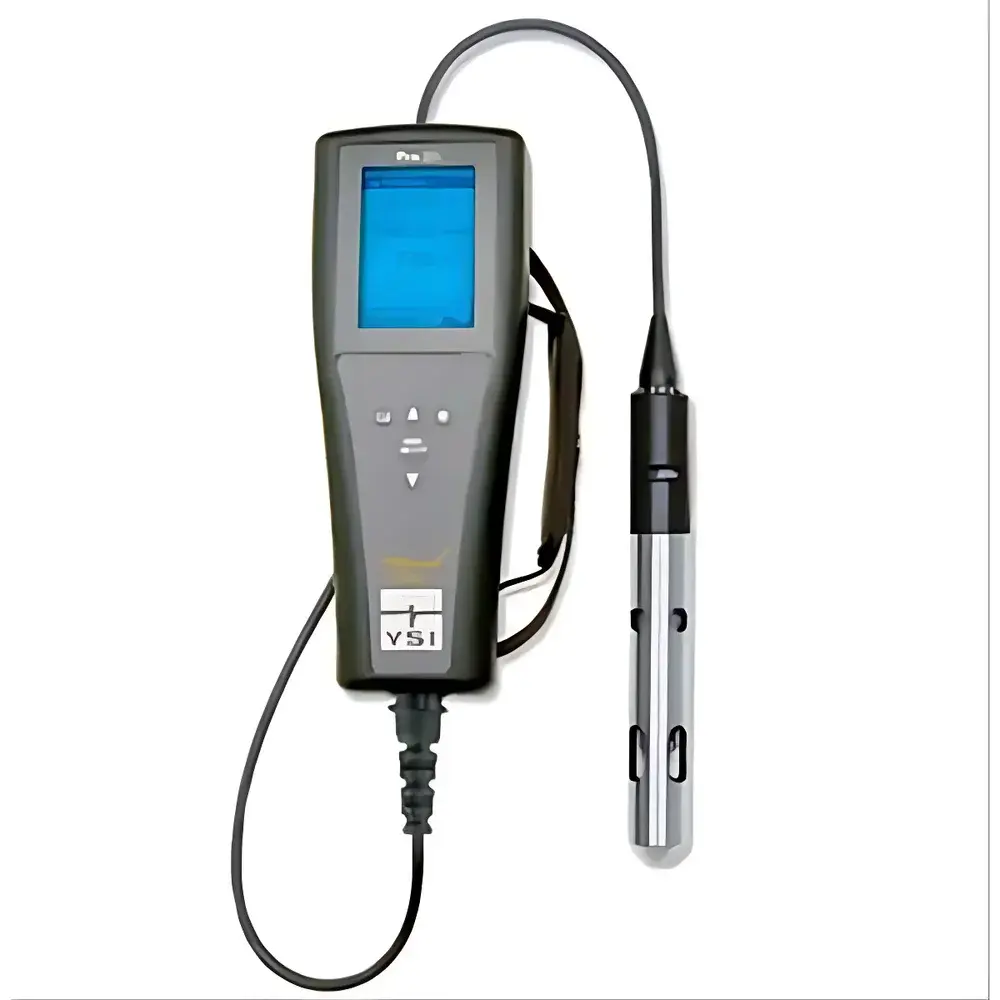
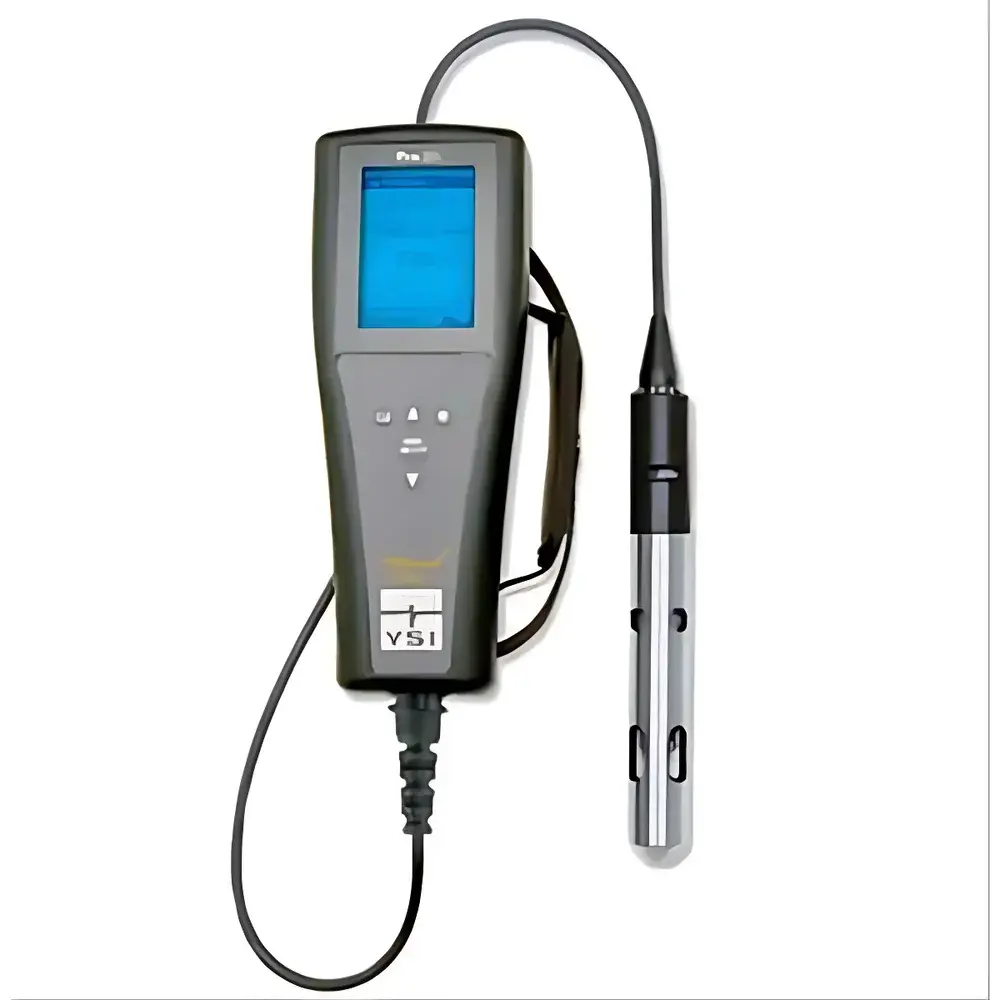
YSI PRO1020 Portable Multiparameter Water Quality Meter
| Brand | YSI |
|---|---|
| Origin | USA |
| Model | PRO1020 |
| Measurement Parameters | Temperature, pH, Dissolved Oxygen (DO) |
| DO Method | Polarographic (Clark-type) or Galvanic Cell (user-selectable) |
| DO Range | 0–50 mg/L (0–500% air saturation) |
| pH Range | 0–14 |
| pH Resolution | 0.01 |
| pH Accuracy | ±0.2 |
| Temperature Range | –5 to +55 °C |
| Temperature Accuracy | ±0.2 °C |
| ORP Range | –1500 to +1500 mV |
| ORP Accuracy | ±20 mV |
| DO Resolution | 0.01 or 0.1 mg/L (selectable) |
| DO Accuracy | ±2% or ±0.2 mg/L (0–20 mg/L), ±6% (20–50 mg/L) |
| Data Storage | 50 measurement sets |
| Display | Backlit LCD with dual backlight (screen + keypad) |
| Enclosure Rating | IP67 |
| Dimensions | 8.3 × 21.6 × 2.3 cm |
| Weight | 475 g (with batteries) |
| Power | Two AA alkaline batteries |
| Cable Options | 1 m / 4 m / 10 m / 20 m / 30 m detachable cables |
| Connector | MIL-spec waterproof quick-disconnect |
| Probe Housing | Stainless steel protective sleeve |
| Battery Compartment | Independently sealed from electronics |
| Bend Endurance | ≥300,000 cable flex cycles |
Overview
The YSI PRO1020 Portable Multiparameter Water Quality Meter is an engineered field-deployable instrument designed for simultaneous, real-time measurement of temperature, pH, dissolved oxygen (DO), and oxidation-reduction potential (ORP) in freshwater, estuarine, wastewater, and marine environments. It operates on electrochemical sensing principles: pH is measured via a glass electrode system compliant with ISO 7888 and ASTM D1293; DO employs either a polarographic (Clark-type) or galvanic cell sensor—both conforming to ISO 5814 and ASTM D888—enabling user-selectable method alignment with regulatory or method-specific requirements. Temperature compensation is automatic and integrated across all parameters, utilizing a high-stability NTC thermistor calibrated to NIST-traceable standards. The device’s architecture prioritizes operational integrity under variable environmental loads: its IP67-rated enclosure ensures dust-tightness and submersion resistance up to 1 meter for 30 minutes, while the physically isolated battery compartment prevents circuit compromise even if moisture ingress occurs.
Key Features
- Modular three-component design: independently replaceable probe, cable, and main unit—no tools required for field servicing.
- MIL-spec waterproof quick-disconnect connectors rated for ≥300,000 flex cycles, ensuring long-term mechanical reliability in repeated deployment scenarios.
- Dual backlighting system (LCD screen + keypad) optimized for low-light or nocturnal sampling operations.
- Ergonomic handheld form factor (8.3 × 21.6 × 2.3 cm; 475 g with batteries) designed for single-hand operation during boat-based or bank-side profiling.
- Stainless steel probe guard provides mechanical protection and facilitates vertical probe immersion without tipping or snagging.
- User-configurable DO measurement mode: selectable between polarographic (requiring warm-up and membrane replacement) and galvanic (zero warm-up, lower maintenance) sensor types.
- Internal barometric pressure sensor enables automatic altitude- and pressure-corrected DO saturation calculations per ISO 5814 Annex A.
Sample Compatibility & Compliance
The PRO1020 is validated for use with natural waters, treated effluents, groundwater, and surface runoff matrices. Its pH electrode complies with US EPA Method 150.1 and ISO 10523; DO measurements meet the performance criteria outlined in ASTM D888–22 (Standard Test Methods for Dissolved Oxygen in Water) and ISO 5814:2012. ORP readings adhere to ASTM D3693–21 for redox characterization in aquatic systems. While not intended for direct compliance with GLP or 21 CFR Part 11 out-of-the-box, raw data export (via optional IR interface or manual transcription) supports traceable recordkeeping in QA/QC workflows aligned with ISO/IEC 17025-accredited laboratories. The instrument’s calibration verification routines support documented two-point pH and DO calibration checks per standard operating procedures.
Software & Data Management
The PRO1020 stores up to 50 discrete measurement sets—including timestamp, parameter values, units, and operator notes—in non-volatile memory. Data retrieval is manual via on-device scrolling or export-ready transcription. Though it lacks onboard Bluetooth or USB connectivity, its stable analog output and standardized electrode interfaces allow integration into larger telemetry networks when paired with third-party data loggers. Firmware updates are supported via YSI-provided utility software and serial interface, enabling periodic alignment with evolving sensor calibration algorithms and regulatory interpretation guidelines. All stored records retain full metrological context: temperature-compensated DO values include both mg/L and % saturation outputs, while pH readings embed slope and offset diagnostics accessible during calibration review.
Applications
This instrument serves as a primary field tool for environmental monitoring programs conducted by municipal water utilities, academic limnology groups, regulatory agencies (e.g., state DEPs), and ecological consulting firms. Typical use cases include: longitudinal river health assessments (e.g., BOD correlation studies using DO depletion curves), wastewater treatment plant influent/effluent screening, stormwater outfall compliance verification, wetland restoration progress tracking, and aquaculture pond management. Its robust physical design and rapid parameter switching make it especially suitable for multi-site surveys where equipment portability, battery longevity (>100 hours typical), and minimal consumables (e.g., no reagents, infrequent membrane replacements) reduce logistical overhead.
FAQ
Does the PRO1020 support automatic temperature compensation for all measured parameters?
Yes—temperature is continuously monitored via an integrated NTC sensor and applied in real time to pH, DO, and ORP calculations per IUPAC and ISO-defined algorithms.
Can the DO sensor be calibrated in air-saturated water without a zero-oxygen standard?
Yes—the galvanic DO sensor allows one-point calibration at 100% air saturation using atmospheric equilibrium; the polarographic variant requires both zero and span calibration per ASTM D888 Section 9.3.
Is the PRO1020 suitable for saline or brackish water measurements?
It is validated for salinities up to 35 ppt; however, DO accuracy specifications assume freshwater matrix conditions—users should apply salinity correction factors per ISO 5814 Table 2 when reporting in marine environments.
What is the expected service life of the DO membrane and electrolyte?
For galvanic sensors: membranes last ≥12 months under routine use; for polarographic sensors: membranes require replacement every 2–3 months, and electrolyte refills every 4–6 weeks depending on deployment frequency.
How does the independent battery compartment enhance operational safety?
By fully isolating the battery cavity from the main PCB and sensor interface board, the design eliminates risk of short-circuiting or corrosion-induced failure—even after prolonged exposure to humid or flooded conditions.
Related Products







