
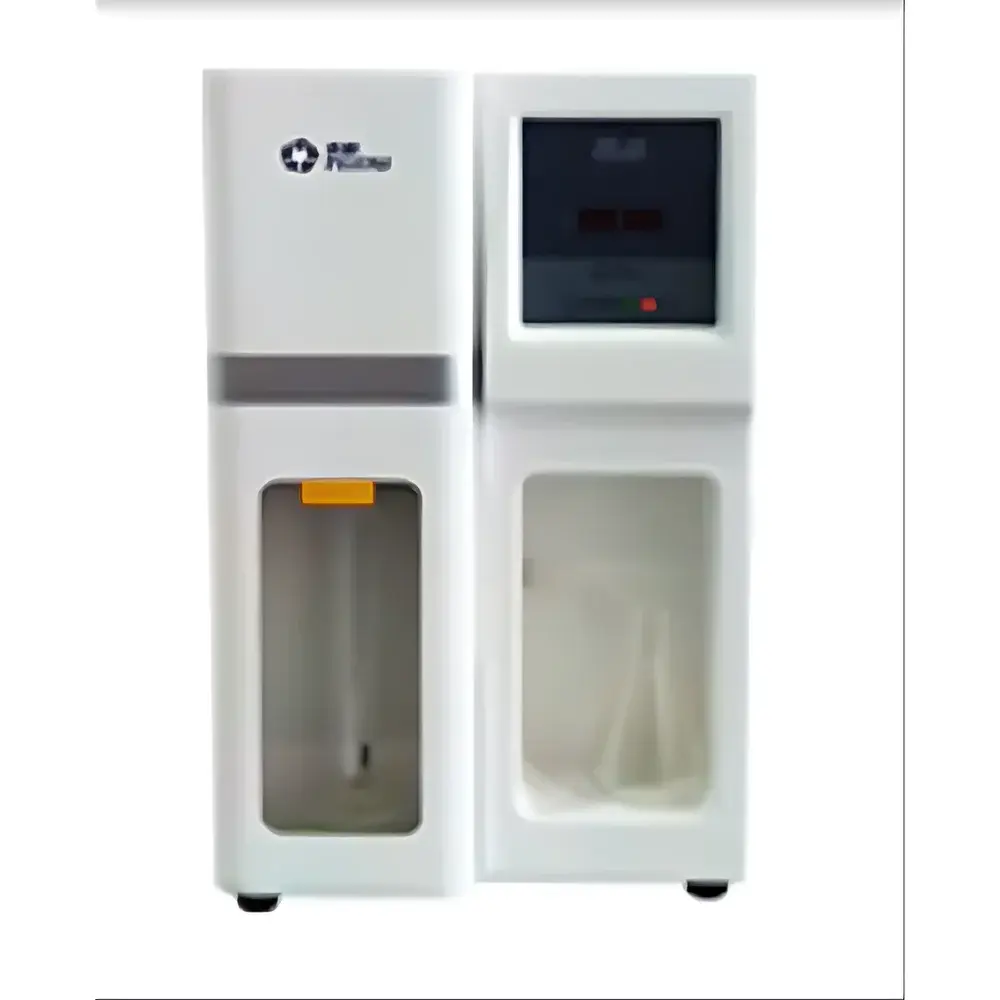
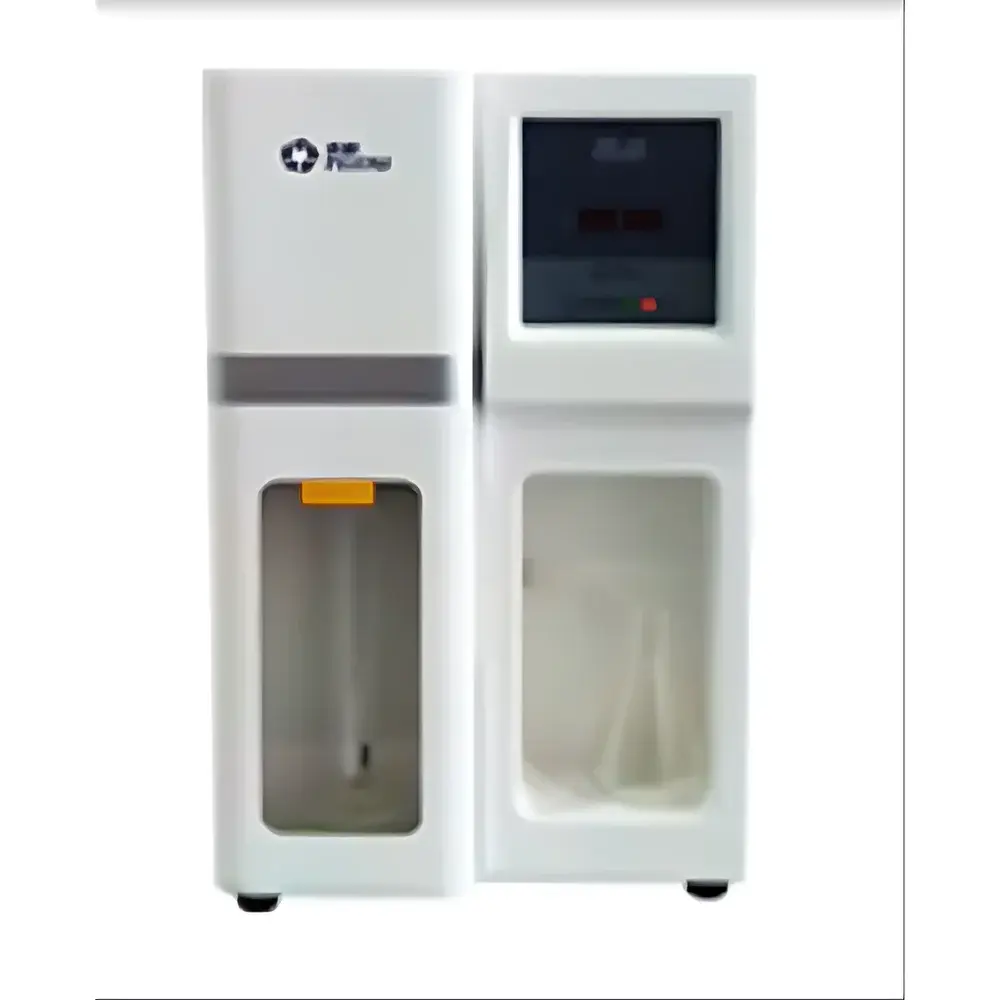
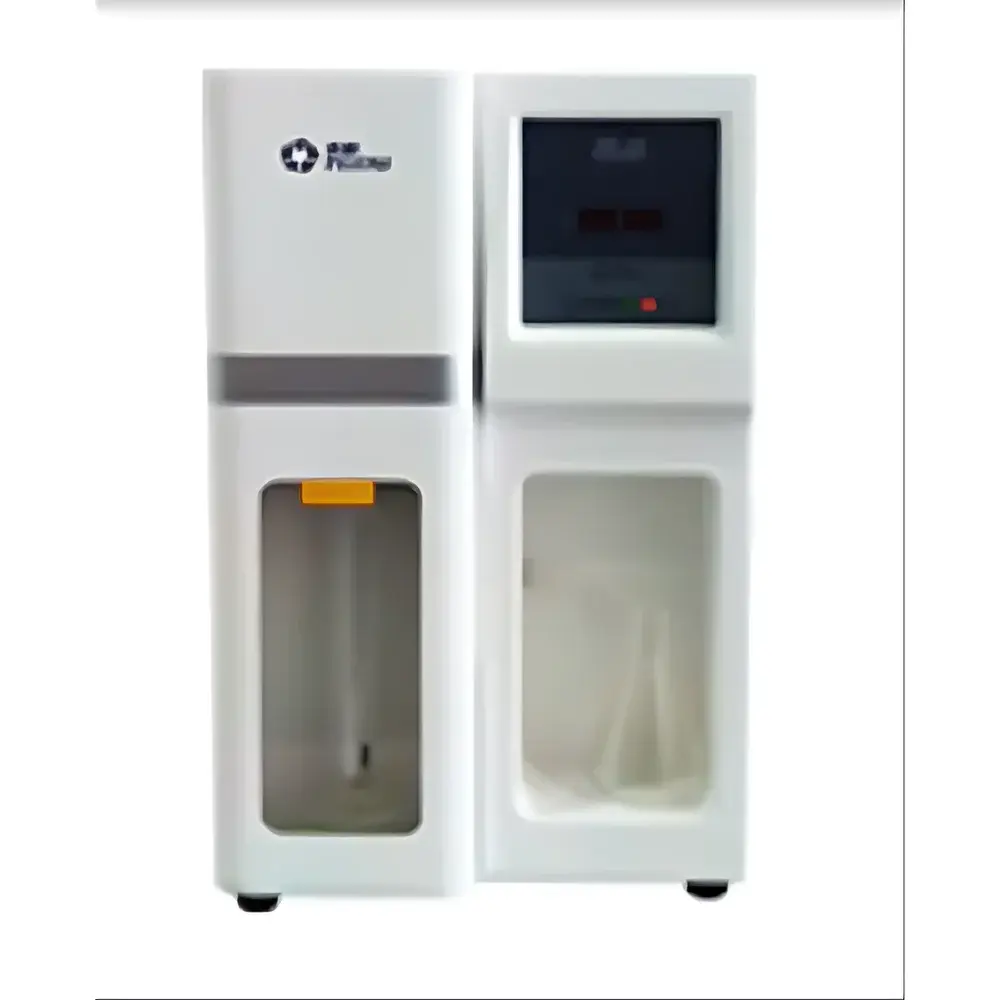
Peiou SKD-180 Volatile Basic Nitrogen (VBN) Distillation Apparatus
| Brand | Peiou |
|---|---|
| Origin | Shanghai, China |
| Model | SKD-180 |
| Heating Method | Electric (stainless steel heating element) |
| Cooling Method | Recirculating water cooling |
| Distillation Speed | 5–8 min per 250 mL sample |
| Warm-up Time | 10–15 min |
| Endpoint Control | Quantitative volume detection + automatic termination |
| Heating Power | Adjustable up to 1500 W |
| Distillation Flow Rate | 15–30 mL/min |
| Sample Capacity | ≤20 g (solid) or ≤30 mL (liquid) per run |
| Nitrogen Measurement Range | 0.1–240 mg N |
| Recovery Rate | >99.5% |
| Repeatability | RSD ≤0.5% |
| Data Storage | 10 programmable distillation/acid-addition protocols |
| Safety Features | Real-time liquid level monitoring, overpressure protection, dry-run prevention, emergency stop |
| Housing Material | Molded ABS engineering plastic (acid- and alkali-resistant) |
| Tubing | Custom corrosion-resistant polymer tubing (rated for long-term HCl/NaOH exposure) |
| Power Supply | AC 220 V ±10%, 50 Hz |
| Water Supply Requirement | ≥0.15 MPa pressure, inlet temperature <20 °C |
| Net Weight | 15 kg |
| Dimensions (W×D×H) | 370 × 300 × 680 mm |
Overview
The Peiou SKD-180 Volatile Basic Nitrogen (VBN) Distillation Apparatus is a fully automated benchtop system engineered for precise, reproducible quantification of volatile basic nitrogen in food, feed, seafood, dairy, and biological samples. It operates on the classical Kjeldahl distillation principle: after acid digestion (performed separately), the digestate is alkalized with sodium hydroxide, liberating ammonia from ammonium salts; the liberated NH3 is then steam-distilled into a standardized boric acid trapping solution and subsequently titrated. The SKD-180 integrates process control, endpoint detection, and safety interlocks into a single compact platform—designed for routine QC laboratories requiring high throughput, regulatory traceability, and minimal operator intervention.
Key Features
- Corrosion-resistant construction: One-piece molded ABS housing withstands prolonged exposure to concentrated HCl, NaOH, and acidic vapors—eliminating rust, electrical leakage, and structural degradation.
- Chemically inert fluid path: All internal tubing is custom-formulated polymer rated for continuous operation under high-pH and low-pH conditions; validated for ≥3 years of service without replacement.
- Intelligent steam management: Integrated pressure-balanced steam generation prevents sample back-suction and ensures stable vapor flow across variable load conditions.
- Programmable distillation logic: Microprocessor-controlled timing for alkali addition (0–99 s), distillation duration (0–99 min), and condensate volume collection (15–30 mL/min), enabling method standardization across operators and shifts.
- Dual safety architecture: Real-time distillation flask liquid level sensing prevents dry-heating; mechanical and electronic overpressure relief safeguards both operator and instrument integrity.
- Automated maintenance cycle: Dedicated cleaning mode sequentially flushes acid, base, and water lines—reducing carryover risk and extending service intervals.
- Thermal compensation algorithm: Dynamically adjusts distillation timing to account for thermal inertia during initial ramp-up, improving volumetric accuracy for low-volume runs.
Sample Compatibility & Compliance
The SKD-180 accommodates solid samples up to 20 g and liquid samples up to 30 mL per run—compatible with standard 550 mL digestion tubes (included). Its measurement range (0.1–240 mg N) covers typical VBN concentrations in fresh fish (5–20 mg N/100 g), spoiled meat (>30 mg N/100 g), and fermented dairy products. The system supports GLP-compliant workflows through timestamped protocol storage (10 user-defined methods), audit-ready parameter logging, and unalterable endpoint records. While not pre-certified to ISO 8586 or AOAC 976.07, its operational parameters align with the instrumental requirements specified in these methods for VBN determination. For regulated environments, data export via USB enables integration with LIMS systems compliant with 21 CFR Part 11 when paired with appropriate electronic signature controls.
Software & Data Management
The SKD-180 employs embedded firmware—not PC-dependent software—to manage all operational sequences. LED display provides real-time feedback on acid addition progress, distillation time elapsed, collected volume, and active safety status. Ten distinct distillation/alkali-addition protocols can be programmed and recalled with numeric identifiers. Each protocol stores alkali delay, distillation duration, flow rate setpoint, and power level—ensuring method fidelity across users. All settings and run logs are retained in non-volatile memory; no external computer or driver installation is required. Data export is supported via USB interface for offline analysis or QA review. No cloud connectivity or remote access functionality is implemented—consistent with secure laboratory network policies.
Applications
- Quality assurance of chilled and frozen seafood: Monitoring trimethylamine (TMA)-derived VBN as an index of microbial spoilage.
- Feed and grain testing: Assessing protein degradation in silage, soybean meal, and fishmeal during storage.
- Dairy product shelf-life studies: Tracking ammonia release in whey protein isolates and casein hydrolysates.
- Meat processing QC: Validating cold chain integrity via VBN thresholds established per Codex Alimentarius standards.
- Research laboratories: Supporting method development for alternative nitrogen speciation assays where ammonia volatility is a key separation criterion.
FAQ
Does the SKD-180 include digestion capability?
No. The SKD-180 is a distillation-only unit. Sample digestion must be performed separately using a compatible block digester or Kjeldahl digestion system prior to loading the digestate.
What type of titration is required after distillation?
Standard acid-base titration using standardized HCl or H2SO4 against boric acid-trapped ammonia. Automatic titrators (e.g., Metrohm 809 or Hanna HI84532) may be interfaced externally.
Is the SKD-180 suitable for ISO 1442-compliant meat analysis?
Yes—when operated within its validated range and coupled with ISO 1442 digestion and titration procedures, it fulfills the instrumental distillation requirement. Users must verify recovery and repeatability per their internal validation protocol.
Can the cooling water system be connected to a centralized chiller?
Yes. The unit accepts inlet water at ≥0.15 MPa and <20 °C. A recirculating chiller meeting these specifications is recommended for consistent condensation efficiency in ambient temperatures above 25 °C.
What maintenance intervals are recommended?
Daily: Visual inspection of tubing integrity and liquid levels. Quarterly: Verification of alkali dosing accuracy and endpoint sensor calibration using certified reference solutions. Annual: Full functional check including pressure relief valve response and thermal cut-off verification.



