
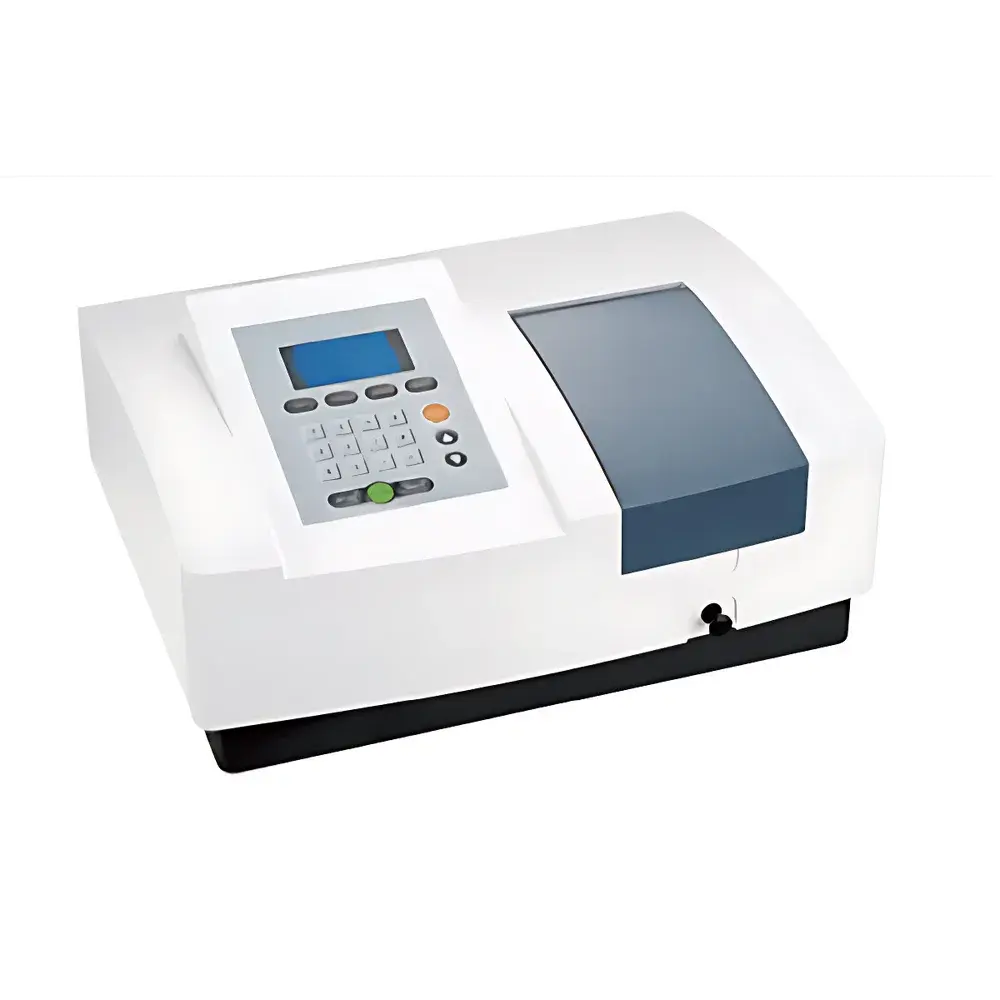
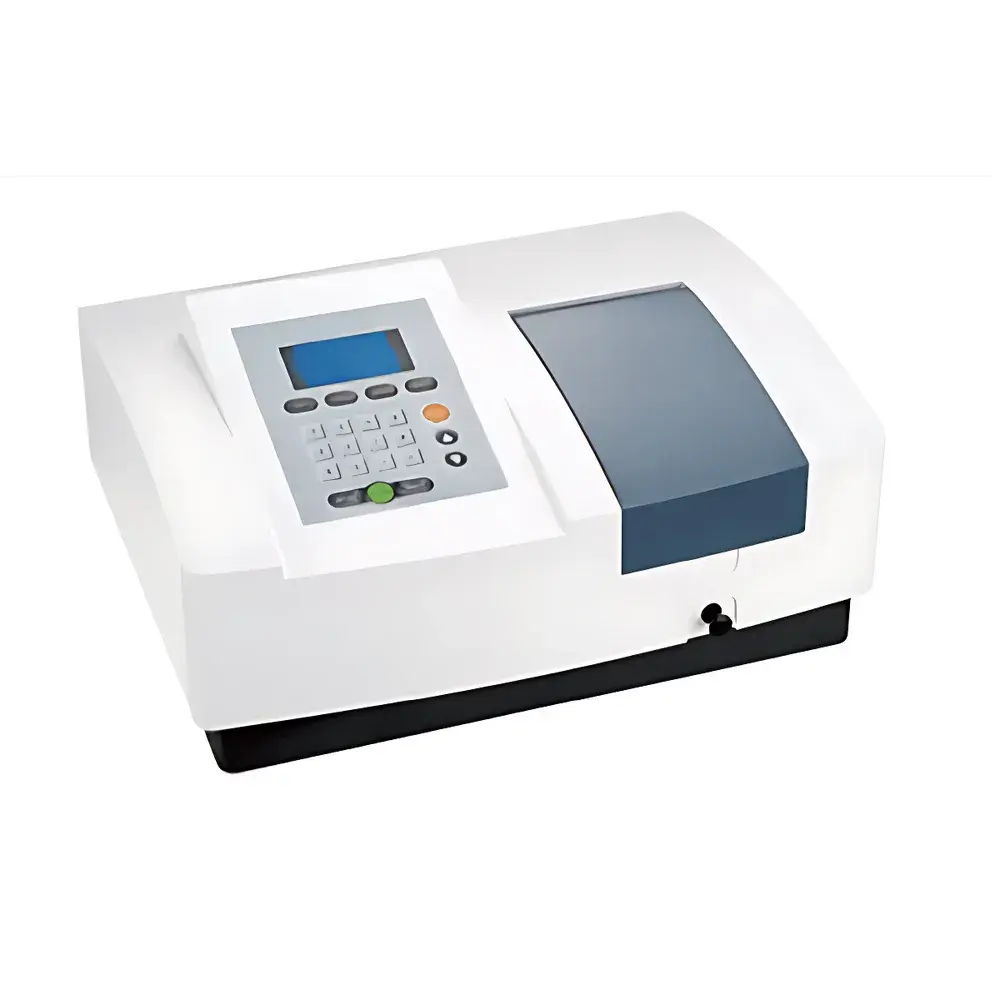
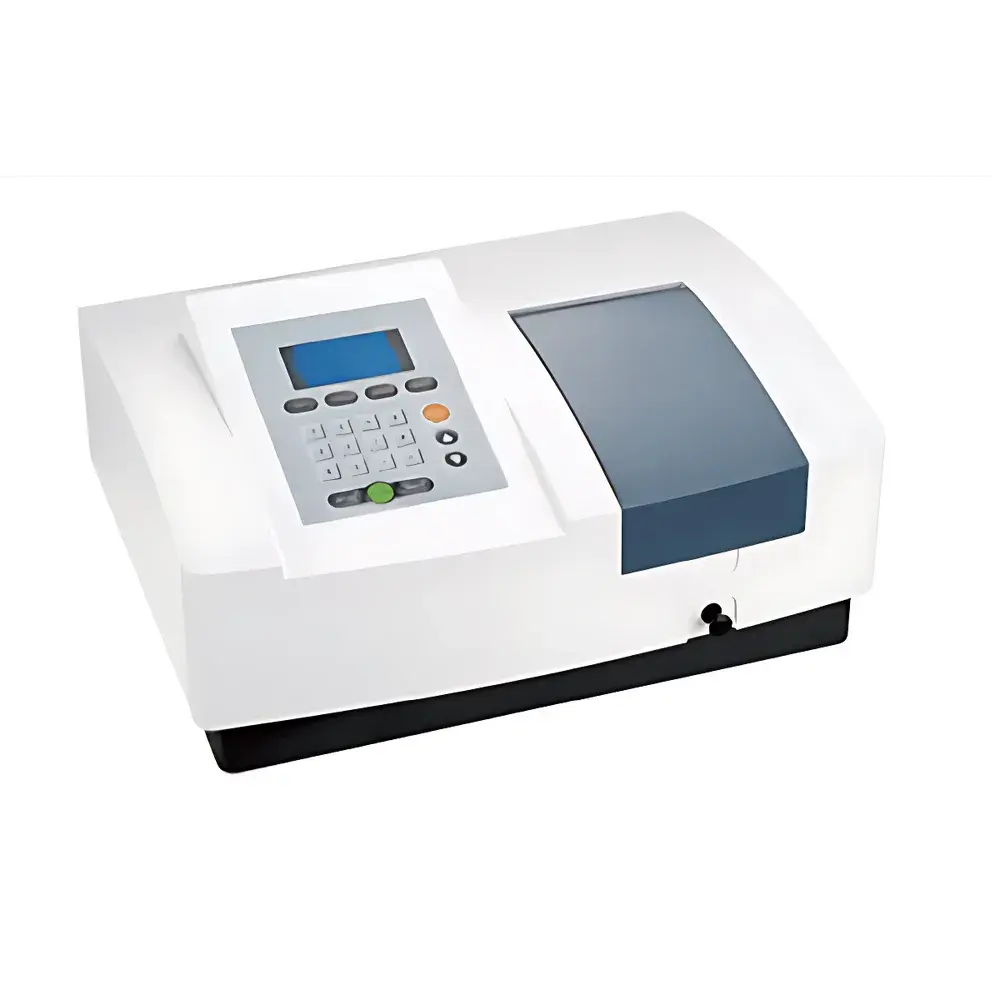
DELEITE 721/722/722N/722S Visible Spectrophotometer
| Brand | DELEITE |
|---|---|
| Origin | Beijing, China |
| Instrument Type | Single-beam Visible Spectrophotometer |
| Model Series | 721 / 722 / 722N / 722S |
| Wavelength Range | 320–1100 nm |
| Spectral Bandwidth | 2 nm (722S), 4–6 nm (721/722/722N) |
| Wavelength Accuracy | ±2 nm (721/722/722N), ±1 nm (722S/723 series) |
| Wavelength Repeatability | ≤0.2–1 nm |
| Stray Light | ≤0.05%T @ 360 nm |
| Photometric Accuracy | ±0.3–0.5%T |
| Photometric Repeatability | ±0.2%T |
| Baseline Linearity | ≤0.2%T |
| Drift | ≤0.001–0.004 A/h @ 500 nm |
| Noise | ≤0.1–0.3%T |
| Optical System | Czerny-Turner monochromator with 1200 lines/mm grating |
| Detector | Imported silicon photodiode |
| Light Source | Imported tungsten halogen lamp |
| Display | 128×64 dot-matrix LCD |
| Data Output | RS-232 (optional), parallel port (optional), USB (via YOKE 3.0 software interface) |
| Sample Compartment | Accommodates cuvettes from 5 mm to 100 mm pathlength |
| Compliance | Designed for routine QC/QA in accordance with ISO 6425, ASTM E275, and USP <857> spectrophotometric validation principles |
Overview
The DELEITE 721/722/722N/722S series represents a family of entry-level visible spectrophotometers engineered for reliable absorbance (A), transmittance (T), and concentration (C) measurements in the 320–1100 nm spectral range. These instruments operate on the principle of single-beam absorption spectroscopy, utilizing a Czerny-Turner monochromator equipped with a high-efficiency 1200 lines/mm holographic grating and an imported tungsten-halogen lamp as the stable broadband source. Unlike double-beam architectures, the 721/722 series achieves cost-effective performance through optimized optical alignment, automatic zeroing and 100%T calibration routines, and robust thermal management—ensuring consistent baseline stability (<0.004 A/h drift at 500 nm) under ambient laboratory conditions. While not intended for regulatory-grade UV-Vis quantification requiring 21 CFR Part 11 compliance, the platform meets fundamental performance criteria outlined in ASTM E275 (Standard Practices for Describing and Measuring Performance of UV-Vis Spectrophotometers) and supports method validation per USP for non-GMP environments.
Key Features
- Single-beam optical architecture with manual or motorized wavelength selection (model-dependent), enabling straightforward operation and minimal maintenance overhead.
- High-stability tungsten-halogen lamp with extended service life and low thermal drift, ensuring reproducible intensity output across the visible-NIR spectrum.
- 128×64 dot-matrix LCD display providing real-time readout of A, T, and C values; supports direct visualization of calibration curves and stored measurement data.
- Integrated automatic zeroing and 100%T adjustment functions—eliminating manual shutter operation and reducing operator-induced variability.
- Expandable sample compartment accommodating standard rectangular cuvettes (10 mm, 20 mm, 50 mm, and up to 100 mm pathlength), compatible with both glass and quartz cells for broad chemical resistance.
- Optional RS-232 serial interface and parallel printer port for external data logging; full PC connectivity enabled via YOKE 3.0 analytical software suite (Windows-compatible).
- Onboard memory stores up to 200 measurement sets and 100 user-named calibration curves—facilitating rapid recall and comparative analysis without continuous PC linkage.
Sample Compatibility & Compliance
The 721/722 series is routinely deployed in educational laboratories, municipal environmental monitoring stations, food quality control labs, and pharmaceutical R&D support units where qualitative and semi-quantitative visible-range analysis suffices. It accommodates aqueous, organic, and mildly corrosive solutions in standard 10 mm PMMA, borosilicate glass, or fused silica cuvettes. While not certified to IEC 61010-1 for hazardous location use, the instrument complies with general electrical safety requirements for Class I laboratory equipment. Its photometric performance aligns with ISO 6425’s baseline linearity (≤0.2%T) and stray light specifications (≤0.05%T @ 360 nm), supporting routine validation per internal SOPs. Note: For GLP/GMP applications requiring audit trails, electronic signatures, or instrument qualification documentation (IQ/OQ/PQ), supplementary third-party software validation and procedural controls are required.
Software & Data Management
YOKE 3.0 is the dedicated Windows-based application for advanced spectral acquisition, curve fitting, and report generation. It supports direct instrument control via USB-to-serial emulation, enabling automated wavelength scanning, kinetic time-course profiling, and multi-point concentration interpolation using the Beer-Lambert law. All raw absorbance data, calibration parameters, and metadata (operator ID, timestamp, cuvette pathlength) are exportable in CSV and TXT formats for integration into LIMS or statistical analysis platforms (e.g., JMP, Minitab). The software enforces user-defined naming conventions for calibration files and includes built-in tools for baseline correction, peak identification, and derivative spectroscopy—extending functionality beyond the onboard LCD interface.
Applications
- Water quality testing: Quantification of nitrate, phosphate, iron, and manganese using colorimetric reagents (e.g., APHA Standard Methods 4500-NO₃⁻, 4500-P).
- Food & beverage QA: Measurement of color indices (e.g., AOAC 996.03 for tomato paste), preservative concentrations (e.g., sulfites), and enzymatic reaction kinetics.
- Educational instruction: Demonstration of Beer-Lambert law, spectral deconvolution, and solvent polarity effects on π→π* transitions.
- Industrial QC: Monitoring dye concentrations in textile effluents, catalyst loading in petrochemical intermediates, and pigment dispersion uniformity.
- Pharmaceutical pre-formulation: Excipient compatibility screening and dissolution profile tracking of colored APIs (e.g., riboflavin, chlorophyll derivatives).
FAQ
Is this instrument suitable for UV-range measurements below 320 nm?
No. The 721/722 series uses a tungsten-halogen lamp and uncoated optics optimized for visible-NIR detection (320–1100 nm). UV measurements require deuterium lamps and UV-grade quartz optics, available only in dedicated UV-Vis models.
Can the 722S perform wavelength scanning?
No. Scanning capability is exclusive to the 723-series variants (e.g., 7230G, 723N/S); the 722S supports discrete wavelength selection only.
What is the maximum cuvette pathlength supported?
The sample chamber accepts cuvettes up to 100 mm in pathlength, provided they fit within the physical dimensions (W × D × H: 125 × 90 × 50 mm).
Does the instrument include factory calibration certificates?
Standard delivery includes a basic performance verification report. NIST-traceable wavelength and photometric calibration certificates are available as optional add-ons upon request.
Is YOKE 3.0 software compatible with Windows 11 and 64-bit systems?
Yes. YOKE 3.0 v3.2.1 and later versions support Windows 10/11 (64-bit) and include signed drivers for plug-and-play USB connectivity.



