
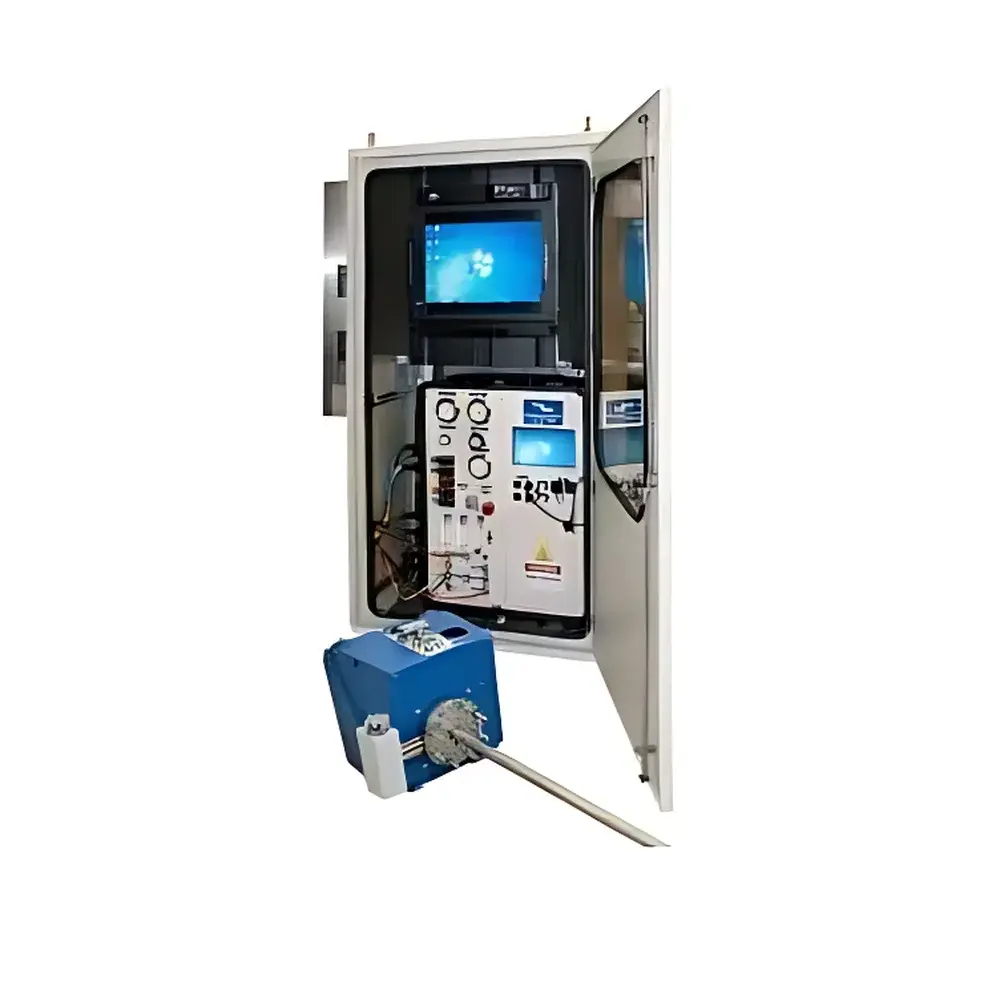
RA-915J Continuous Online Flue Gas Mercury CEMS Analyzer
| Brand | — |
|---|---|
| Origin | Beijing, China |
| Manufacturer Type | Authorized Distributor |
| Product Origin | Domestic (China) |
| Model | RA-915J |
| Pricing | Upon Request |
Overview
The RA-915J Continuous Online Flue Gas Mercury CEMS Analyzer is a fully integrated, EPA PS 12A–certified (Level 3) monitoring system engineered for real-time, unattended quantification of elemental and total gaseous mercury (Hg⁰ and Hgtot) in industrial flue gas streams. It employs high-temperature catalytic conversion coupled with Zeeman-effect background-corrected atomic absorption spectroscopy (AAS), eliminating the need for gold amalgamation preconcentration or cryogenic trapping. Unlike conventional cold vapor AAS systems, the RA-915J utilizes a polarization-modulated Zeeman light source operating at high frequency to deliver intrinsic spectral discrimination—effectively suppressing broadband and structured molecular absorption interferences from SO₂, NOx, HCl, H₂O vapor, and particulate-laden matrices. The optical path incorporates a multi-pass absorption cell, enhancing effective pathlength without increasing physical footprint, while dry-gas thermal conversion at 750 °C ensures quantitative oxidation of all mercury species (including Hg²⁺ and particulate-bound Hg) to elemental form prior to detection. This architecture enables direct, interference-resistant measurement across complex, untreated flue gas conditions—including upstream and downstream locations of ESPs, SCR/NSCR units, and wet/dry FGD systems.
Key Features
- Zeeman-background-corrected AAS with polarization-modulated high-frequency source for baseline stability and sub-ppq sensitivity
- Dual-stream sampling configuration: one path bypasses the converter for elemental mercury (Hg⁰); the other passes through a 750 °C catalytic converter for total mercury (Hgtot)
- Integrated dry-conversion technology—no chemical reagents, no liquid scrubbers, no consumable catalyst cartridges
- Heated sample probe with 4-inch ANSI flange interface; stainless steel, nickel-alloy construction rated for continuous operation up to 200 °C
- Custom-length heated sample line (10–50 ft), insulated and trace-heated to >180 °C to prevent mercury adsorption or condensation
- Onboard calibration module using pure elemental mercury vapor generator—fully automated, no external standards required
- Modular Pelikan® NEMA 4X enclosure housing all electronics, controller, and data acquisition unit (IP66-rated, corrosion-resistant, field-serviceable)
- Automatic filter back-pulse cleaning cycle with activated carbon trap for residual mercury capture and system protection
- Precision orifice-based dilution with certified mass flow control; dilution ratio programmable and traceable per ISO 12039 and EN 14181
Sample Compatibility & Compliance
The RA-915J is validated for use in high-dust, high-moisture, and chemically aggressive flue gases typical of coal-fired boilers, cement kilns, municipal solid waste incinerators, non-ferrous metal smelters, and hazardous waste treatment facilities. Its robust design meets mechanical and environmental requirements per NEMA 4X (ANSI/NEMA 250-1991), IP66, and IEC 60529. The system complies with U.S. EPA Performance Specification 12A (PS 12A) Level 3 certification for mercury CEMS, supporting regulatory reporting under 40 CFR Part 60, Subpart B (NSPS) and Subpart UUU (MATS). It supports audit-ready data integrity protocols aligned with 21 CFR Part 11 (electronic records/signatures), including secure user access control, immutable audit trails, and time-stamped calibration logs. All measurements adhere to ISO 12039:2000 (stationary source emissions—determination of mercury—manual and automatic methods) and EN 14181:2014 (QA/QC procedures for automated measuring systems).
Software & Data Management
The embedded industrial PC runs proprietary CEMS control software compliant with IEC 62443 cybersecurity principles. Real-time concentration values (0.1–100 µg/m³, reported at 30-second intervals) are logged with full metadata—including temperature, pressure, flow rate, dilution factor, and diagnostic flags. Data export formats include native Excel (.xlsx), CSV, and Modbus TCP/IP for integration into DCS/SCADA platforms. Remote access is enabled via encrypted HTTPS and SSH tunnels, permitting off-site calibration verification, firmware updates, and troubleshooting without physical presence. The software supports configurable alarm thresholds, automatic zero/span checks, drift correction algorithms, and compliance reporting templates aligned with EPA 7520-1 and EU Directive 2010/75/EU (IED) Annex V requirements.
Applications
- Continuous emission monitoring (CEM) of mercury at stack outlets of coal combustion power plants
- Process control and optimization in cement clinker production lines with alternative fuel firing
- Regulatory compliance tracking for mercury abatement systems in municipal waste incineration (MWI) and hazardous waste co-incineration
- Stack testing and performance evaluation of activated carbon injection (ACI) and brominated sorbent systems
- Baseline characterization and long-term trend analysis in non-ferrous metallurgical smelting (e.g., zinc, copper, lead recovery)
- Supporting MACT (Maximum Achievable Control Technology) and LMP (Load-Based Monitoring Program) reporting obligations
FAQ
Does the RA-915J require gold-coated traps or chemical reagents for mercury enrichment?
No. It uses direct Zeeman AAS with catalytic thermal conversion—eliminating consumables, reducing maintenance, and avoiding memory effects.
Can it operate reliably upstream of an electrostatic precipitator (ESP) or selective catalytic reduction (SCR) unit?
Yes. Its heated probe, high-temperature conversion, and Zeeman background correction enable stable operation in raw, high-dust, high-temperature flue gas environments.
What is the minimum detectable concentration (MDC) and measurement range?
The system achieves a proven MDC of 0.1 µg/m³ (at 1 m pathlength equivalent) with linear dynamic range spanning 0.1–100 µg/m³ per EPA PS 12A validation protocol.
Is remote diagnostics and calibration supported?
Yes. Full web-based interface allows secure remote access for real-time status monitoring, scheduled calibration execution, and log file retrieval.
How is data integrity ensured for regulatory submissions?
All measurements are timestamped, digitally signed, and stored with tamper-evident audit trails satisfying 21 CFR Part 11 and EN 14181 QA/QC requirements.







