
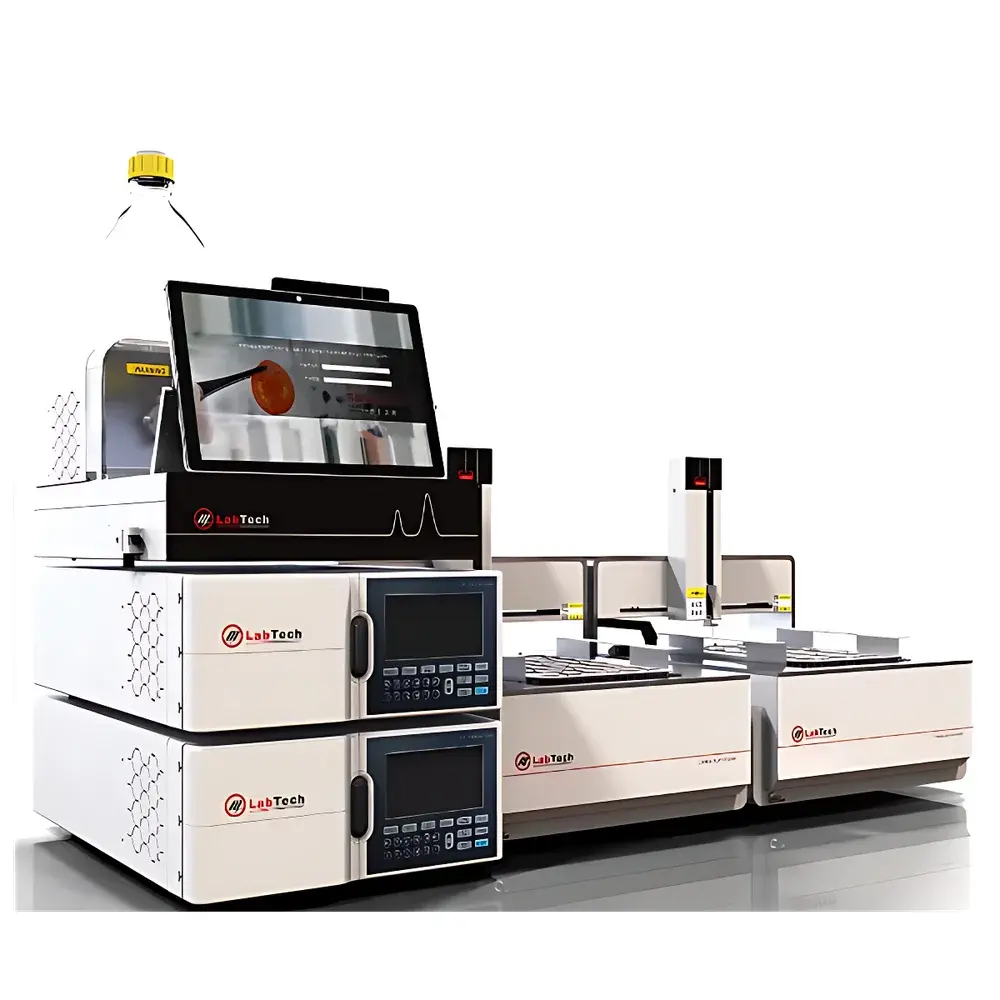
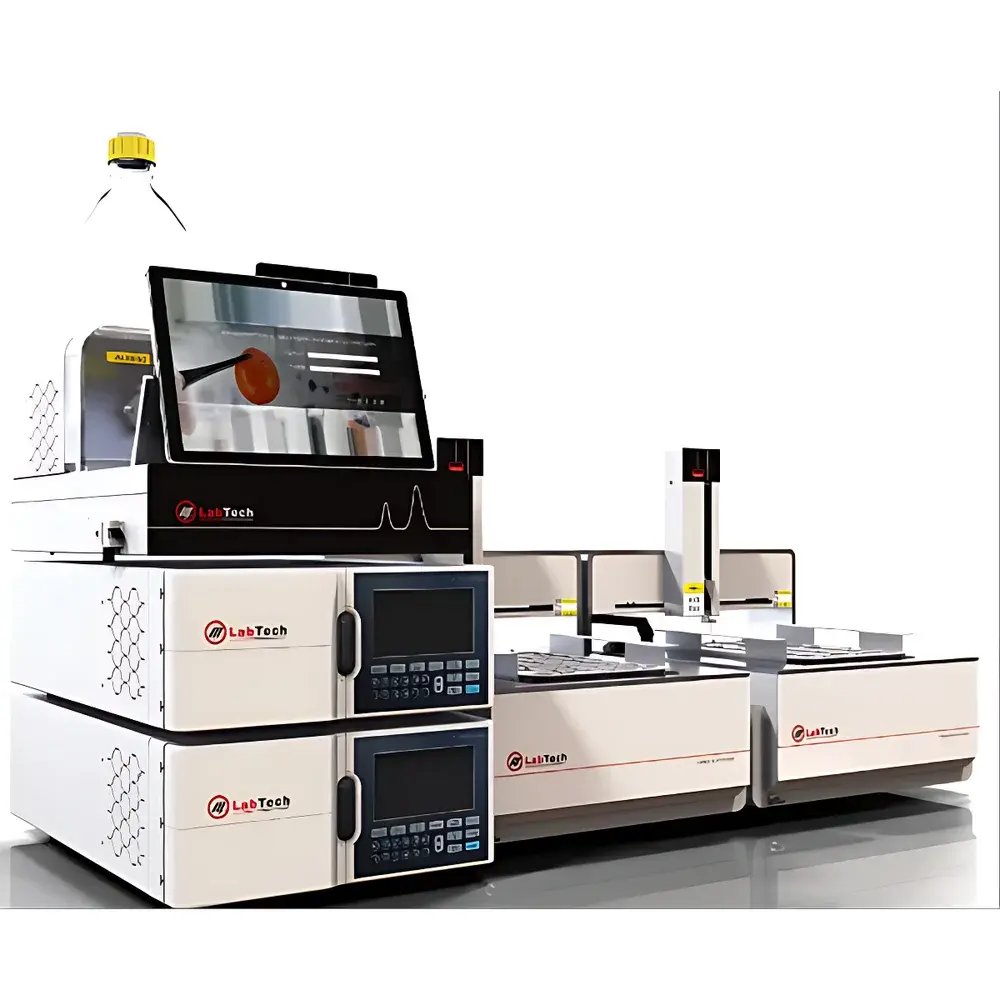
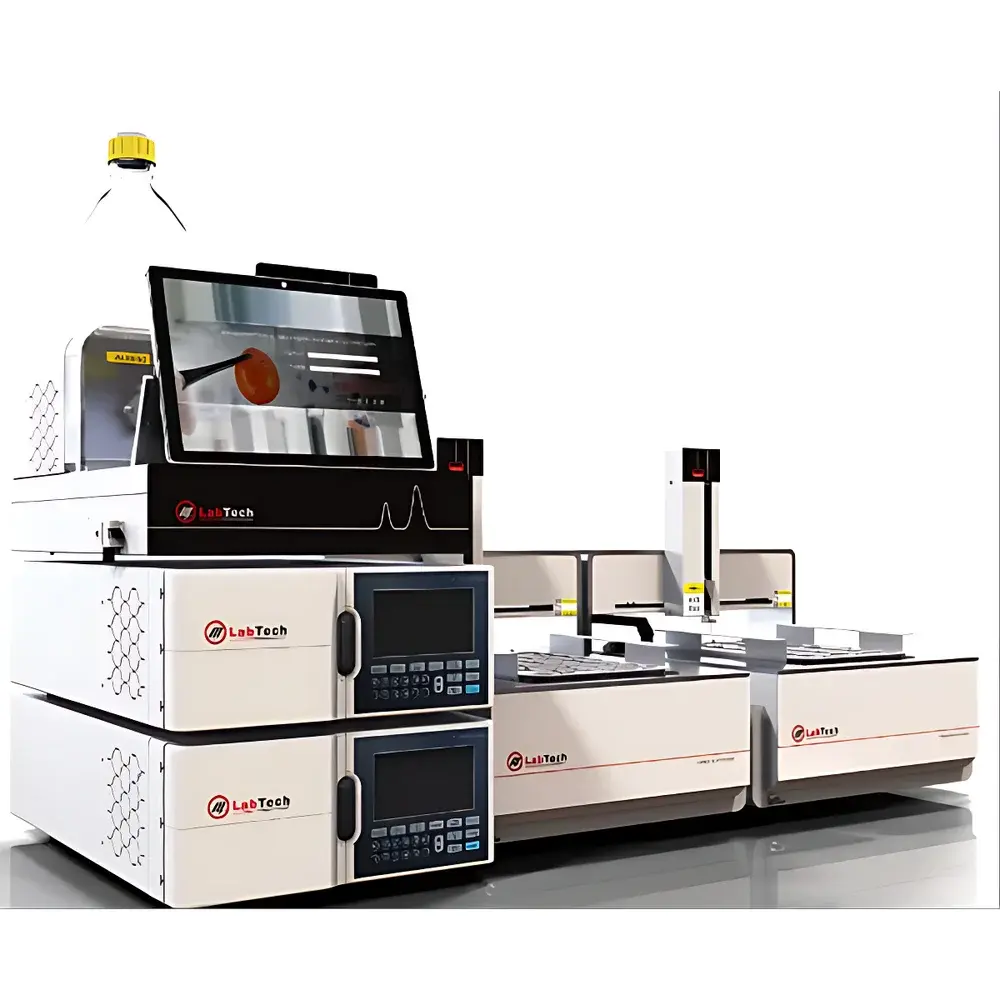
LabTech GPC 1000 Automated Gel Permeation Chromatography System
| Brand | LabTech |
|---|---|
| Origin | Beijing, China |
| Model | GPC 1000 |
| Flow Rate | 0.1–20 mL/min |
| Maximum Pressure | ≥20 MPa |
| Flow Stability (RSD) | ≤0.5% |
| Auto-sampling Volume | 0.1–100 mL |
| Sample Capacity | Up to 60 vials per run (standard 4–12 mL vials) |
Overview
The LabTech GPC 1000 Automated Gel Permeation Chromatography System is an integrated, high-precision sample cleanup platform engineered for laboratories requiring robust, reproducible molecular-size-based fractionation of complex matrices. Based on the fundamental principle of gel permeation chromatography (GPC)—also widely referred to as size-exclusion chromatography (SEC)—the system separates analytes according to hydrodynamic volume in solution. Large-molecular-weight interferences (e.g., lipids, proteins, polymers, humic substances) elute first, while low-molecular-weight target compounds (e.g., pesticides, PCBs, PAHs, mycotoxins, pharmaceutical residues) are resolved in later fractions. This orthogonal separation mechanism enables effective removal of macromolecular matrix components and small-molecule contaminants without chemical derivatization or selective adsorption—preserving analyte integrity and minimizing recovery bias. Designed for unattended operation, the GPC 1000 supports full automation of sample loading, column elution, real-time UV monitoring, fraction collection, and system rinse—reducing manual intervention and operator-induced variability.
Key Features
- Stainless-steel pre-packed GPC columns—factory-validated for consistent pore size distribution, pressure stability, and batch-to-batch reproducibility; eliminates manual column packing and associated performance drift.
- Dual-piston precision solvent delivery pump with integrated pulse dampener ensures stable, pulsation-free flow across the full 0.1–20 mL/min range, critical for baseline stability and fraction sharpness in preparative-scale GPC.
- Variable-wavelength UV detector (190–400 nm) with analog output and digital signal processing provides real-time chromatographic feedback for method development, peak triggering, and fraction window definition.
- Independent 3D robotic autosampler and fraction collector—each equipped with septum-piercing capability—enables simultaneous sample introduction and targeted collection while minimizing solvent evaporation and cross-contamination.
- Full-loop injection architecture allows complete introduction of volumes up to 10 mL without loop overfill or sample dilution, supporting high-concentration environmental extracts and food homogenates.
- Real-time pressure monitoring with programmable overpressure alarm and automatic pressure relief safeguarding column integrity and system longevity under variable solvent viscosity conditions.
- Modular hardware design accommodates expansion with auxiliary collectors, SPE interface modules, or parallel concentration units—facilitating seamless integration into end-to-end sample preparation workflows.
Sample Compatibility & Compliance
The GPC 1000 processes a broad spectrum of organic solvent-based extracts derived from environmental (soil, sediment, water), food (oils, dairy, cereals), agricultural (crop tissue, animal feed), and biological (serum, tissue homogenates) matrices. Compatible solvents include cyclohexane, ethyl acetate, dichloromethane, toluene, and their mixtures—subject to column chemical stability specifications. The system meets essential operational requirements for GLP-compliant laboratories: audit-trail-enabled software logging (user actions, method parameters, run timestamps), electronic signature support, and data immutability features aligned with FDA 21 CFR Part 11 principles. While not certified to ISO/IEC 17025 by default, its performance characteristics—including RSD ≤0.5% flow precision and ≥20 MPa pressure tolerance—support validation protocols per ASTM D5296 (polymer molecular weight distribution) and EPA Method 3640A (cleanup of organochlorine pesticide extracts).
Software & Data Management
Control and data acquisition are managed via LabTech’s dedicated GPC Control Suite—a Windows-based application supporting method creation, sequence scheduling, real-time chromatogram visualization, UV spectral overlay, and fraction-triggered collection logic. All instrument parameters, chromatograms, and collection logs are stored in a structured SQLite database with optional export to CSV, PDF, or LIMS-compatible XML formats. Software includes built-in calibration tools for retention time alignment, peak area integration (with baseline subtraction and tangent skim options), and QC report generation (system suitability, pressure history, flow accuracy verification). Audit trail records capture operator ID, timestamp, parameter changes, and event flags—including pressure excursions, UV lamp status, and vial position errors—ensuring traceability for regulatory submissions.
Applications
- Environmental analysis: Cleanup of lipid-rich soil/sediment extracts prior to GC-MS determination of persistent organic pollutants (POPs), including dioxins, furans, and brominated flame retardants.
- Food safety testing: Removal of triglycerides and sterols from edible oil, fish tissue, or dairy extracts to enhance sensitivity and reduce GC inlet contamination during pesticide residue analysis.
- Agricultural residue monitoring: Isolation of polar pesticide metabolites from plant matrix extracts where conventional SPE fails due to co-eluting polysaccharides or pigments.
- Pharmaceutical impurity profiling: Fractionation of synthetic reaction mixtures to isolate low-MW degradants or catalyst residues prior to HPLC-UV or LC-MS identification.
- Biomedical research: Desalting and buffer exchange of peptide digests or oligonucleotide preparations without loss of labile modifications.
FAQ
What column chemistries are supported by the GPC 1000?
The system is optimized for commercially available cross-linked polystyrene-divinylbenzene (PS-DVB) gel columns with pore sizes ranging from 10³ to 10⁶ Å—typically configured in series (e.g., 10⁶ Å + 10⁴ Å) to maximize resolution across broad molecular weight ranges.
Can the GPC 1000 interface directly with an online concentrator or SPE manifold?
Yes—its modular architecture includes standardized fluidic and electrical I/O ports compatible with LabTech’s TurboVap® concentrators and MultiSPE® solid-phase extraction platforms, enabling automated extract transfer without manual vial handling.
Is method validation documentation provided with the system?
LabTech supplies a comprehensive Instrument Qualification (IQ/OQ) protocol package, including test scripts, acceptance criteria, and blank templates for PQ execution—aligned with ISO/IEC 17025 and USP analytical instrument qualification guidelines.
What maintenance intervals are recommended for the dual-piston pump and UV lamp?
Pump seals should be inspected every 6 months or after 1,000 hours of operation; UV lamp lifetime is rated at ≥2,000 hours under continuous use, with intensity monitoring available via software diagnostics.
Does the system support gradient elution?
No—the GPC 1000 operates exclusively under isocratic conditions, as gel permeation chromatography requires constant mobile phase composition to preserve elution order based solely on molecular size.



