
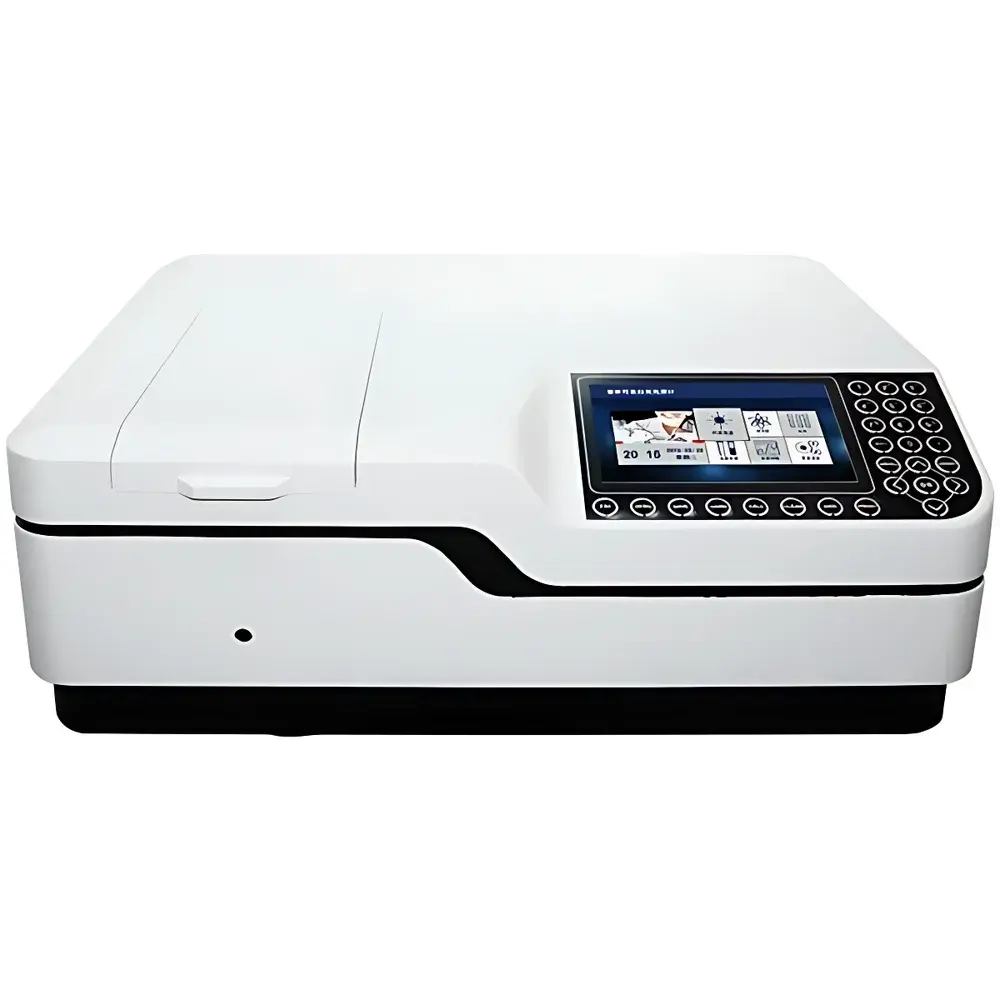
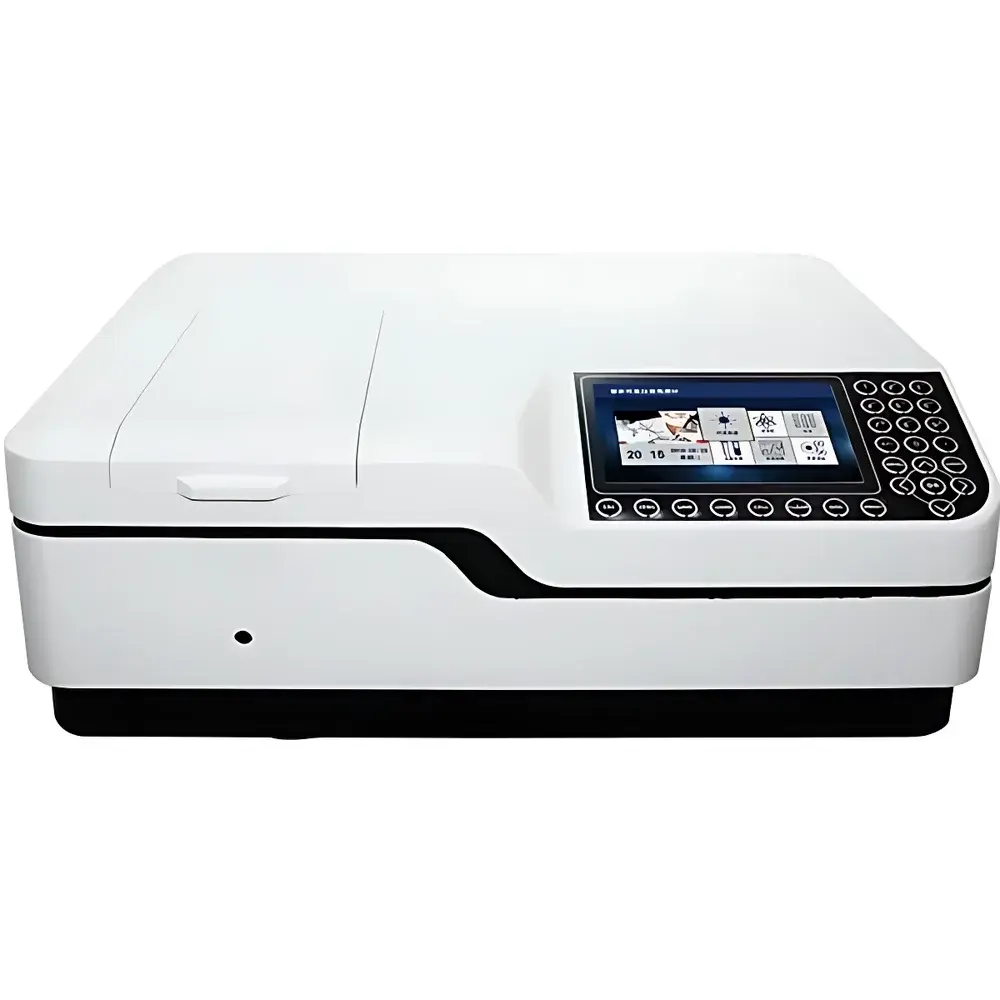
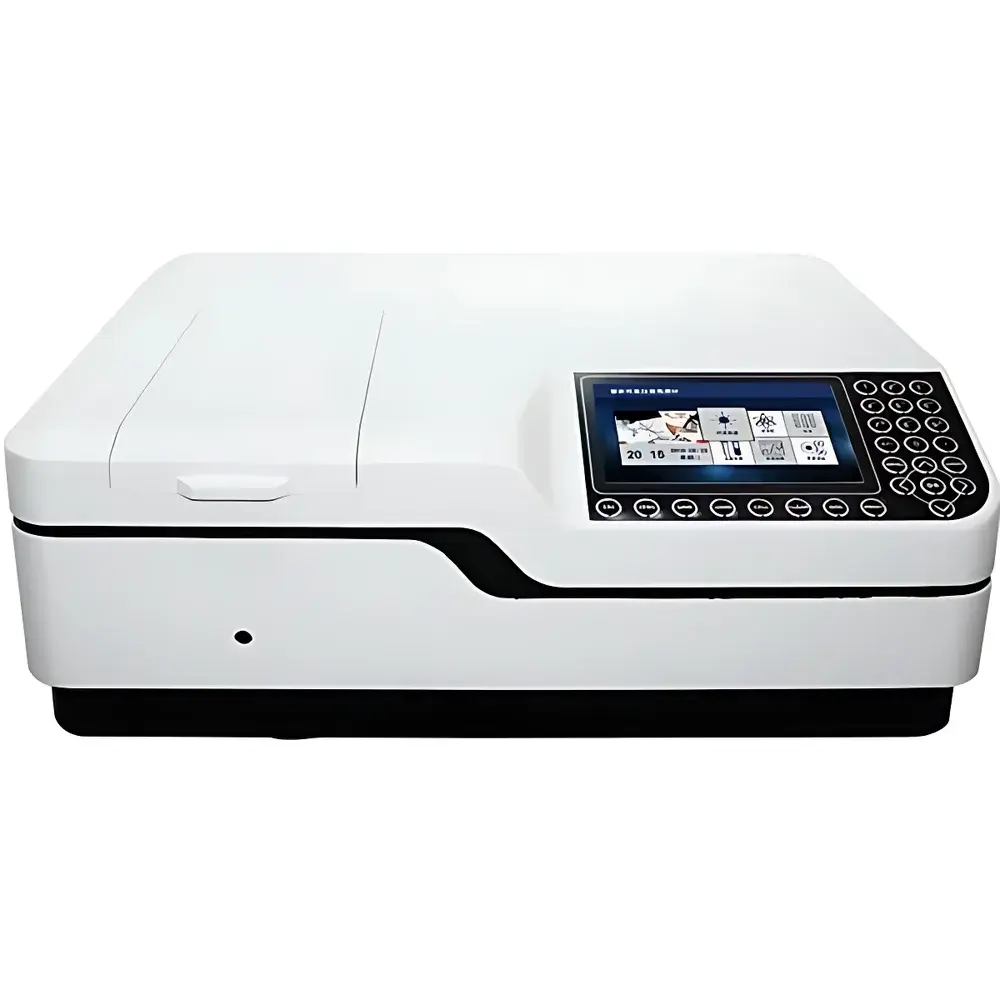
Yoke T3202S Dual-Beam Ultraviolet-Visible Spectrophotometer
| Brand | Yoke |
|---|---|
| Origin | Shanghai, China |
| Model | T3202S |
| Optical Design | Dual-beam |
| Detector | Photomultiplier Tube (PMT) |
| Wavelength Range | 190–1100 nm |
| Wavelength Accuracy | ±0.3 nm |
| Wavelength Repeatability | ≤0.1 nm |
| Spectral Bandwidth | 1 nm (standard), adjustable to 0.5/1/2/4/5 nm |
| Stray Light | ≤0.03% at 220 nm (NaI) |
| Display | 10.1-inch capacitive touchscreen |
| Data Storage | Internal 8 GB + USB drive support |
| Interface | RS-232C, USB Device, USB Host |
| Onboard Memory | Up to 5000 absorbance measurements or 500 calibration curves |
| Optional Accessories | 8-position rotating cuvette changer, integrated flow cell system |
Overview
The Yoke T3202S Dual-Beam Ultraviolet-Visible Spectrophotometer is a precision optical instrument engineered for quantitative and qualitative analysis across the UV-Vis spectral region (190–1100 nm). Based on the dual-beam optical architecture—where sample and reference beams are measured simultaneously—the T3202S eliminates time-dependent fluctuations in source intensity and detector response, ensuring high reproducibility and long-term stability in absorbance, transmittance, and concentration measurements. Its core optical path employs a Czerny-Turner monochromator with a holographic grating, optimized for minimal aberration and consistent spectral resolution. The photomultiplier tube (PMT) detector delivers superior signal-to-noise ratio (SNR), particularly critical in low-light applications such as trace-level quantitation or kinetic assays. Designed and manufactured in Shanghai with over two decades of spectrometer engineering heritage, the T3202S meets the functional and reliability expectations of regulated and research-intensive laboratories.
Key Features
- 10.1-inch high-resolution capacitive touchscreen interface—enables full instrument control, real-time spectrum visualization, multi-curve overlay, and method-driven workflows without external PC dependency.
- Dual-beam optical configuration with suspended optical bench design—minimizes mechanical drift and thermal distortion; reinforced aluminum baseplate enhances rigidity and vibration resistance.
- Adjustable spectral bandwidth (0.5/1/2/4/5 nm)—supports method flexibility per ASTM E275, ISO 6223, and pharmacopeial requirements (e.g., USP <857>).
- Integrated 8 GB internal storage plus USB Host port—stores up to 5000 absorbance readings or 500 user-defined calibration curves; supports direct export to USB drives in CSV, QUA, TXT, and BMP formats.
- ARM12-based embedded computing platform—enables rapid data processing, multi-tasking operation, and deterministic response timing for time-resolved measurements.
- Modular hardware expansion—optional 8-position motorized cuvette changer ensures precise beam alignment and positional repeatability; optional flow cell module enables automated liquid handling for HPLC fraction analysis or continuous monitoring.
Sample Compatibility & Compliance
The T3202S accommodates standard 10 mm square quartz, glass, or plastic cuvettes (pathlengths from 1–50 mm via optional holders), as well as microvolume adapters and flow cells. It complies with key international standards governing spectrophotometric instrumentation, including ISO/IEC 17025:2017 (general requirements for competence of testing and calibration laboratories), ASTM E275-22 (standard practices for describing and measuring performance of UV-Vis spectrophotometers), and EU Directive 2014/30/EU (EMC Directive). While not pre-certified for FDA 21 CFR Part 11, its audit-trail-capable software architecture—including timestamped measurement logs, user access control, and immutable data export—supports implementation in GLP/GMP environments when deployed with validated SOPs and electronic signature protocols.
Software & Data Management
The embedded operating system provides native support for absorbance, transmittance, reflectance, concentration, kinetics, and wavelength scanning modes. All data—including raw spectra, derivative plots, and multi-point calibrations—are stored with metadata (date/time, operator ID, instrument serial number, method name). USB export preserves data integrity through checksum-verified file transfer. Optional PC-based software (Yoke SpectraLink™) extends functionality with advanced curve fitting (Gaussian/Lorentzian deconvolution), spectral library matching, and batch report generation compliant with ISO 10012 and ISO 9001 documentation frameworks.
Applications
The T3202S serves as a foundational analytical tool in diverse sectors: pharmaceutical QC labs perform assay validation and dissolution testing per USP <711>; environmental labs quantify nitrate, phosphate, and heavy metal complexes using EPA-approved colorimetric methods; food & beverage facilities monitor pigment degradation (e.g., anthocyanins, chlorophyll) and preservative concentrations; academic and industrial life science groups conduct enzyme kinetics (e.g., NADH/NADPH oxidation), protein quantification (Bradford/Lowry), and nucleic acid purity assessment (A260/A280 ratios). Its wide dynamic range (0–3.5 AU) and low stray light (<0.03% at 220 nm) ensure reliable detection even in highly absorbing or scattering matrices.
FAQ
Does the T3202S support compliance with 21 CFR Part 11?
The instrument’s firmware does not include built-in electronic signatures or role-based audit trails; however, its deterministic data logging, immutable export formats, and time-stamped metadata enable integration into Part 11-compliant workflows when paired with validated third-party LIMS or ELN systems.
What cuvette types are compatible with the standard holder?
The default 10 mm pathlength holder accepts square quartz (UV-grade), optical glass, and disposable plastic cuvettes; custom holders for 1 mm, 5 mm, 20 mm, and 50 mm pathlengths are available as accessories.
Is spectral calibration traceable to NIST standards?
Yes—factory calibration uses NIST-traceable holmium oxide and didymium oxide filters for wavelength verification; users may perform periodic verification using certified reference materials per ISO/IEC 17025 clause 6.4.
Can the T3202S be integrated into automated lab systems?
Via RS-232C or USB virtual COM port, the instrument supports SCPI command sets for remote triggering, parameter setting, and data acquisition—enabling integration with robotic liquid handlers, PLC-controlled reactors, or centralized lab automation platforms.






