
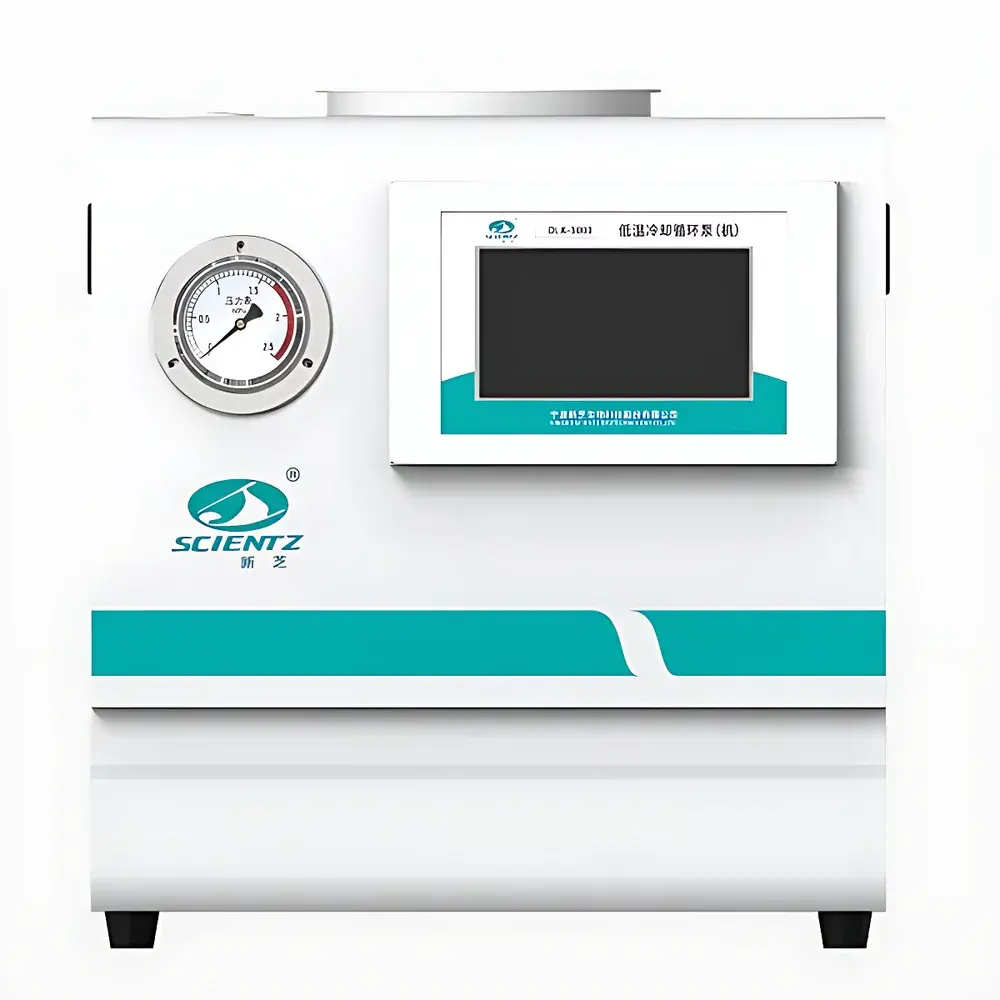
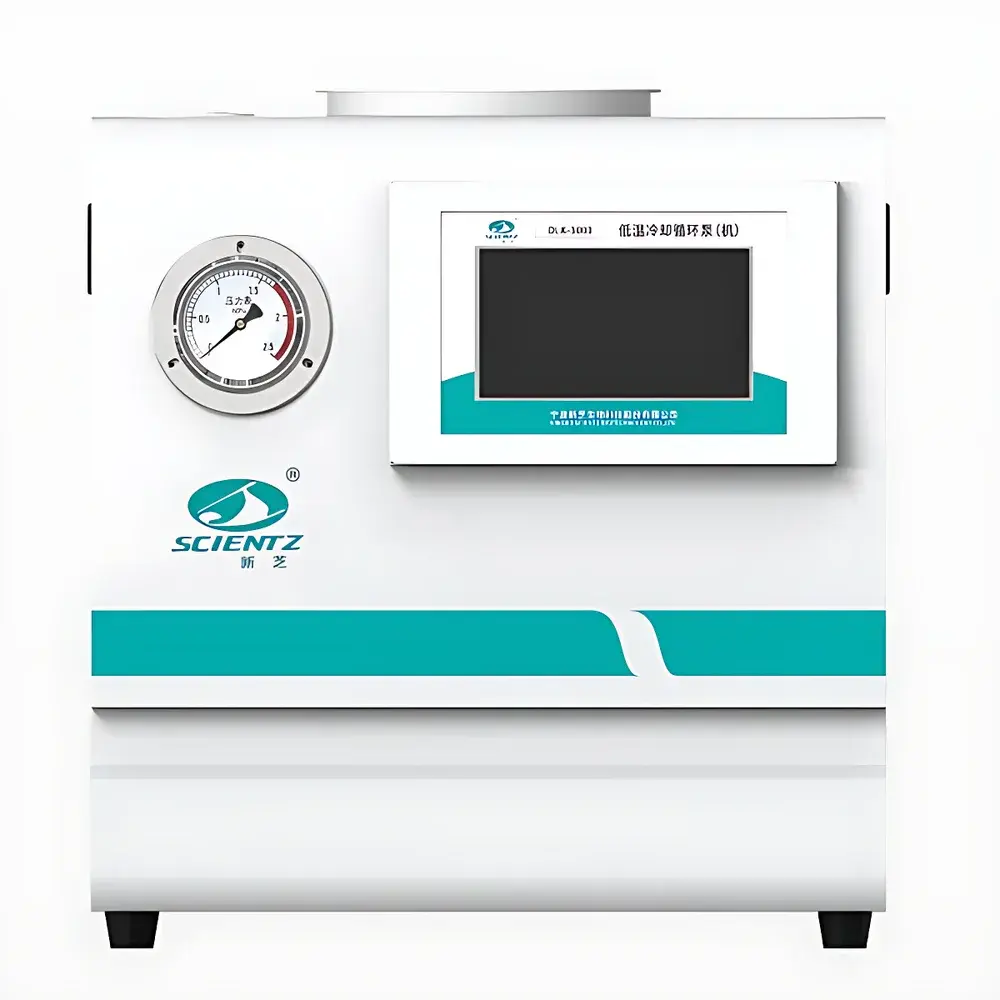
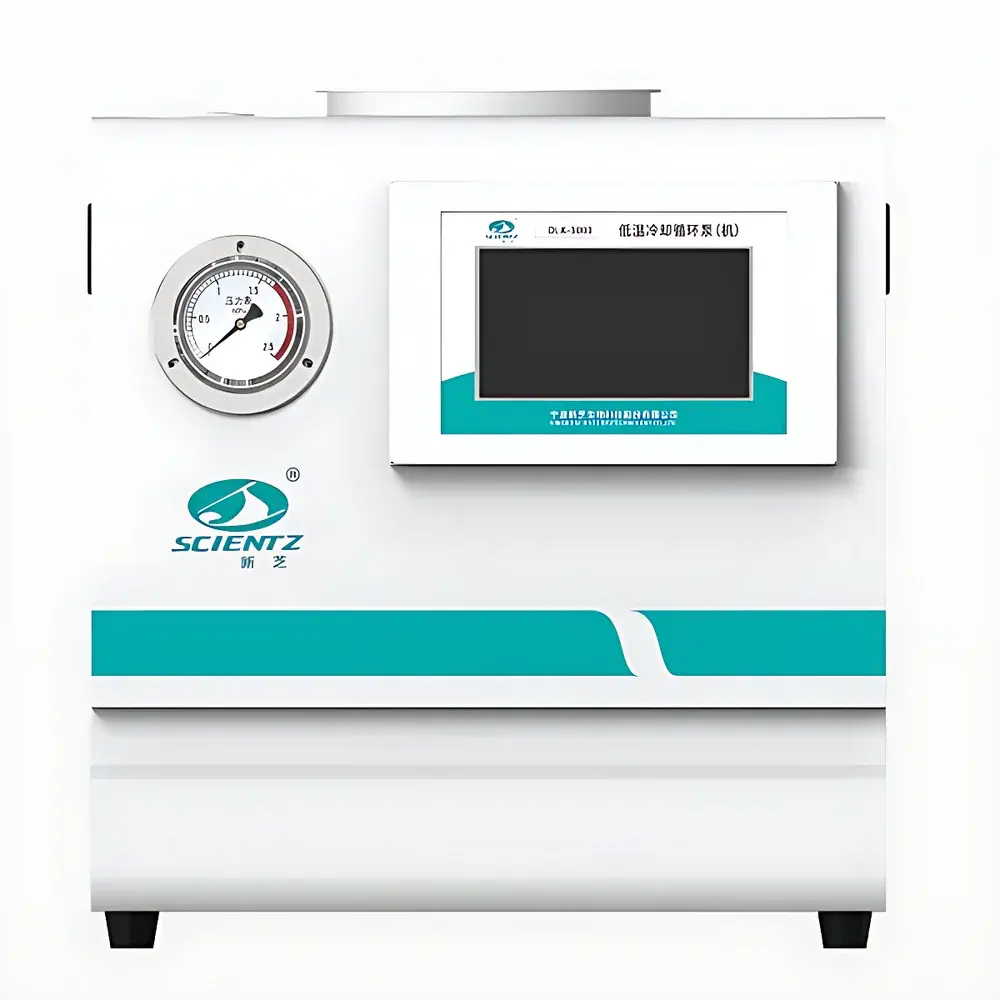
Scientz DLK-5003 Integrated Circulating Chiller
| Brand | Scientz |
|---|---|
| Origin | Shanghai, China |
| Model | DLK-5003 |
| Cooling Type | Water-cooled |
| Temperature Range | −5 °C to 45 °C |
| Refrigeration Capacity | 0.76 kW at 45 °C |
| Pump Pressure | 1.2 bar |
| Flow Rate | 20 L/min |
| Reservoir Volume | 3 L |
| Temperature Stability | ±2 °C |
| Display Resolution | 0.1 °C |
| Power Input | 0.55 kW |
| Voltage/Frequency | 220 V / 50 Hz |
| Noise Level | ≤57 dB(A) |
| Dimensions (W×L×H) | 390 × 423 × 445 mm |
| Weight | 29 kg |
| Connection Port | G1/2″ internal thread |
Overview
The Scientz DLK-5003 Integrated Circulating Chiller is a compact, self-contained refrigeration system engineered for precise temperature control and reliable heat removal in laboratory applications requiring stable low-temperature cooling. Operating on the vapor-compression refrigeration cycle with an environmentally compliant refrigerant (R134a or equivalent), the unit delivers consistent thermal management across a wide operational range of −5 °C to 45 °C. Its integrated architecture eliminates the need for external condenser water supplies or auxiliary cooling infrastructure—making it especially suitable for space-constrained environments such as fume hoods, benchtop installations beneath rotary evaporators, or adjacent to analytical instrumentation. Designed for continuous duty under ambient conditions up to 40 °C, the DLK-5003 maintains thermal stability within ±2 °C across its full setpoint range, with digital PID control ensuring minimal overshoot and steady-state drift. The chiller’s thermally insulated 3-liter reservoir minimizes evaporation loss and reduces thermal inertia during dynamic load changes.
Key Features
- Integrated design with built-in compressor, condenser, expansion valve, evaporator, and circulation pump—no external water source required
- Wide operational temperature range from −5 °C to +45 °C, supporting both cryogenic and ambient-temperature cooling tasks
- High-flow circulation system delivering up to 20 L/min at 1.2 bar pressure, compatible with multi-point distribution manifolds and long-loop configurations
- G1/2″ internal threaded fluid ports enabling secure, leak-resistant connections to common laboratory equipment interfaces
- Digital LED display with 0.1 °C resolution and intuitive menu navigation; supports timer function and power-failure memory retention
- Low-noise operation (≤57 dB[A]) achieved through acoustic insulation, vibration-dampened mounting, and optimized fan/compressor sequencing
- Energy-efficient 0.55 kW motor-compressor assembly meeting IEC 60034 efficiency standards; R134a refrigerant compliant with EU F-Gas Regulation (No. 517/2014) and EPA SNAP program requirements
Sample Compatibility & Compliance
The DLK-5003 is routinely deployed as a secondary coolant source for instruments sensitive to thermal drift—including rotary evaporators, atomic absorption spectrometers (AAS), reflux condensers, jacketed reactors, double-walled grinding vessels, and incubation chambers. Its flow and pressure characteristics are validated for compatibility with standard laboratory tubing (e.g., silicone, Viton®, or fluoropolymer-lined hoses rated to −20 °C). While not certified to ISO/IEC 17025 or FDA 21 CFR Part 11 out-of-the-box, the unit’s stable thermal output and reproducible setpoint behavior support GLP-compliant workflows when paired with external validation protocols (e.g., ASTM E2554–22 for temperature uniformity mapping). All electrical components conform to IEC 61010-1:2012 safety standards for laboratory equipment, and the housing meets IP20 ingress protection rating.
Software & Data Management
The DLK-5003 operates via embedded firmware without proprietary software dependency. All configuration—including setpoint, timer duration, and display brightness—is managed locally via tactile membrane buttons and real-time feedback on the front-panel display. No USB, RS-232, or Ethernet interface is provided; however, analog 0–10 V or 4–20 mA process outputs can be added via optional OEM modules for integration into centralized building management systems (BMS) or SCADA platforms. For auditability, users may manually log operating parameters (setpoint, actual bath temperature, runtime) using standardized lab notebooks or LIMS templates aligned with ISO/IEC 17025 clause 7.5.2 (record control).
Applications
- Cooling of rotary evaporation systems to prevent solvent boiling and improve condensation efficiency
- Thermal regulation of AAS graphite furnace coolants and nebulizer gas lines
- Heat extraction from exothermic chemical reactions in jacketed glass reactors (e.g., Grignard synthesis, polymerization)
- Stabilization of temperature-sensitive detectors in FTIR, UV-Vis, and HPLC systems
- Supporting cryo-milling operations in planetary ball mills equipped with double-wall grinding jars
- Providing controlled cooling to environmental test chambers and bioreactor jackets requiring sub-ambient setpoints
FAQ
What is the minimum ambient temperature at which the DLK-5003 can operate reliably?
The unit is rated for continuous operation in ambient environments between 10 °C and 40 °C. Below 10 °C, compressor oil viscosity increases and may impair startup reliability; supplemental heating of the condenser compartment is not supported.
Can the DLK-5003 be used with ethylene glycol/water mixtures?
Yes—up to 30% v/v ethylene glycol is permissible for enhanced freeze protection below 0 °C; however, glycol reduces thermal conductivity and volumetric flow by ~12%, requiring recalibration of flow-dependent processes.
Is remote monitoring or control possible?
No native network connectivity exists; optional analog signal modules (0–10 V or 4–20 mA) may be installed to transmit temperature and status signals to external PLCs or data loggers.
Does the chiller require periodic refrigerant recharging?
Under normal operation and proper handling, the sealed refrigeration circuit requires no maintenance or recharge over its service life; annual visual inspection of hose integrity and reservoir level is recommended.
How does the DLK-5003 compare to the DLK-5003R variant?
The DLK-5003R features upgraded PID tuning and a high-stability platinum RTD sensor, achieving ±0.1 °C temperature stability versus ±2 °C for the base model—intended for applications demanding tighter thermal tolerance, such as crystallization studies or calorimetry reference baths.



