
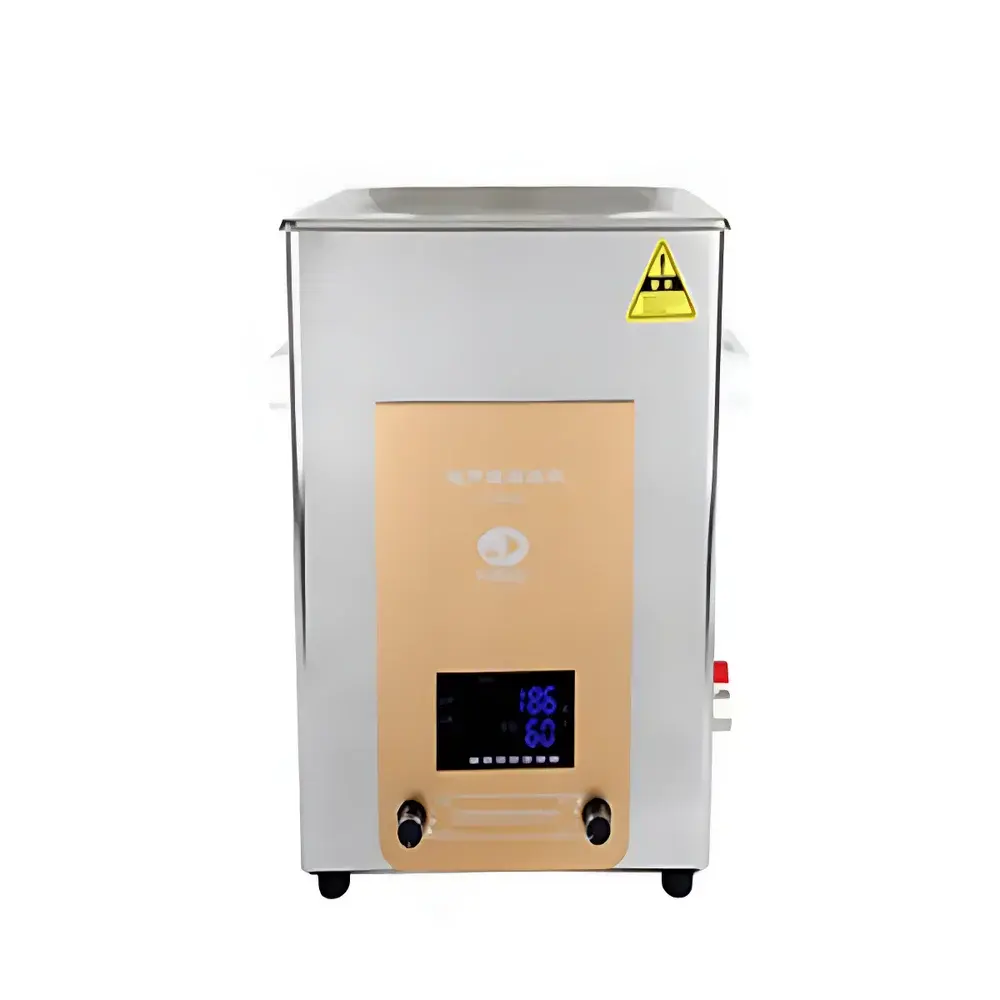
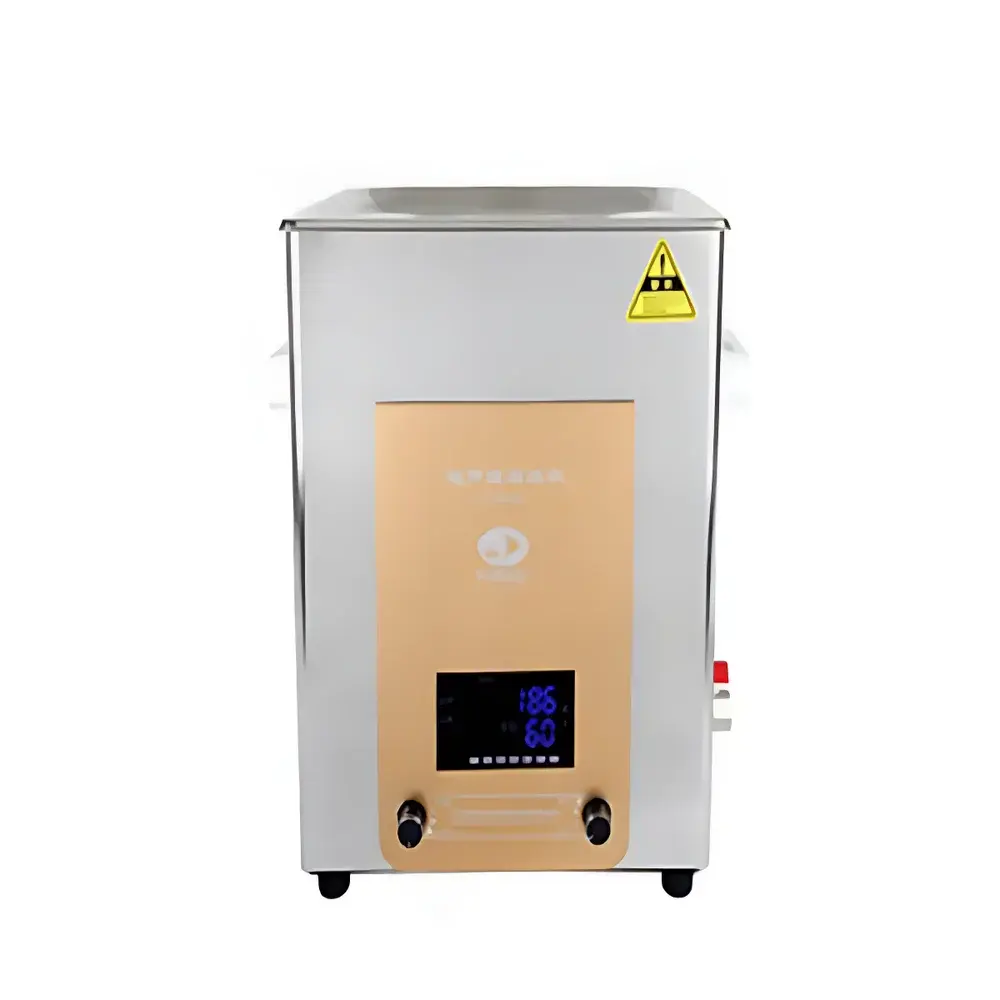
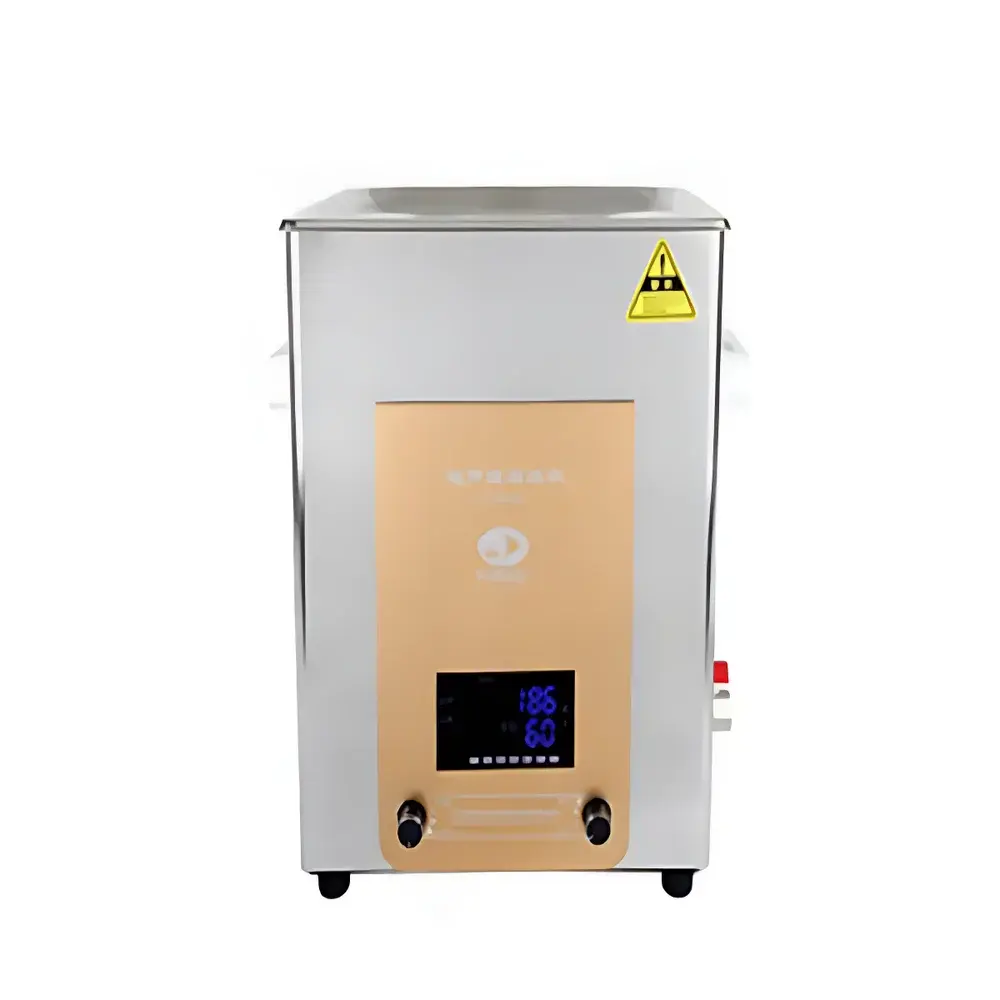
Scientz SB-4200DT Heated Ultrasonic Cleaner
| Brand | Scientz |
|---|---|
| Origin | Zhejiang, China |
| Model | SB-4200DT |
| Tank Capacity | 14.4 L |
| Ultrasonic Frequency | 40 kHz |
| Ultrasonic Power | 480 W |
| Heating Range | Ambient to 80 °C |
| Timer Range | 1–999 min |
| Heating Power | 800 W |
| Tank Dimensions (L×W×H) | 300 × 240 × 200 mm |
| Drain Valve | Yes |
Overview
The Scientz SB-4200DT Heated Ultrasonic Cleaner is an industrial-grade benchtop ultrasonic cleaning system engineered for precision laboratory and quality control environments. It operates on the principle of acoustic cavitation: high-frequency mechanical vibrations (40 kHz) generated by piezoelectric transducers are transmitted through the cleaning medium—typically aqueous or solvent-based solutions—inducing the formation, growth, and violent collapse of microscopic vapor bubbles. This transient cavitation event produces localized shockwaves and microstreaming forces capable of dislodging sub-micron particulates, organic residues, biofilms, and adsorbed contaminants from complex geometries—including blind holes, capillary channels, porous surfaces, and delicate optical components—without mechanical abrasion or surface damage. The integrated heating module (ambient to 80 °C) enhances cleaning efficacy by reducing solution viscosity, accelerating chemical reaction kinetics, and promoting emulsification of hydrophobic soils such as oils and greases. Designed with a robust stainless-steel tank (300 × 240 × 200 mm), sealed transducer mounting, and thermally stable power electronics, the SB-4200DT delivers consistent energy delivery and long-term operational reliability under repeated thermal and acoustic cycling.
Key Features
- Stainless-steel ultrasonic tank (300 × 240 × 200 mm) with integrated drain valve for controlled fluid disposal and maintenance
- Precise digital timer with 1–999 minute adjustable duration and real-time countdown display
- Independent temperature control system with ±1 °C stability across ambient to 80 °C range; heating power rated at 800 W
- Dedicated ultrasonic generator delivering 480 W continuous output at fixed 40 kHz frequency—optimized for broad-spectrum contaminant removal
- Power interruption memory function: retains last-set time and temperature parameters after power loss
- Front-panel LED display with intuitive interface for simultaneous monitoring of elapsed time, set temperature, and active mode status
- Transducer assembly constructed with high-reliability imported piezoceramic elements and epoxy bonding technology for uniform acoustic field distribution
Sample Compatibility & Compliance
The SB-4200DT accommodates a wide spectrum of sample types and cleaning protocols common in regulated laboratories. Compatible substrates include borosilicate glassware (vials, cuvettes, pipettes), quartz optics, stainless-steel surgical instruments, titanium dental tools, silicon wafers, ceramic substrates, and polymer-based microfluidic devices. Its cleaning performance supports routine validation procedures aligned with ISO 13485 (medical device manufacturing), ASTM D2603 (ultrasonic cleaning efficacy testing), and USP / environmental decontamination requirements. While not certified for sterile processing per AAMI ST79, the unit supports pre-sterilization cleaning steps when used with validated detergents and rinse protocols. All electrical components comply with IEC 61010-1 safety standards for laboratory equipment; CE marking is applicable for EU market deployment under Low Voltage and EMC directives.
Software & Data Management
The SB-4200DT is a standalone analog-digital hybrid instrument with no embedded firmware or network connectivity. Parameter settings (time, temperature) are stored in non-volatile memory and recalled automatically upon power-up. No software installation, driver dependencies, or data export functionality is provided—consistent with Class I laboratory equipment design philosophy emphasizing operational simplicity, audit readiness, and minimal cybersecurity surface. For GLP/GMP environments requiring traceability, users may integrate external logging systems via serial TTL output (optional accessory) or manual logbook entries referencing batch numbers, cleaning cycle IDs, detergent lot codes, and operator initials—fully compatible with 21 CFR Part 11-compliant electronic record systems when paired with validated third-party data acquisition modules.
Applications
- Cleaning of analytical glassware prior to HPLC, GC, or ICP-MS analysis to eliminate carryover and spectral interference
- Preparation of cell culture flasks, bioreactor components, and filtration housings in pharmaceutical R&D and manufacturing
- Removal of polishing compounds and metal fines from precision machined parts in metrology labs
- De-gassing of solvents and mobile phases to prevent pump cavitation and baseline noise in chromatographic systems
- Disassembly support for MEMS devices and microelectrode arrays where mechanical scrubbing is prohibited
- Routine maintenance of endoscopes, laparoscopic tools, and orthopedic implants in hospital central sterile supply departments (CSSD)
- Restoration of optical clarity on microscope objectives, interferometer mirrors, and photomask blanks
FAQ
What is the recommended cleaning solution for general laboratory use?
Aqueous alkaline detergent formulations (pH 10–11) with surfactants and chelating agents are optimal for removing proteins, lipids, and particulates from glass and metal surfaces. Avoid chloride-containing solutions with stainless-steel tanks unless corrosion-inhibited.
Can the SB-4200DT be used with flammable solvents?
No. This model lacks explosion-proof certification and is designed exclusively for aqueous or high-flashpoint (>60 °C) solvents. Use only in well-ventilated fume hoods if low-flashpoint solvents are required—and only with appropriate safety interlocks and vapor monitoring.
How often should the ultrasonic tank be descaled?
In hard-water regions, descaling with 5% citric acid solution every 2–4 weeks prevents calcium carbonate buildup on transducers and tank walls, maintaining acoustic coupling efficiency and thermal transfer.
Is the heating function programmable independently of ultrasonic activation?
Yes. The heater operates in parallel mode: it can run continuously during sonication or independently for pre-warming or post-rinse holding without ultrasonic output.
Does the unit support calibration verification per ISO/IEC 17025?
While the SB-4200DT itself is not a measuring instrument, its temperature sensor and timer may be verified using NIST-traceable reference standards. Calibration records must be maintained per organizational quality management system requirements.



