
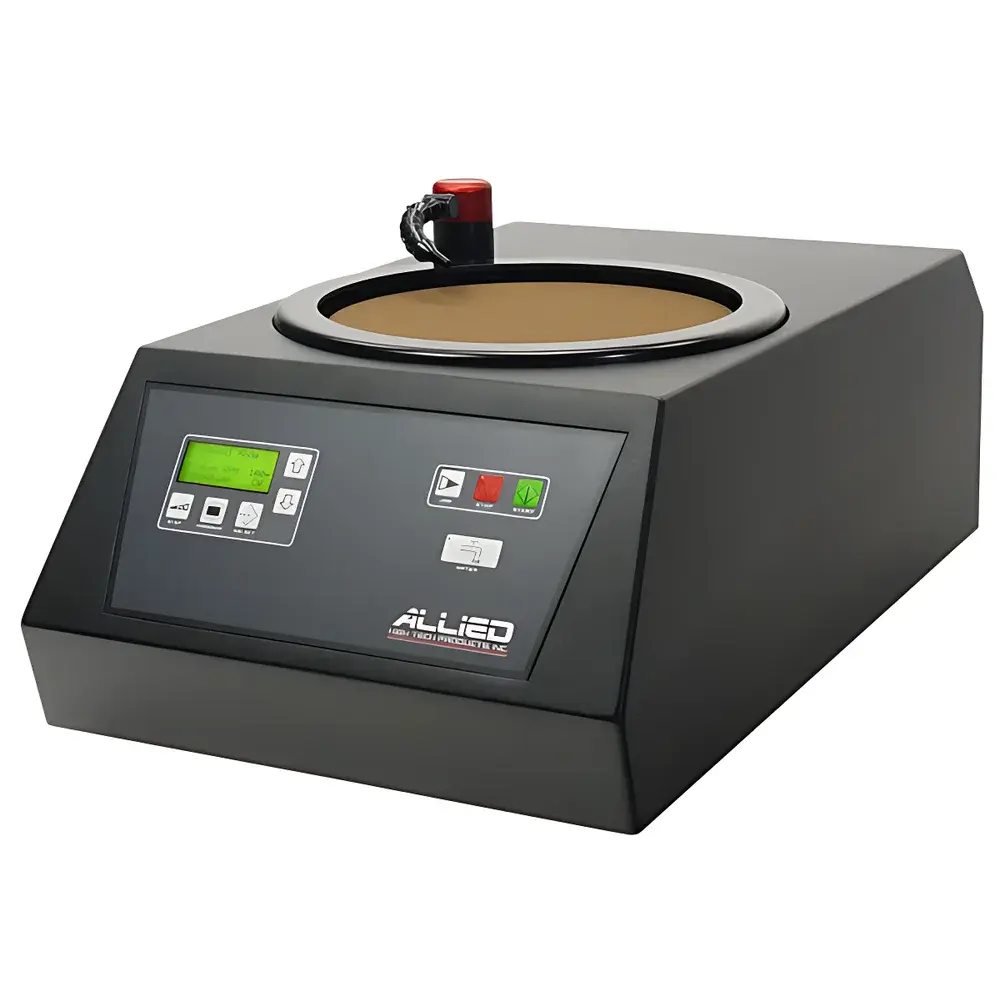
Allied MetPrep 1™ Manual Grinding and Polishing Machine
| Brand | Allied |
|---|---|
| Origin | USA |
| Model | MetPrep 1™ |
| Dimensions (L×W×H) | 15" W × 26" D × 20" H (381 × 660 × 508 mm) |
| Number of Platen | 1 |
| Platen Diameter | 8" (203 mm) |
| Speed Range | 5–350 RPM (in 5 RPM increments) |
| Motor Power | 0.5 HP (375 W) |
| Platen Runout | < 5 µm |
| Control Interface | Touch-button digital panel |
| Coolant Delivery | Solenoid-actuated valve with manual flow control |
| Construction | Aluminum and steel frame |
| Rotation Direction | Bidirectional (CW/CCW) |
| Voltage | 100–240 V AC |
Overview
The Allied MetPrep 1™ is a precision-engineered manual grinding and polishing machine designed for reproducible, vibration-minimized sample preparation in metallurgical, geological, ceramic, and advanced materials laboratories. Unlike fully automated systems, the MetPrep 1™ bridges the gap between operator control and instrument-grade consistency—enabling skilled technicians to execute repeatable, low-damage surface conditioning on delicate or heterogeneous specimens. Its operation is grounded in controlled mechanical abrasion: samples are manually held against a rotating 8-inch (203 mm) platen while coolant is delivered via solenoid-actuated flow regulation. The system employs Couette-flow-based rotational dynamics and rigid mechanical coupling to ensure torque stability across the full 5–350 RPM speed range, minimizing chatter-induced subsurface deformation—a critical requirement for subsequent microstructural analysis (e.g., optical microscopy, SEM, EBSD). Engineered and manufactured in the United States, the MetPrep 1™ complies with UL 61010-1 and IEC 61000-6-3 safety and EMC standards, supporting GLP-aligned documentation workflows.
Key Features
- Digital touch-button interface for precise control of start/stop, platen speed (5–350 RPM in 5-RPM increments), rotation direction (CW/CCW), and coolant activation
- High-torque 0.5 HP (375 W) motor delivering consistent rotational force even under variable load conditions—essential for uniform material removal during coarse grinding and fine polishing stages
- Ultra-low runout platen (< 5 µm vertical deviation) certified for compatibility with thin-film polishing cloths, diamond suspensions, and colloidal silica slurries
- Modular platen design with quick-release mechanism enabling tool-free replacement of aluminum, magnetic aluminum, glass, or custom platens (e.g., 8″ aluminum platen P/N 5-2005; magnetic variant P/N 5-2005M)
- Bidirectional platen rotation optimized for directional scratch mitigation and anisotropic sample conditioning
- Integrated solenoid-controlled coolant delivery system with calibrated manual valve—ensuring reproducible fluid volume per unit time without pressure spikes that cause slurry pooling or splashing
- Rigid aluminum-and-steel chassis with isolated platen spindle assembly, reducing transmitted vibration by >70% compared to conventional benchtop grinders (per internal modal analysis at 0–200 Hz)
Sample Compatibility & Compliance
The MetPrep 1™ accommodates a broad spectrum of specimen geometries and mechanical properties—including brittle intermetallics, soft polymers, sintered carbides, and layered composites—when used with appropriate consumables (e.g., SiC papers, diamond-impregnated pads, chemo-mechanical polishing films). Its manual operation mode permits real-time tactile feedback, making it especially suitable for edge-sensitive samples (e.g., TEM lamellae mounts, thin-sectioned rock cores, or coated biomedical implants) where automated downforce may induce delamination or rounding. The system supports ASTM E3, ISO 14487, and ASTM E407-compliant metallographic preparation protocols. While not a GMP-certified instrument per se, its deterministic digital controls, audit-ready operational parameters (speed, direction, runtime), and traceable platen calibration enable integration into FDA 21 CFR Part 11–compliant environments when paired with validated SOPs and electronic lab notebook (ELN) documentation.
Software & Data Management
The MetPrep 1™ operates as a stand-alone electromechanical platform with no embedded firmware or network connectivity. All operational parameters are set locally via the sealed membrane keypad; no software installation, driver dependencies, or cloud synchronization is required. This architecture eliminates cybersecurity vulnerabilities and ensures long-term functional continuity—critical for regulated labs maintaining legacy validation states. For laboratories requiring digital recordkeeping, Allied provides optional CSV-loggable timer modules (e.g., Timer+ accessory) that timestamp start/stop events and total runtime. These logs integrate natively with LIMS platforms supporting RS-232 or USB-HID input. No proprietary file formats or vendor-locked ecosystems are employed—data remains fully portable and human-readable.
Applications
- Preparation of cross-sectional samples for failure analysis (FA) in electronics packaging and solder joint evaluation
- Edge-preserving thinning of geological thin sections prior to petrographic imaging
- Surface planarization of additively manufactured (AM) metal parts for pore structure quantification per ASTM F2924
- Controlled polishing of ceramic matrix composites (CMCs) to expose fiber/matrix interfaces without pull-out artifacts
- Low-stress finishing of dental alloys and orthopedic implant materials for biocompatibility assessment per ISO 10993-12
- Research-scale development of novel abrasive media and lubricant formulations via comparative wear-track metrology
FAQ
Is the MetPrep 1™ compatible with automated force-applying accessories?
No—the MetPrep 1™ is strictly a manual operation platform. It does not support motorized sample holders, load cells, or programmable downforce modules. Its design prioritizes operator agency and tactile process control.
Can the platen speed be calibrated or certified for traceability?
Yes. Allied provides NIST-traceable speed verification reports upon request (additional service fee applies). The internal tachometric feedback loop maintains ±1 RPM accuracy across the full operating range.
What maintenance intervals are recommended for sustained precision?
Platen bearing inspection every 1,500 hours of operation; coolant line flush every 6 months; keypad membrane cleaning with isopropyl alcohol every 3 months. Full service manuals and spare parts diagrams are available through Allied’s Technical Documentation Portal.
Does the 8″ platen accommodate industry-standard 200 mm wafer carriers?
No—the 8″ (203 mm) platen diameter is optimized for metallurgical and geologic specimens, not semiconductor wafers. For 200 mm wafer processing, Allied recommends the MultiPrep™ or AutoMet™ series.
Is CE marking available for EU shipment?
Yes. Units shipped to EEA countries include CE marking per Machinery Directive 2006/42/EC and RoHS 2011/65/EU compliance documentation in the shipping package.



