
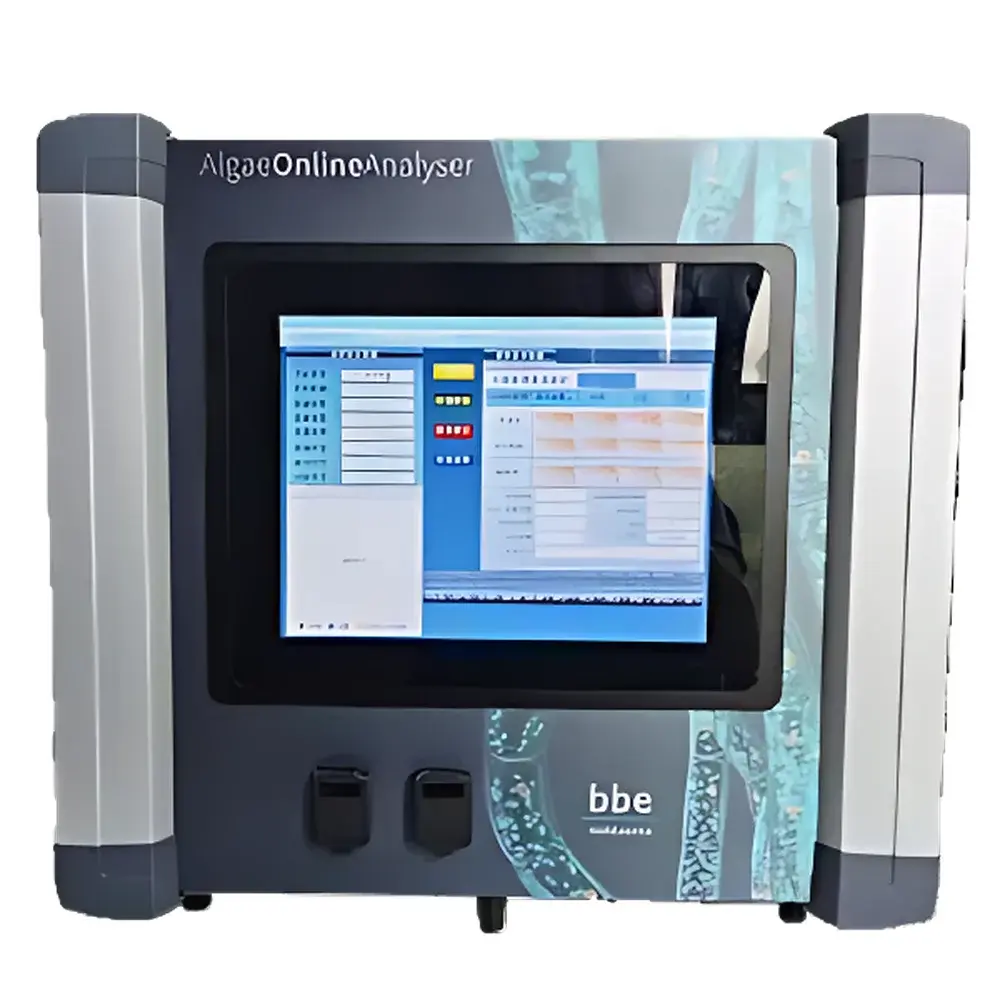
BBE Moldaenke Algal Quality Control System Ver. 1.1
| Brand | BBE Moldaenke |
|---|---|
| Origin | Shanghai, China |
| Manufacturer Type | Original Equipment Manufacturer (OEM) |
| Country of Origin | China |
| Model | Ver. 1.1 |
| Instrument Type | Algal Quality Control System |
| Compliance | Designed for ISO/IEC 17025-aligned QC workflows in environmental laboratories |
Overview
The BBE Moldaenke Algal Quality Control System Ver. 1.1 is an automated, standalone quality assurance platform engineered to perform routine verification and validation of algal pigment quantification data generated by BBE’s family of in vivo fluorometric algal analyzers (e.g., MOLDENKE ALGALab, µMACS). Unlike conventional calibration check standards, this system implements real-time, traceable QC protocols grounded in photobiological reference materials and flow-controlled sample delivery. It operates on the principle of controlled excitation-emission spectral response monitoring—leveraging standardized algal suspension batches with known chlorophyll-a, phycocyanin, and phycoerythrin concentrations—to verify instrument linearity, zero-point stability, repeatability (RSD ≤ 2.5% over 24 h), and measurement accuracy against certified reference materials (CRMs) traceable to NIST SRM 1951c (estuarine sediment) and EPA Method 445.0. The system is designed for unattended operation in fixed-site water quality monitoring stations, municipal drinking water intakes, and wastewater treatment plant influent/effluent control points where regulatory compliance with EU WFD (Water Framework Directive) Annex V and US EPA Method 1623.1 requires documented QC frequency, audit trails, and data integrity.
Key Features
- Automated QC scheduling: Configurable intervals (1–24 h) for routine verification of linearity, zero drift, and recovery rate using preloaded CRM vials
- Integrated fluidic module: Peristaltic sampling pump with chemically resistant tubing (Pharmed® BPT), precision flow control (±1.5% full scale), and self-cleaning rinse cycle between QC events
- Real-time diagnostics: Onboard temperature, pressure, and optical path integrity monitoring with automatic fault logging and alert escalation via Modbus TCP or RS-485
- Robust mechanical design: IP65-rated enclosure, shock-absorbing mounting brackets, and vibration-damped internal chassis suitable for installation in pump houses or outdoor kiosks
- Low-power operation: <8 W average consumption; compatible with solar-battery hybrid power systems for remote deployment
- Minimal maintenance footprint: Quarterly service interval includes filter replacement, tubing inspection, and CRM vial replenishment—no optical recalibration required
Sample Compatibility & Compliance
The system accepts aqueous suspensions of cultured freshwater/marine algae (e.g., Microcystis aeruginosa, Anabaena flos-aquae, Chlorella vulgaris) and standardized CRM solutions prepared per ISO 10260:2022 (water quality — guidance on preparation and use of reference materials for algal pigment analysis). It supports QC verification for instruments measuring fluorescence intensity at 450 nm (excitation) / 680 nm (emission) for chlorophyll-a, 590 nm / 650 nm for phycocyanin, and 490 nm / 575 nm for phycoerythrin. All QC records comply with GLP and ISO/IEC 17025 requirements, including timestamped operator ID, environmental conditions (ambient temperature, humidity), and raw signal output files (.csv and .xlsx). Data export supports FDA 21 CFR Part 11–compliant electronic signatures when integrated with validated LIMS platforms.
Software & Data Management
The embedded firmware (v3.2.1) provides local web-based configuration via HTTPS-enabled interface (TLS 1.2), supporting role-based access control (admin, technician, viewer). QC reports include statistical process control (SPC) charts (X-bar & R charts), trend analysis of zero-point drift over 90 days, and pass/fail determination per predefined acceptance criteria (e.g., ±5% deviation from CRM target value). Historical QC logs are retained for ≥12 months onboard and synchronized to external NAS or cloud storage (AWS S3 or Azure Blob) via scheduled FTP/SFTP push. Audit trails record all configuration changes, manual QC initiations, emergency stops, and firmware updates with SHA-256 hash verification.
Applications
- Regulatory compliance monitoring for cyanobacterial toxin risk assessment under WHO Guidelines for Drinking-water Quality (GDWQ)
- Performance verification of online algal fluorometers deployed in reservoirs and rivers under USGS NWIS and EU Copernicus Inland Water services
- Method validation support for ISO 10260:2022 and ASTM D8020-16 (Standard Practice for Quantifying Algal Pigments by In Vivo Fluorometry)
- Long-term stability assessment of field-deployed algal analyzers during seasonal bloom cycles (spring–autumn)
- Reference laboratory intercomparison studies requiring documented QC frequency and traceability to SI units
FAQ
What types of algal analyzers is the Ver. 1.1 QC system compatible with?
It is specifically designed for BBE Moldaenke fluorometric algal analyzers utilizing in vivo chlorophyll and phycobiliprotein fluorescence detection. Integration with third-party instruments requires analog voltage output (0–5 V or 4–20 mA) and Modbus RTU/TCP protocol support.
Does the system require daily operator intervention?
No—once configured, it performs fully autonomous QC cycles. Manual initiation is optional for troubleshooting or method validation.
How is data integrity ensured during transmission?
All data packets include CRC-32 checksums; TLS 1.2 encryption secures web interface access; audit logs are write-once and tamper-evident.
Can the system be deployed in offshore buoy platforms?
Yes—its IP65 rating, wide operating temperature range (−10 °C to +50 °C), and low-voltage DC input (12–24 VDC) make it suitable for marine buoy integration with appropriate anti-fouling housing.
Is firmware update capability available remotely?
Yes—secure OTA (over-the-air) updates are supported via authenticated HTTPS POST with digital signature verification.
Related Products







