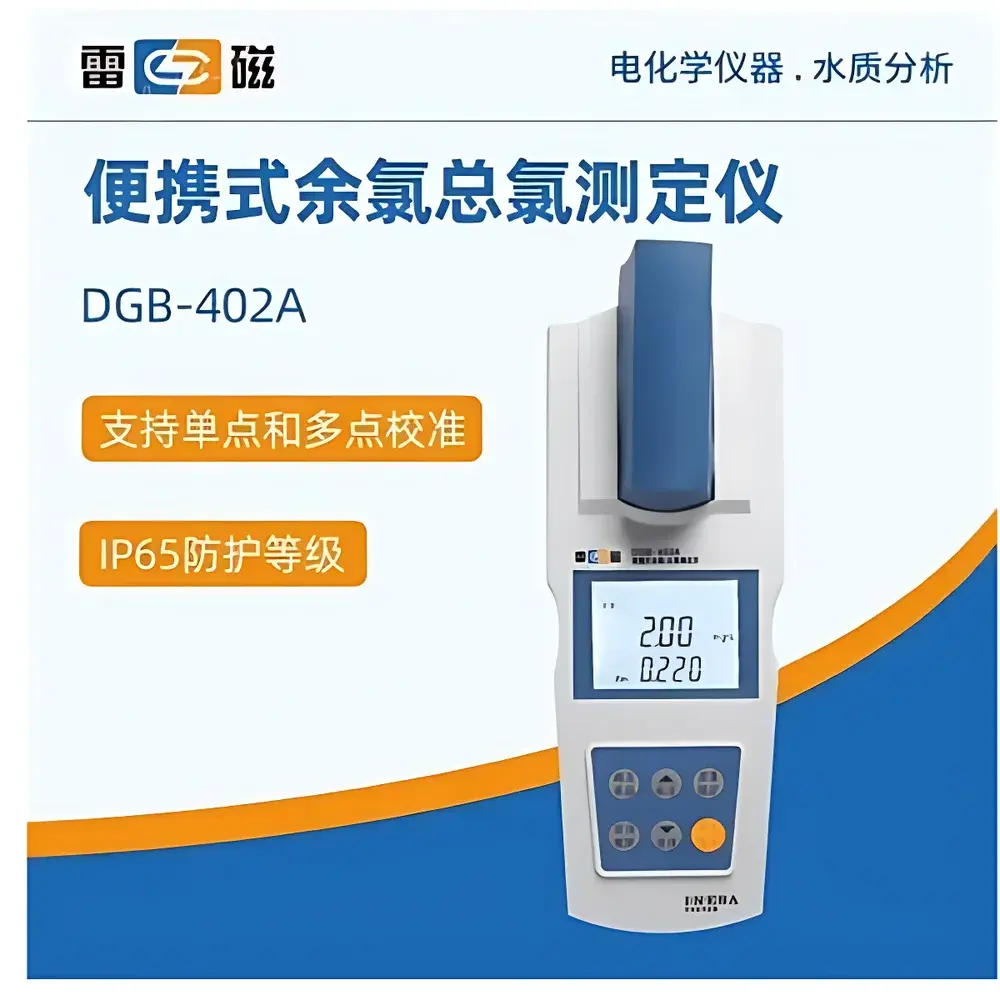
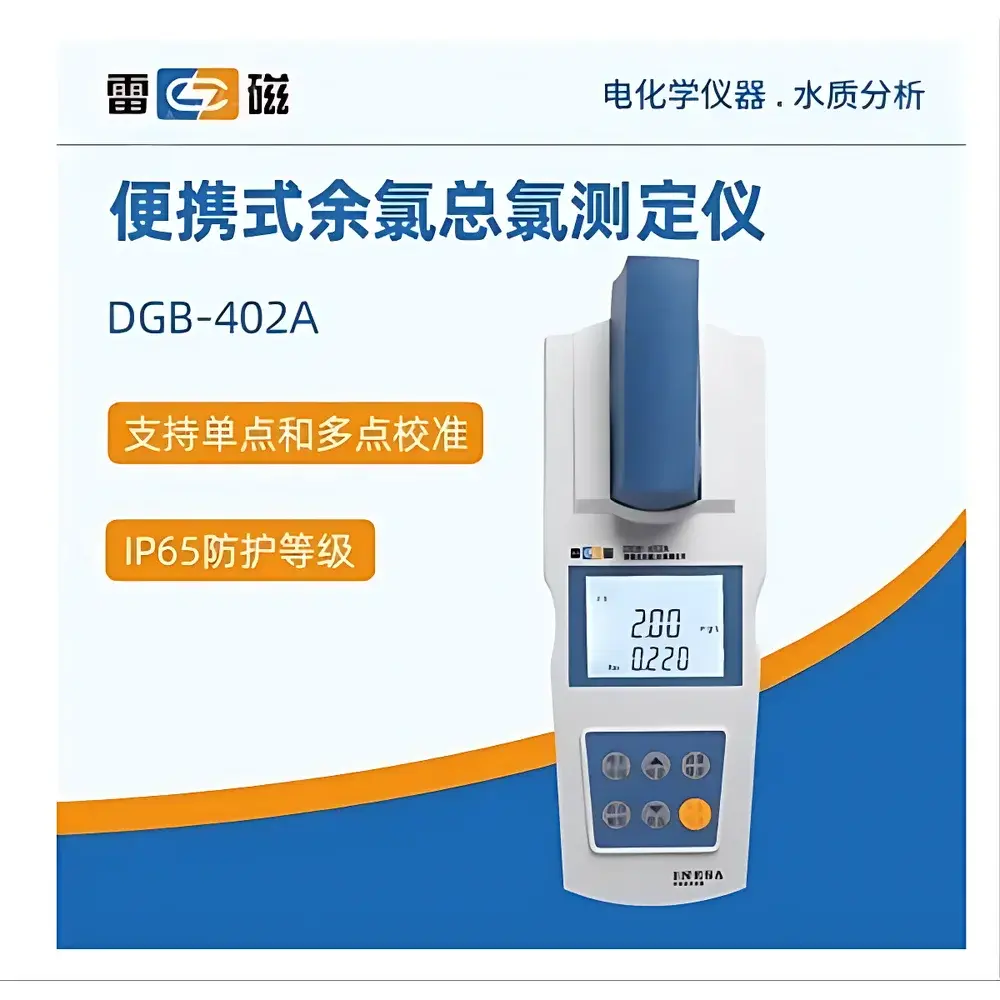
Leichi DGB-402A Portable Residual & Total Chlorine Analyzer
| Brand | Leichi |
|---|---|
| Origin | Shanghai, China |
| Model | DGB-402A |
| Measurement Principle | DPD Colorimetric Method (515 nm LED) |
| Range | 0.00–3.00 mg/L (Residual & Total Chlorine) |
| Resolution | 0.01 mg/L (Concentration), 0.001 ABS (Absorbance) |
| Accuracy | ±0.05 mg/L (≤1 mg/L) |
| Repeatability | ≤2.5% |
| LOD | ≤0.02 mg/L |
| Calibration | Up to 5-point user-defined calibration |
| Data Storage | 200 measurement records with timestamp, operator ID, and calibration history |
| Power Supply | 4 × AA alkaline batteries (1.5 V) |
| Enclosure Rating | IP65 |
| Dimensions | 230 × 86 × 47 mm |
| Weight | ~0.4 kg |
| Compliance | GLP-compliant data management, aligned with ISO 7393-2 and EPA Method 334.0 for chlorine determination |
Overview
The Leichi DGB-402A Portable Residual & Total Chlorine Analyzer is a field-deployable, single-wavelength photometric instrument engineered for rapid, on-site quantification of free residual chlorine and total chlorine in aqueous samples. It operates on the standardized N,N-diethyl-p-phenylenediamine (DPD) colorimetric method—recognized under ISO 7393-2, EPA Method 334.0, and Chinese National Standard GB/T 5750.11—where chlorine oxidizes DPD to form a stable magenta-colored complex proportional to concentration. The analyzer employs a precision 515 nm light-emitting diode (LED) as its optical source, delivering long-term spectral stability (>10,000 hours), minimal thermal drift, and immunity to mechanical shock—critical advantages over traditional tungsten-halogen or filtered lamp systems. Its compact, handheld architecture integrates a low-power microcontroller platform, enabling extended battery operation without compromising photometric linearity or signal-to-noise ratio. Designed for routine monitoring rather than research-grade speciation, the DGB-402A targets operational compliance verification across municipal water distribution, recreational aquatic facilities, healthcare wastewater discharge points, and disinfectant dosing validation.
Key Features
- Stable 515 nm LED optical system with factory-aligned wavelength tolerance (±2 nm), eliminating need for periodic lamp replacement or warm-up time
- Integrated microprocessor with real-time ambient temperature compensation and auto-zero function during measurement cycle
- Flexible calibration architecture supporting both single-point offset adjustment and up to five-point non-linear calibration curves, editable via intuitive button-driven interface
- GLP-compliant data logging: each of the 200 stored records includes sample ID, measurement date/time, operator code, calibration version, and absorbance value—traceable for internal audits
- Robust IP65-rated enclosure with sealed keypad and gasketed battery compartment, certified for operation in high-humidity environments (e.g., pump stations, pool decks, mobile labs)
- Intelligent power management: automatic sleep mode after 5 minutes of inactivity; low-battery indicator with remaining runtime estimation
Sample Compatibility & Compliance
The DGB-402A is validated for use with clarified, low-turbidity water matrices including potable water, treated effluent, swimming pool and spa water, cooling tower make-up, and diluted disinfectant solutions. Samples must be free of interfering oxidants (e.g., bromine, ozone, chlorine dioxide) unless compensated via sequential DPD reagent addition protocols. Turbidity exceeding 5 NTU requires pre-filtration (0.45 µm membrane). The instrument conforms to functional requirements outlined in ISO/IEC 17025 for field-portable testing equipment and supports documentation practices required under WHO Guidelines for Drinking-water Quality and US CDC Model Aquatic Health Code. While not FDA 21 CFR Part 11–certified out-of-the-box, its immutable audit trail structure enables integration into laboratory quality management systems adhering to GLP and GMP principles.
Software & Data Management
Data export is performed manually via visual readout and manual transcription, as the DGB-402A lacks USB or Bluetooth connectivity—a deliberate design choice to enhance field reliability and reduce firmware attack surface. All stored entries are retained through battery replacement and power cycling. Each record includes a unique sequential index, ISO 8601-formatted timestamp (YYYY-MM-DD HH:MM), and operator identifier (user-definable 3-character code). Internal memory retains calibration metadata—including date, standard concentrations used, and regression coefficients—enabling full traceability during regulatory review. For laboratories requiring electronic data capture, Leichi provides optional companion software (Leichi LabLink v2.1) compatible with Windows-based PCs for batch download and CSV export, supporting basic statistical summaries (mean, SD, CV%) per sample set.
Applications
- Routine verification of chlorine residual at entry points of municipal distribution networks per WHO and EPA guidance
- Compliance monitoring of swimming pool and hot tub free chlorine (1–3 mg/L) and combined chlorine (<0.2 mg/L) thresholds
- Validation of point-of-use disinfection systems in hospitals and dental clinics
- Field assessment of chlorination efficacy in emergency response water treatment units
- Quality control of sodium hypochlorite stock solutions prior to dilution and dosing
- Educational use in environmental science and public health curricula for hands-on water quality methodology training
FAQ
Does the DGB-402A differentiate between free chlorine and combined chlorine?
No—it measures total chlorine directly using DPD reagent No. 1. To determine free chlorine, users must perform a separate measurement with DPD No. 1 only; combined chlorine is calculated by subtracting free chlorine from total chlorine (measured with DPD No. 1 + No. 3).
Can the instrument be calibrated with NIST-traceable standards?
Yes—calibration is performed using aqueous chlorine standards prepared from potassium permanganate–stabilized sodium hypochlorite reference materials, traceable to NIST SRM 3194 or equivalent national metrology institute standards.
Is the 515 nm LED replaceable in the field?
No—the LED is soldered and optically aligned during manufacturing; replacement requires return to authorized service center and recalibration.
What is the recommended maintenance interval?
Optical path cleaning with lint-free tissue and isopropyl alcohol every 50 measurements; full performance verification against primary standard recommended quarterly or after 500 measurements.
Does the device meet CE or UKCA marking requirements?
The DGB-402A complies with IEC 61010-1:2010 for electrical safety and EMC Directive 2014/30/EU; CE marking is applied for instruments distributed within the EEA. UKCA marking is not applicable for this model variant.
Related Products