
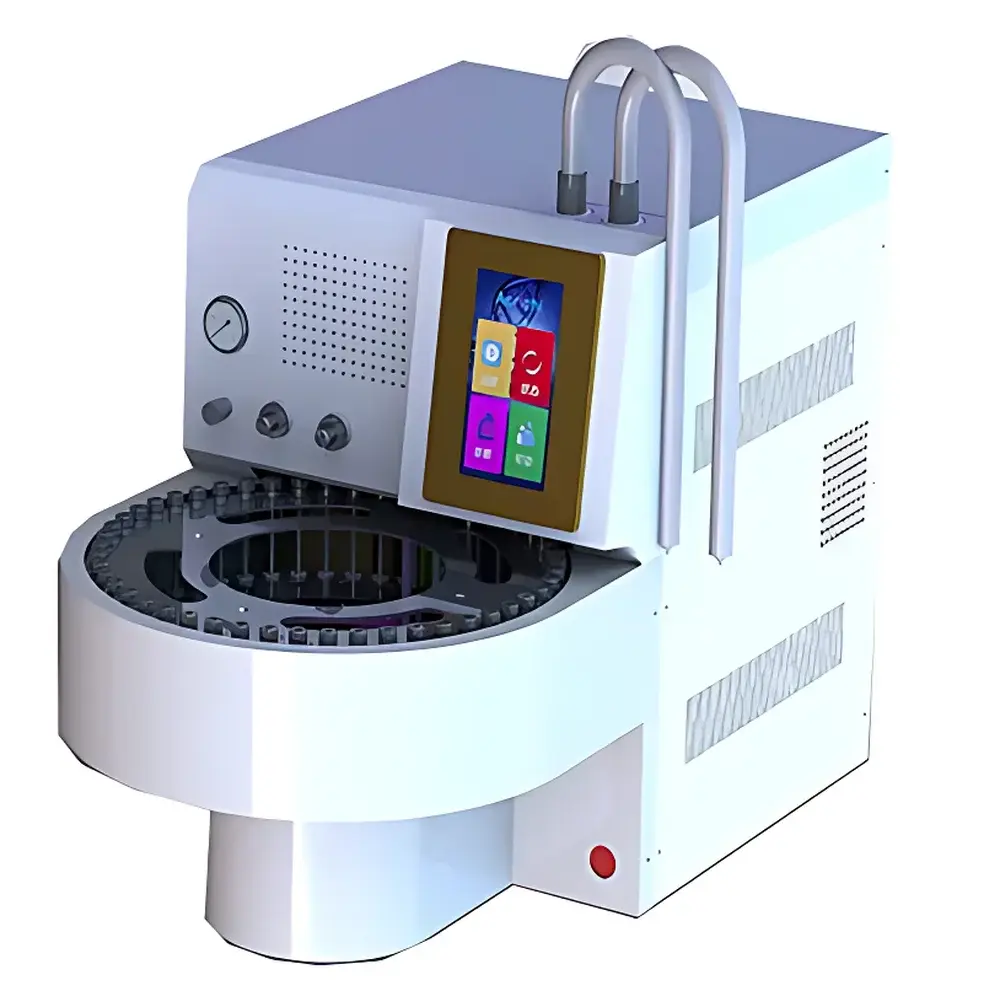
Acrichi ATD I-50 Automated Single-Stage Thermal Desorber
| Brand | Acrichi |
|---|---|
| Origin | Beijing, China |
| Manufacturer Type | Authorized Distributor |
| Product Category | Domestic |
| Model | Acrichi ATD I-50 |
| Instrument Type | Single-Stage Thermal Desorber |
| Desorption Temperature Range | Ambient to 420 °C |
| Temperature Control Accuracy | ±1 °C (desorption furnace, 6-port valve, transfer line) |
| Desorption Pressure/Flow Range | 0–300 mL/min (continuously adjustable) |
| Desorption/Injection/Activation Time | 0–99 min |
| Sample Capacity | 50 positions |
| Sorbent Tube Dimensions | 6.35 mm OD × 88.9 mm L (1/4″ × 3.5″) |
| Power Consumption | 500 W |
| Dimensions (W×D×H) | 605 × 350 × 520 mm |
| Weight | ~30 kg |
| Desorption Recovery Rate | >98% |
| Interface | Touchscreen HMI with event-triggered GC synchronization |
| Method Storage | 10 user-editable, recallable methods |
| Leak Detection | Integrated real-time pressure decay monitoring |
| Fault Diagnostics | Auto-alert with on-screen status code and operational log |
Overview
The Acrichi ATD I-50 is an automated single-stage thermal desorption system engineered for high-throughput, reproducible analysis of volatile and semi-volatile organic compounds (VOCs and SVOCs) adsorbed onto standard 1/4″ OD sorbent tubes. It operates on the principle of controlled thermal desorption—where analytes are thermally released from solid-phase sorbents under inert gas flow and quantitatively transferred directly into a gas chromatograph (GC) inlet via a heated transfer line. Unlike multi-stage systems, the ATD I-50 performs direct desorption without cryofocusing, making it especially suited for routine environmental air monitoring, indoor air quality (IAQ) assessment, occupational hygiene screening, and polymer off-gassing studies where method simplicity, robustness, and regulatory traceability are prioritized over ultra-trace detection limits. Its architecture complies with core requirements of ASTM D6196, ISO 16017-1, and US EPA TO-17 for sorbent tube-based sampling and thermal desorption workflows.
Key Features
- 50-position autosampler with precise carousel indexing and tube recognition—enabling unattended overnight operation and batch processing of field-collected samples.
- Triple-zone independent temperature control: desorption furnace (ambient–420 °C), 6-port switching valve (ambient–220 °C), and transfer line (ambient–220 °C), all maintained within ±1 °C accuracy to ensure consistent analyte elution profiles and minimize breakthrough or degradation.
- Mass-flow-controlled desorption with 0–300 mL/min range and digital flow calibration—supporting method optimization across diverse sorbent chemistries (e.g., Tenax TA, Carbopack B/C, graphitized carbon blacks).
- Integrated leak detection via real-time pressure decay monitoring during pre-desorption hold—automatically halting sequence execution and flagging compromised tube seals or valve leaks before injection.
- Touchscreen human-machine interface (HMI) with embedded method editor, runtime parameter logging, and timestamped event history—designed for GLP-compliant lab environments requiring audit-ready operational records.
- Event-triggered GC synchronization: initiates GC oven ramp and data acquisition upon valve actuation; also accepts external TTL or contact-closure signals from third-party chromatography data systems (CDS).
Sample Compatibility & Compliance
The ATD I-50 accommodates industry-standard 1/4″ OD × 3.5″ stainless steel or glass sorbent tubes—including those packed with single- or multi-bed sorbents per ISO 16017-1 Annex A recommendations. It supports both passive and active sampling configurations, and is validated for use with EPA Compendium Method TO-17 sampling protocols. All thermal zones meet Class II temperature uniformity specifications per ASTM E2738, and the system’s firmware maintains a secure, non-volatile operational log compliant with FDA 21 CFR Part 11 requirements for electronic records and signatures when paired with validated CDS software. No internal cryogenic components are present; therefore, cold trap-related maintenance or liquid nitrogen dependency is eliminated—reducing total cost of ownership and enhancing operational uptime.
Software & Data Management
The onboard HMI stores up to 10 fully editable thermal desorption methods—including desorption time, trap activation parameters, flow setpoints, and valve timing sequences—with password-protected access levels for operator, supervisor, and administrator roles. Each run generates a timestamped metadata file (.csv) containing actual temperatures, measured flows, valve actuation times, and diagnostic flags—exportable via USB for integration into LIMS or QA/QC review workflows. The system does not include proprietary chromatography software but provides standardized RS-232 and dry-contact I/O interfaces for seamless interoperability with Agilent OpenLab, Thermo Chromeleon, Shimadzu GCsolution, and Waters Empower platforms. Audit trails record all method modifications, user logins, and critical alarm events with immutable timestamps.
Applications
- Environmental laboratories conducting EPA Method TO-17 analyses for ambient air VOCs (e.g., benzene, toluene, xylenes, C2–C4 aliphatics).
- Indoor air quality (IAQ) testing per ISO 16000-6 and ASTM D5116—evaluating building material emissions, cleaning product volatiles, and HVAC system contaminants.
- Occupational health and safety programs monitoring workplace exposure to regulated solvents and process vapors using NIOSH 1501/1600 series sampling strategies.
- Materials science R&D assessing polymer outgassing, adhesive off-gassing, and packaging migration under controlled thermal stress conditions.
- Pharmaceutical stability studies tracking residual solvents in lyophilized products or medical device packaging headspace.
FAQ
Does the ATD I-50 support cold trapping or cryofocusing?
No. The ATD I-50 is a single-stage thermal desorber and does not incorporate a cryogenic trap. It delivers analytes directly from the sorbent tube to the GC inlet under controlled thermal and flow conditions.
Can it be used with GC-MS systems?
Yes—provided the GC inlet is configured for splitless or cold on-column injection and the transfer line temperature is maintained above the boiling point of target analytes to prevent condensation.
Is method validation documentation available?
Acrichi provides IQ/OQ protocol templates aligned with ISO/IEC 17025 and GMP Annex 15 guidelines, including temperature mapping reports, flow linearity verification, and recovery rate test procedures using certified TO-17 reference standards.
What maintenance intervals are recommended?
Valve rotor seal inspection every 6 months; quartz liner cleaning after every 200 runs; annual calibration of temperature sensors and mass flow controller using NIST-traceable references.
How is data integrity ensured during extended unattended runs?
All operational parameters are logged continuously to non-volatile memory with cyclic overwrite protection; power-fail recovery resumes the current tube position and method step upon reboot, preserving sample integrity and chain-of-custody continuity.
Related Products




