
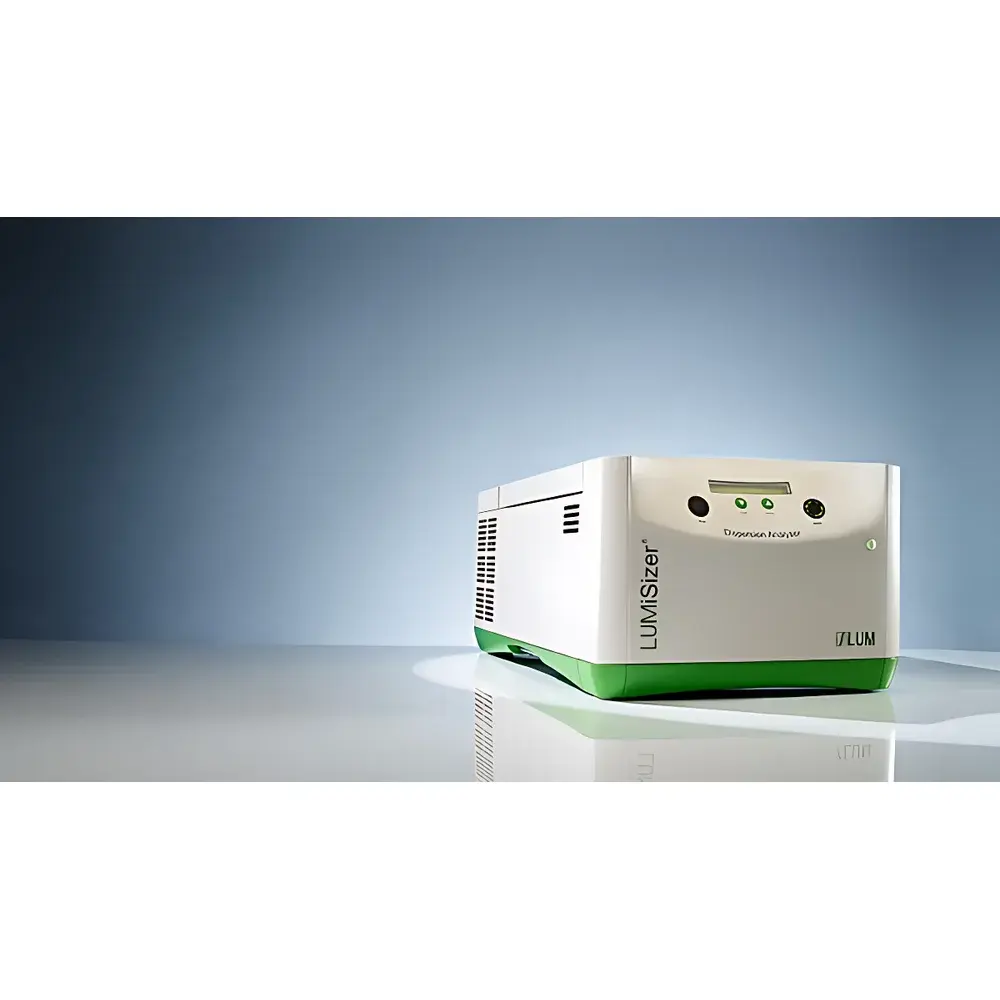
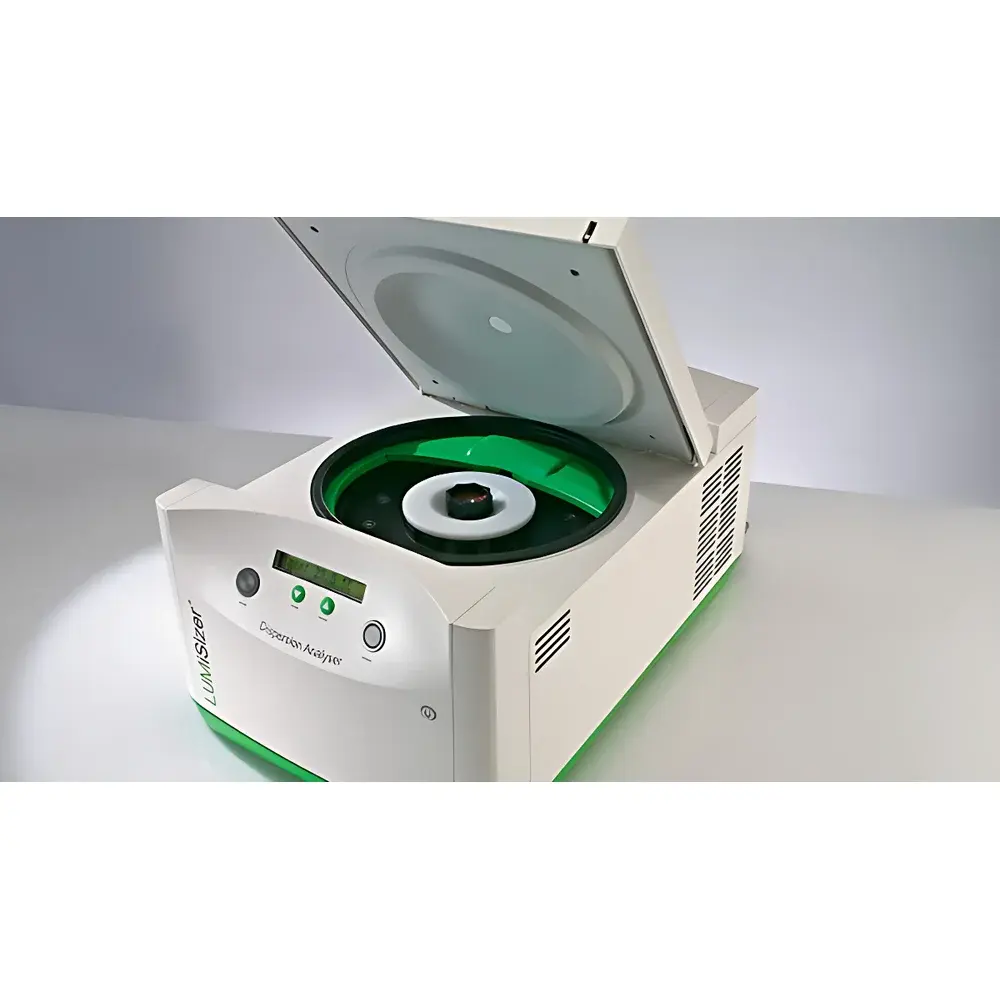
LUM LUMiSizer Stability Analyzer
| Brand | LUM |
|---|---|
| Origin | Germany |
| Manufacturer Type | Authorized Distributor |
| Origin Category | Imported |
| Model | LUMiSizer |
| Price Range | USD 92,000 – 131,500 (converted at ~¥7.6/USD) |
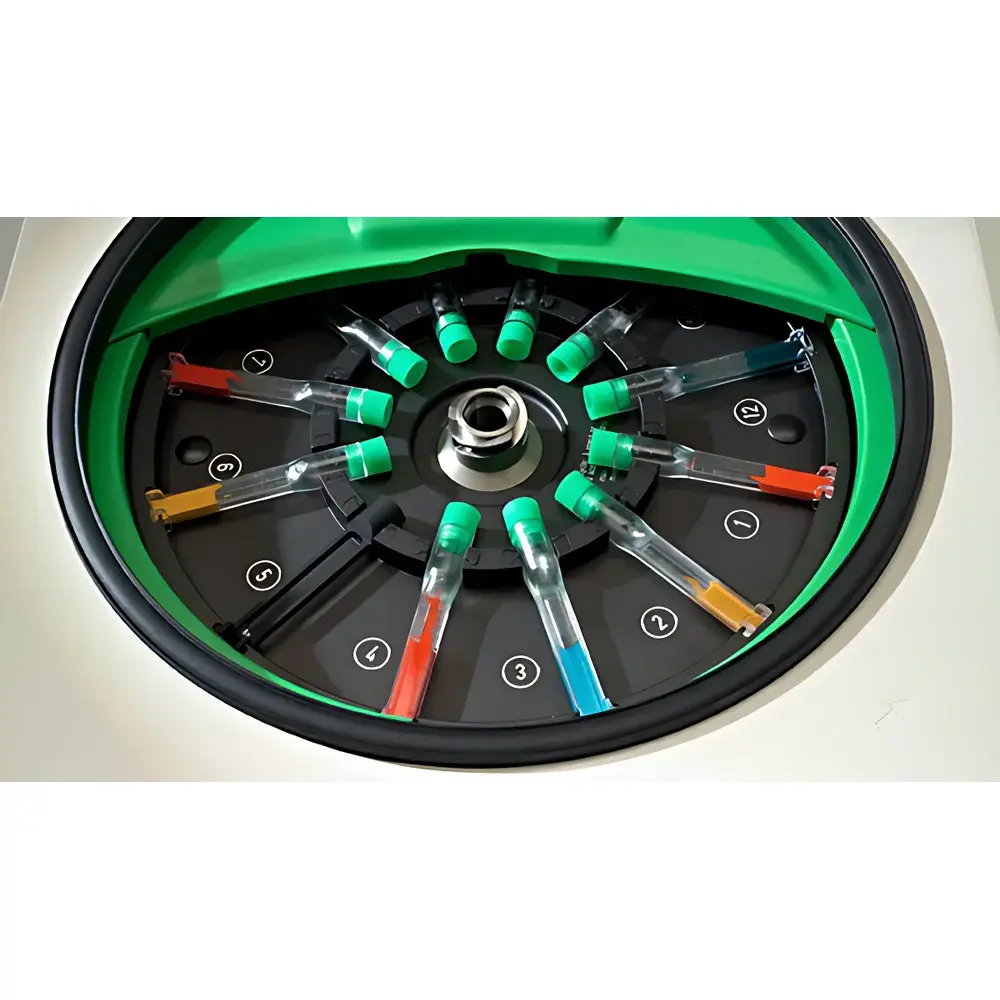
| Sample Capacity | 12 positions |
| Temperature Control | 4 °C to 60 °C (±1 K) |
| Acceleration Range | 6×g to 2300×g |
| Particle Size Range (by STEP-Technology) | 20 nm – 100 μm (stability & sedimentation velocity) |
| Concentration Range | 0.00015 wt% – 90 wt% |
| Density Range | up to 22 g/cm³ |
| Viscosity Range | 0.8 – 10⁸ mPa·s |
| Optical System | Multi-wavelength transmission scanning (650 nm, optional 470 nm & 870 nm) |
| Measurement Principle | Spatial and temporal extinction profiling (STEP-Technology) |
| Compliance | ISO/TR 13097, ISO 13318-2, FDA 21 CFR Part 11 (software audit trail enabled), GLP-ready |
| Sample Volume | 0.05 mL – 2.0 mL |
| Dimensions (W×H×D) | 37 cm × 27 cm × 60 cm |
| Weight | 40 kg |
| Power Supply | 100–240 V AC, 50/60 Hz |
Overview
The LUM LUMiSizer Stability Analyzer is a high-precision, centrifugal analytical instrument engineered for real-time, non-invasive characterization of colloidal and particulate dispersion stability and particle size distribution. Unlike conventional light scattering or sedimentation methods requiring dilution or material-specific assumptions, the LUMiSizer employs patented Spatially Resolved Extinction Profile (STEP) Technology — an ISO 13318-2 compliant optical method that records time-resolved transmission profiles across the entire sample height (from meniscus to bottom) during controlled centrifugal acceleration (6×g to 2300×g). This enables direct quantification of particle migration velocity distributions — independent of particle density, refractive index, or shape — making it uniquely capable of resolving complex instability mechanisms (e.g., creaming, sedimentation, flocculation, coalescence, phase separation) in undiluted, high-concentration systems (up to 90 wt%) and non-Newtonian media. Its multi-wavelength capability (standard 650 nm; optional 470 nm and 870 nm) supports differential analysis of absorbing, scattering, or fluorescent components, while integrated Peltier-based temperature control (4 °C to 60 °C, ±1 K) ensures thermally stable measurements aligned with accelerated shelf-life testing protocols.
Key Features
- Simultaneous analysis of up to 12 heterogeneous samples per run — differing in viscosity, concentration, temperature, or formulation — without cross-contamination or reconfiguration.
- Full-height, high-resolution extinction profiling: captures >1,000 spatial data points per sample, enabling reconstruction of local concentration gradients and velocity fields across the entire 2 mL column.
- Material-independent particle sizing: derives particle size distribution (PSD) from sedimentation/creaming velocity spectra using fundamental Stokes’ law inversion — no input of density, shape factor, or optical constants required.
- Quantitative stability ranking: calculates instability indices (e.g., sedimentation rate, interface movement, clarification time) and generates predictive shelf-life models based on Arrhenius-accelerated kinetics.
- Multi-parametric detection: resolves distinct instability mechanisms — including flocculation (via velocity distribution broadening), coalescence (via abrupt transmission jumps), and gelation (via arrested migration) — within a single measurement.
- Robust hardware architecture: stainless-steel rotor, precision-balanced optics, and vibration-damped chassis ensure long-term measurement reproducibility (RSD < 1.2% for certified reference dispersions).
Sample Compatibility & Compliance
The LUMiSizer accommodates a broad spectrum of industrial and research-grade dispersions: aqueous and non-aqueous suspensions, emulsions, pastes, gels, nanofluids, polymer blends, and biological colloids. It accepts standard quartz, glass, or polymer cuvettes (0.05–2.0 mL volume) with customizable path lengths and optical windows. The system complies with international standards governing dispersion analysis and regulatory data integrity: ISO/TR 13097 (guidance on dispersion stability assessment), ISO 13318-2 (centrifugal sedimentation particle sizing), and FDA 21 CFR Part 11 (enforced via SEPView software’s electronic signature, audit trail, and role-based access control). All instruments ship with factory pre-calibration certificates traceable to NIST-maintained reference materials, and are validated for GLP and GMP environments upon installation.
Software & Data Management
SEPView software (v4.0+) provides a modular, workflow-driven interface for method development, automated data acquisition, multivariate statistical analysis, and regulatory reporting. Core capabilities include: real-time visualization of extinction profiles; automatic identification of phase boundaries and instability onset times; parametric mapping of particle velocity vs. position; batch comparison of stability rankings; and export of raw and processed data in ASTM E1447-compliant CSV, PDF, and XML formats. The software supports user-defined calculation templates (e.g., flocculation ratio, creaming index, sediment volume fraction), integrates with LIMS via ODBC, and maintains full 21 CFR Part 11 compliance — including immutable audit logs, electronic signatures, and secure user authentication. Data backups and method libraries are encrypted and version-controlled.
Applications
The LUMiSizer delivers actionable insights across R&D, QC, and formulation optimization in sectors including pharmaceuticals (injectables, suspensions, liposomes), food & beverage (protein beverages, plant-based milks, sauces), personal care (creams, sunscreens, color cosmetics), advanced materials (CNT/graphene dispersions, ceramic slurries, battery electrode pastes), and environmental engineering (wastewater flocs, sludge dewaterability). It replaces empirical “vial testing” with quantitative, mechanism-based stability assessment — accelerating formulation screening, excipient selection, packaging compatibility studies, and root-cause analysis of batch failures. In nanomaterial development, it validates dispersion homogeneity prior to TEM/DLS, while in quality control, it verifies lot-to-lot consistency against stability release specifications.
FAQ
How does the LUMiSizer differ from traditional DLS or laser diffraction instruments?
Unlike DLS (which requires dilute, optically transparent samples and assumes spherical, monodisperse particles) or laser diffraction (which necessitates dispersion in low-viscosity carriers), the LUMiSizer analyzes concentrated, undiluted, and optically complex systems directly — using centrifugal force as a tunable driving parameter to resolve particle dynamics.
Can it measure particle density?
Yes — by comparing sedimentation behavior under multiple acceleration levels and applying inverse modeling, the LUMiSizer determines effective particle density relative to the continuous phase, even in polydisperse or aggregated systems.
Is method transfer possible between LUMiFuge and LUMiSizer?
Fully compatible — all LUMiFuge methods (including rotor speed ramps, temperature profiles, and analysis parameters) load natively into SEPView; LUMiSizer extends functionality with enhanced spatial resolution, multi-wavelength support, and expanded concentration/viscosity ranges.
What sample preparation is required?
Minimal: samples are loaded into standardized cuvettes without filtration, dilution, or sonication — preserving native aggregation state and interfacial structure.
Does it support IQ/OQ/PQ validation?
Yes — comprehensive validation documentation packages (including URS, FDS, DQ/IQ/OQ/PQ protocols and reports) are available for regulated environments, with on-site qualification support provided by LUM-certified engineers.



