
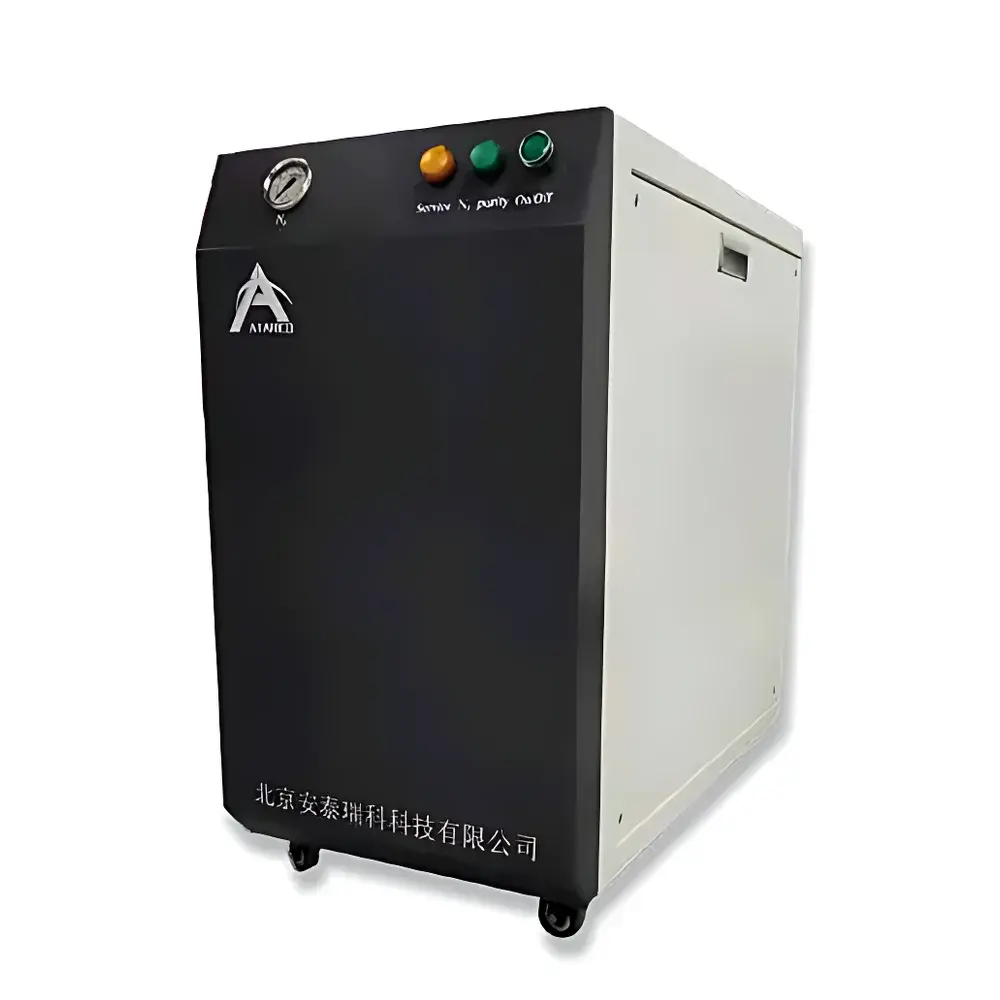
ATARICO Anshou Series Nitrogen Generator ATCN-90
| [Brand | ATARICO |
|---|---|
| Origin | Beijing, China |
| Manufacturer Type | Direct Manufacturer |
| Model | ATCN-90 |
| Nitrogen Generation Principle | Pressure Swing Adsorption (PSA) with Zeolite Molecular Sieve |
| Output Flow Rate | ≥90 L/min |
| Output Pressure Range | 0.1–0.5 MPa (14.5–72.5 psi), Adjustable |
| Nitrogen Purity | 90–99% |
| Dew Point | −40 °C to −45 °C |
| Particle Size Retention | <0.01 µm |
| Oil-Free Output | Yes |
| Noise Level | 58 dB(A) |
| Power Supply | 230 V, 50/60 Hz |
| Input Power | 3.35 kW |
| Dimensions (W×D×H) | 650 × 1060 × 1150 mm |
| Weight | 260 kg |
| Operating Ambient | 5–35 °C, ≤80% RH, ≤1500 m altitude] |
Overview
The ATARICO Anshou Series Nitrogen Generator ATCN-90 is an engineered-on-site, oil-free nitrogen supply system designed specifically for high-demand laboratory applications requiring continuous, stable, and contaminant-free nitrogen gas. Utilizing proven Pressure Swing Adsorption (PSA) technology with high-selectivity zeolite molecular sieve beds, the ATCN-90 separates nitrogen from compressed ambient air by selectively adsorbing oxygen, moisture, CO₂, and trace hydrocarbons under elevated pressure — releasing purified nitrogen (>90–99% N₂) during depressurization cycles. This principle ensures consistent output without consumables or cryogenic infrastructure. The system integrates a custom high-reliability air compressor (rated for >10,000 hours MTBF), multi-stage cooling and filtration, and proprietary Japanese SMC hydrophobic membrane dryers to achieve a certified dew point of −40 °C to −45 °C — critical for moisture-sensitive sample preparation workflows including nitrogen blow-down, solvent evaporation, and inert-atmosphere glove box purging.
Key Features
- Engineered compatibility with multi-channel nitrogen evaporators (12-, 24-, 36-, 48-, 54-, and 96-position configurations) across leading OEM platforms.
- Integrated aluminum-finned heat exchanger and three-stage filtration: coalescing pre-filter, activated carbon post-filter, and ultrafine particulate filter (<0.01 µm retention).
- SMC-certified hydrophobic membrane dryer for deep desiccation, eliminating condensate carryover and preventing downstream ice formation in capillary lines.
- Large-capacity aluminum alloy buffer and storage tanks ensure pressure stability (0.1–0.5 MPa, continuously adjustable) with zero secondary contamination risk.
- Imported solenoid valve manifold, PLC-based control unit, and redundant pressure monitoring for fail-safe operation and long-term repeatability.
- Compact footprint (650 × 1060 × 1150 mm) with industrial-grade casters and leveling feet — optimized for benchtop integration or dedicated utility cabinet placement.
- Acoustically insulated enclosure and vibration-damped compressor mounting reduce operational noise to ≤58 dB(A) — suitable for shared lab environments.
Sample Compatibility & Compliance
The ATCN-90 delivers nitrogen meeting ISO 8573-1:2010 Class 2:2:2 specifications for particulate, water, and oil content — fully compatible with USP , ASTM D6350, and ISO 8573-7 requirements for laboratory-grade inert gas. Its validated output purity range (90–99% N₂) supports method-critical applications such as LC-MS mobile phase blanking, GC carrier gas substitution, and controlled-atmosphere cell culture. The system complies with IEC 61000-6-3 (EMC emission) and IEC 61000-6-2 (immunity) standards. All electrical components meet CE marking requirements; pressure vessels conform to PED 2014/68/EU Annex I essential safety requirements. Optional audit trail logging and user-access controls can be configured to support GLP/GMP-aligned workflows per FDA 21 CFR Part 11 when integrated with compliant LIMS or ELN systems.
Software & Data Management
The ATCN-90 operates via an embedded industrial PLC with a 5.7-inch TFT HMI interface supporting real-time display of inlet pressure, PSA cycle status, outlet dew point, flow rate, and cumulative runtime. Event logs (including alarm timestamps, pressure deviations, and filter service alerts) are stored onboard for ≥12 months and exportable via USB. No proprietary software installation is required; configuration parameters (e.g., pressure setpoint, auto-shutdown thresholds) are adjusted directly on-device. For centralized lab infrastructure management, Modbus RTU (RS-485) and optional Ethernet/IP interfaces enable integration into building automation systems or third-party SCADA platforms — facilitating remote monitoring, predictive maintenance scheduling, and energy usage reporting.
Applications
- High-throughput sample concentration using nitrogen blow-down evaporators (12–96 channel)
- Inert gas overlay for HPLC/GC autosampler vials and solvent reservoirs
- Purging and maintenance of argon/nitrogen glove boxes (ISO Class 5–7 environments)
- Carrier gas supply for thermal desorption units and purge-and-trap concentrators
- Blank gas for FTIR, Raman, and XRD sample chambers requiring low-humidity inert atmosphere
- Process gas for plasma cleaning, thin-film deposition, and semiconductor wafer handling
FAQ
What is the expected service life of the molecular sieve beds?
Under normal operating conditions (≤80% RH inlet air, routine filter maintenance), zeolite beds maintain performance for ≥20,000 hours — equivalent to ~2.3 years of continuous operation.
Can the ATCN-90 be used as a primary nitrogen source for LC-MS systems?
Yes — when operated at ≥95% purity and paired with an optional inline hydrocarbon trap, it meets ASTM D6350 Grade A specifications for LC-MS carrier gas; validation data available upon request.
Is external cooling water required?
No — all thermal management is self-contained via the integrated aluminum-finned heat exchanger and forced-air convection.
How often do filters require replacement?
Coalescing and particulate filters: every 3,000–4,000 operating hours; activated carbon filter: every 6,000 hours; SMC dryer membrane: every 12,000 hours (condition-dependent).
Does the system support automatic start/stop synchronized with connected instrumentation?
Yes — dry-contact relay outputs and Modbus-enabled digital I/O allow seamless interlock with evaporators, glove boxes, or chromatography systems.



