
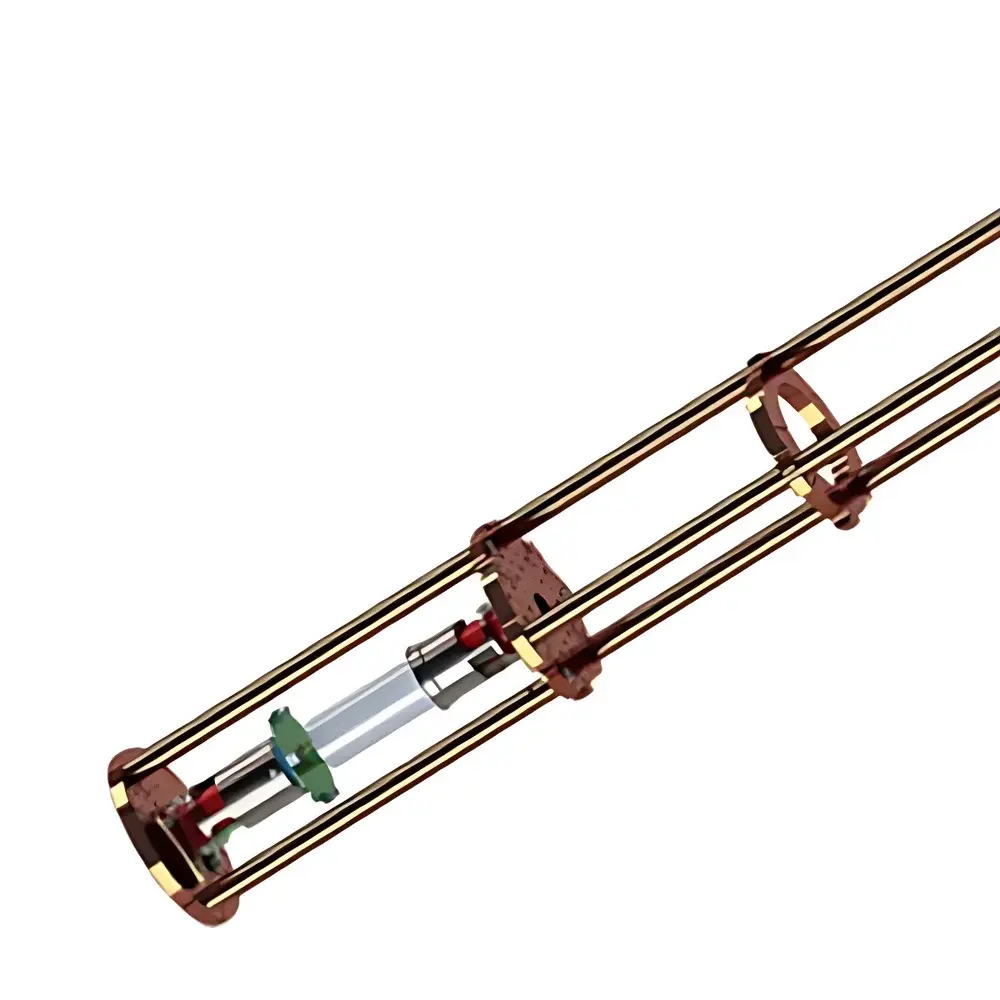
3i MK-CFM/RAMAN Confocal Raman Microscope with Cryogenic Capability
| Brand | 3i |
|---|---|
| Origin | Germany |
| Model | MK-CONFOCAL/RAMAN MICROSCOPE (MK-CFM/RAMAN) |
| Objective | 0.82 NA, 0.95 mm working distance, cryo-compatible APO objective |
| Temperature Range | 10 mK to 300 K |
| Magnetic Field Compatibility | Up to 31 T |
| Scan Range | 50 × 50 × 25 µm @ 300 K / 30 × 30 × 15 µm @ 4 K |
| Sample Approach Range | XYZ ±6 × ±6 × ±12 mm, step size 50–700 nm |
| Closed-Loop Positioning | Resistive encoder, 200 nm resolution |
| Fine Scan Range | 7.5 µm @ 300 K / 1 µm @ 4.2 K |
| Max Sample Dimensions | 10 × 10 × 5 mm |
| Sample Holder | 8-pin electrical interface |
Overview
The 3i MK-CFM/RAMAN is a high-precision confocal Raman microscope engineered for correlated structural, vibrational, and electronic characterization of solid-state materials under extreme cryogenic and high-magnetic-field conditions. Integrating a custom-designed 0.82 NA, 0.95 mm working distance apochromatic objective optimized for low-temperature operation, the system enables diffraction-limited spatial resolution while maintaining optical throughput across the visible to near-infrared excitation range. Its core architecture supports simultaneous confocal imaging and micro-Raman spectroscopy within temperature regimes spanning 10 mK to 300 K — achieved via integration with commercial dilution refrigerators or wet/dry cryostats — and in magnetic fields up to 31 T, making it suitable for studies of quantum materials, topological insulators, superconductors, and low-dimensional semiconductors where phonon, magnon, and electron–phonon coupling behaviors are strongly temperature- and field-dependent.
Key Features
- Cryo-optimized optical train with anti-icing coatings and thermal drift compensation for stable long-term acquisition below 4 K
- High-numerical-aperture (0.82 NA), long-working-distance (0.95 mm) apochromatic objective designed for minimal spherical aberration at cryogenic temperatures
- Three-axis closed-loop piezo scanning stage with resistive encoder feedback (200 nm resolution) and coarse/fine dual-range motion: ±6 × ±6 × ±12 mm coarse approach; 7.5 µm fine scan at 300 K, 1 µm at 4.2 K
- Modular vacuum and exchange-gas compatible chamber design, rated for UHV (<10⁻⁸ mbar) and compatible with standard 50 mm cold-bore dilution refrigerators
- Electrical sample interface with 8-pin feedthrough for in situ transport, gate, or impedance measurements during Raman acquisition
- Integrated laser coupling optics supporting multiple excitation wavelengths (e.g., 532 nm, 633 nm, 785 nm) with automated filter switching and notch rejection
Sample Compatibility & Compliance
The MK-CFM/RAMAN accommodates samples up to 10 × 10 × 5 mm in volume, mounted on a thermally anchored, electrically isolated sample holder with 8-pin connectivity for concurrent electrical characterization. The system is fully compatible with industry-standard cryogenic platforms including BlueFors, Oxford Instruments Triton, and Quantum Design PPMS systems. All mechanical and optical components comply with ISO 10110 surface quality standards for precision optics, and the stage control firmware adheres to IEC 61508 functional safety guidelines for laboratory automation. No proprietary consumables or vendor-locked calibration routines are required; all alignment procedures follow NIST-traceable protocols for reproducible Raman shift calibration (±0.1 cm⁻¹ accuracy).
Software & Data Management
Acquisition and analysis are performed using 3i’s SlideBook 6 software platform, which provides native support for time-resolved, hyperspectral Raman mapping, spectral unmixing, and correlation with simultaneous fluorescence or reflectance channels. Data files are saved in open-format HDF5 containers with embedded metadata (temperature, field, laser power, grating position, objective ID), ensuring full FAIR (Findable, Accessible, Interoperable, Reusable) compliance. Audit trails, user authentication, and electronic signatures meet FDA 21 CFR Part 11 requirements for regulated environments. Export modules support direct ingestion into Python (via h5py), MATLAB, and Igor Pro for advanced statistical modeling or machine learning workflows.
Applications
- Phonon softening and symmetry-breaking transitions in correlated oxides across the Mott–Hubbard crossover regime
- Strain-engineered Raman mode splitting in twisted bilayer graphene under in-plane magnetic fields
- Local superconducting gap mapping in iron-based pnictides using resonant Raman scattering at sub-Kelvin temperatures
- Vibrational lifetime thermometry in nanoscale quantum emitters coupled to photonic crystal cavities
- In situ doping evolution monitoring in perovskite thin films during thermal cycling from 10 mK to 300 K
FAQ
Is the system compatible with existing dilution refrigerator infrastructure?
Yes — the MK-CFM/RAMAN is mechanically and thermally designed for seamless integration with 50 mm cold-bore dilution refrigerators, including wiring, thermal anchoring, and vibration isolation specifications aligned with BlueFors and Leiden Cryogenics standards.
Can Raman spectra be acquired simultaneously with electrical transport measurements?
Yes — the 8-pin sample holder supports four-terminal DC or low-frequency AC measurements in parallel with Raman acquisition, with galvanic isolation and shielding verified to <1 nV/√Hz noise floor.
What laser safety certifications does the system meet?
The integrated laser subsystem complies with IEC 60825-1:2014 Class 3B/4 requirements, with interlocked beam paths, automatic shuttering upon chamber venting, and redundant hardware-based power limiters.
Is third-party spectrometer integration supported?
Yes — the optical output port provides C-mount and SM1-threaded interfaces for coupling to external spectrometers, CCD/EMCCD detectors, or superconducting nanowire single-photon detectors (SNSPDs).
Does the system support polarization-resolved Raman measurements?
Yes — motorized half-wave and quarter-wave plates, along with a rotating analyzer, are available as optional modules and fully synchronized within SlideBook for automated polarization state control and Mueller matrix acquisition.



