
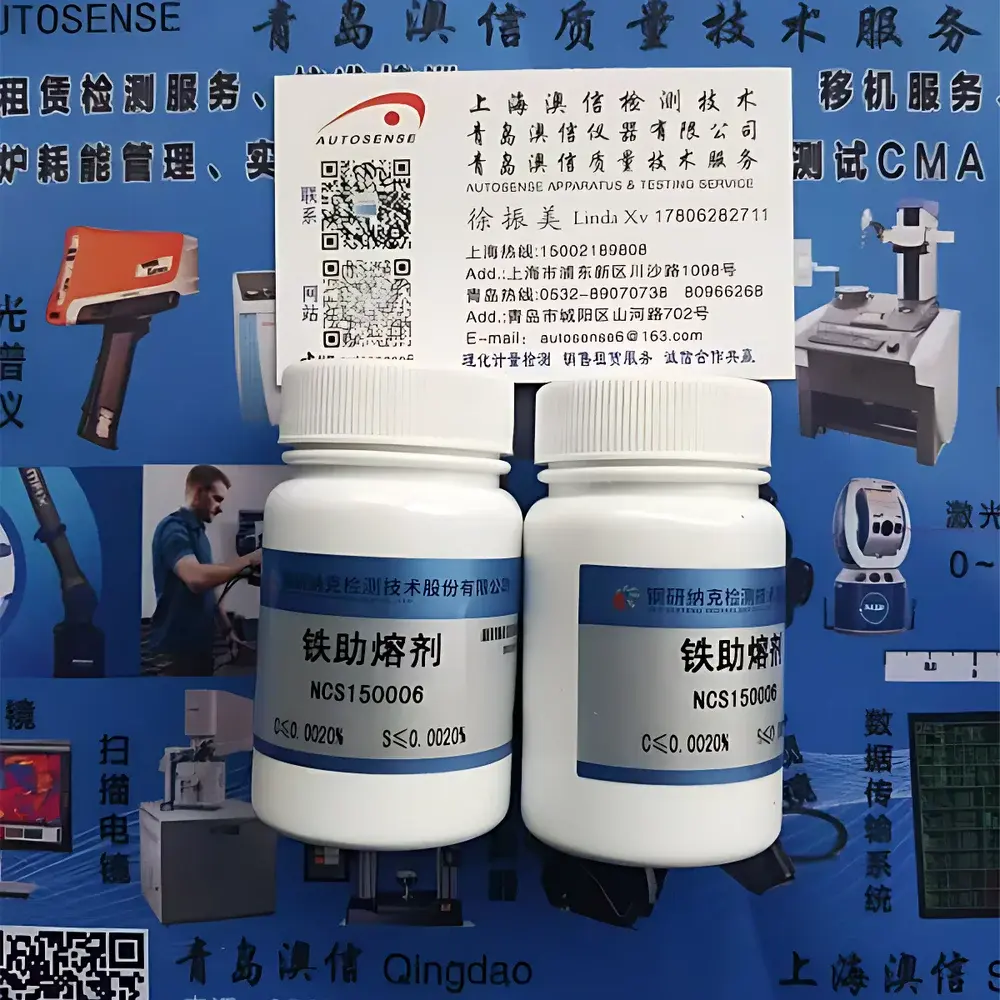
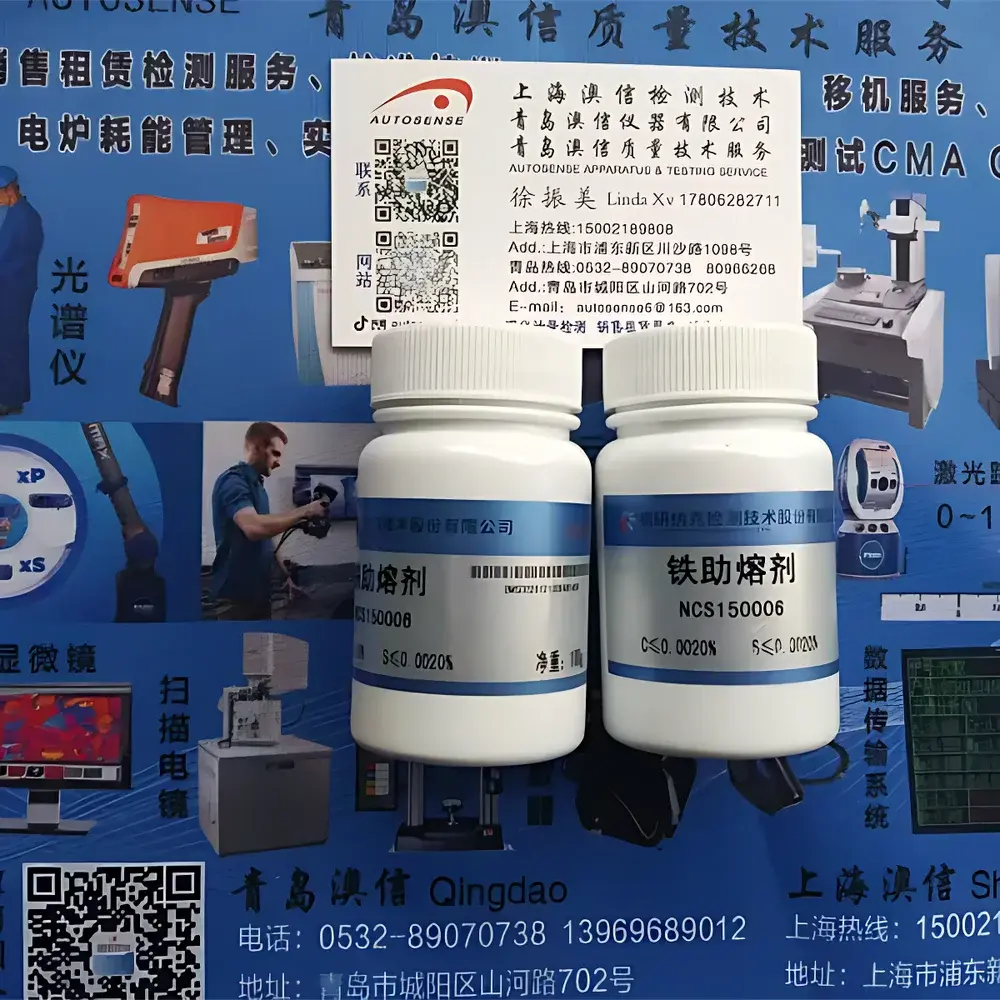
NCS Pure Iron Flux for Elemental Analysis
| Brand | NCS (China Iron and Steel Research Institute Group) |
|---|---|
| Origin | China |
| Manufacturer Type | Authorized Distributor |
| Model | Pure Iron Flux |
| Pricing | Available Upon Request |
Overview
NCS Pure Iron Flux is a high-purity, low-contamination auxiliary reagent specifically formulated for fusion sample preparation in wavelength-dispersive X-ray fluorescence spectrometry (WDXRF), energy-dispersive XRF (EDXRF), and inductively coupled plasma optical emission spectrometry (ICP-OES) applications. Engineered to achieve complete dissolution of refractory oxides—including SiO₂, Al₂O₃, TiO₂, and Cr₂O₃—this flux operates via high-temperature alkaline fusion (typically 1050–1150 °C) in platinum or graphite crucibles. Its stoichiometric composition ensures consistent melt viscosity, minimal volatilization loss of analytes, and reproducible bead geometry—critical parameters for quantitative calibration and long-term instrument stability. Unlike generic iron-based fluxes, NCS Pure Iron Flux undergoes rigorous batch certification per ISO/IEC 17025-accredited procedures, with trace elemental impurities (e.g., Na, K, Ca, Mg, Mn, Ni, Cu, Zn, Pb) quantified by ICP-MS and reported in full Certificate of Analysis (CoA). It is compatible with automated fusion systems (e.g., Claisse LeNeo, Rigaku Fusion-3) and manual fusion workflows used in metallurgical, geological, and cement laboratories compliant with ASTM E1361, ISO 29581-2, and GB/T 20123 standards.
Key Features
- Ultra-high purity: ≥99.99% Fe metal content, with total non-iron impurities <10 ppm (verified by ICP-MS)
- Controlled particle size distribution: D₅₀ = 45–65 µm, optimized for uniform mixing and rapid, homogeneous fusion
- Low hygroscopicity: Packaged under inert argon atmosphere in sealed aluminum-laminated pouches to prevent oxidation and moisture uptake
- Batch traceability: Each lot assigned a unique identifier linked to full CoA, including certified values for 22 trace elements and uncertainty budgets
- Thermal stability: Consistent melting behavior across 1000–1180 °C range; no premature decomposition or slag phase separation
- Compatibility with certified reference materials (CRMs): Validated with NIST SRM 278, GBW 07103, and IRMM-016 for accuracy verification
Sample Compatibility & Compliance
NCS Pure Iron Flux is validated for use with silicate-rich matrices (e.g., ores, slags, ceramics), ferrous alloys, and high-alumina refractories. It enables complete dissolution of samples containing up to 70 wt% SiO₂ when used at 1:10 flux-to-sample ratio (w/w). The resulting glassy beads exhibit excellent transparency, homogeneity, and mechanical integrity for WDXRF analysis. All production batches comply with ISO 9001:2015 quality management requirements and are manufactured in a cleanroom-class facility adhering to GLP principles. Documentation supports audit readiness for ISO/IEC 17025 accreditation and FDA 21 CFR Part 11–aligned laboratory information management systems (LIMS).
Software & Data Management
While the flux itself is a consumable, its integration into analytical workflows is supported through digital traceability tools. Each package includes a QR code linking to an online portal where users access downloadable CoAs, shelf-life tracking (24 months from date of manufacture), and compatibility guidance for major fusion instruments. NCS provides optional CSV/XML data export formats compatible with LIMS platforms such as LabWare, STARLIMS, and Thermo Fisher SampleManager. Batch-specific uncertainty data can be imported directly into metrological software (e.g., Uncertainty Calculator v4.2) to propagate measurement uncertainty in final elemental concentration reports.
Applications
- Quantitative major/minor element analysis in iron ore and sinter feed (Fe, Si, Al, P, S, Mn)
- High-precision determination of trace REEs (La, Ce, Nd) in monazite and bastnäsite concentrates
- Quality control of stainless steel scrap blends prior to electric arc furnace charging
- Geochemical mapping of volcanic tuffs using fused-bead XRF with internal standard correction
- Validation of handheld XRF field assays against lab-based reference methods (ASTM D7902)
FAQ
What is the recommended flux-to-sample ratio for high-silica samples?
For samples containing >50% SiO₂, a 12:1 flux-to-sample mass ratio is recommended, with Li₂B₄O₇ co-flux (2–3% w/w) to reduce melt viscosity.
Can this flux be used in automated fusion systems?
Yes—fully compatible with Claisse LeNeo, Rigaku Fusion-3, and SPEX CertiPrep Fusion Machine; pre-programmed method templates available upon request.
How should unused flux be stored?
Store unopened pouches at 15–25 °C in dry conditions; after opening, transfer to a desiccator with indicating silica gel and use within 72 hours.
Is there a safety data sheet (SDS) available?
Yes—SDS complies with GHS Rev. 8 and includes thermal decomposition products (FeO, Fe₂O₃ fumes) and first-aid measures for high-temperature handling.
Does NCS offer custom-certified lots for regulated industries?
Yes—custom CoAs with expanded element lists (up to 45 analytes), extended uncertainty reporting, and 21 CFR Part 11–compliant electronic signatures are available under contract.






