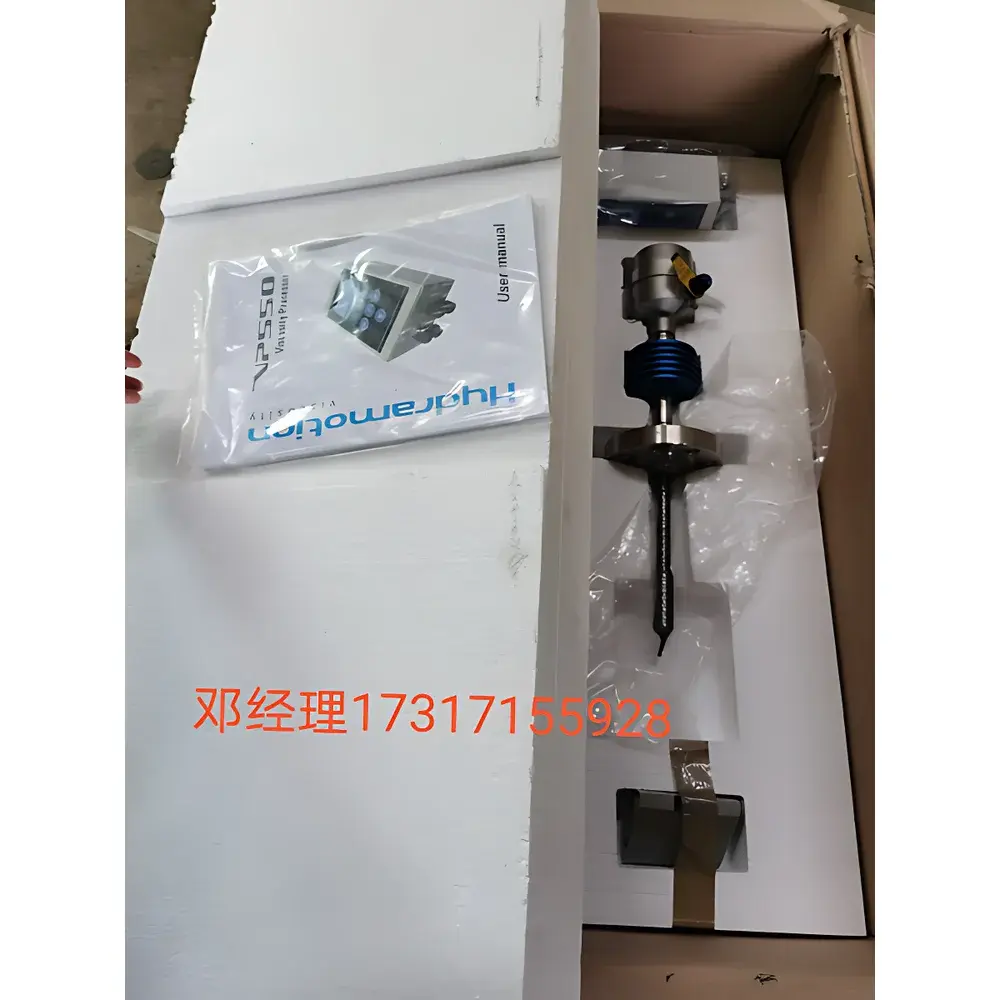
XL7 Online Viscometer – Hemerson XL-3124ET-E234 Industrial In-Line Rotational Viscometer
| Origin | UK |
|---|---|
| Manufacturer Type | Authorized Distributor |
| Origin Category | Imported |
| Model | XL-3124ET-E234 |
| Viscosity Range | 0–1,000,000,000 cP |
| Accuracy | ±1% of reading |
| Temperature Range | −40 °C to +400 °C |
| Temp. Accuracy | ±1.0% of span |
| Max. Process Pressure | 70 MPa |
| Power Supply | 24 VDC |
| Output Signal | 4–20 mA analog (linear, HART-compatible) |
| Shear Rate Control | Configurable, continuous real-time measurement |
Overview
The Hemerson XL7 Online Viscometer is an industrial-grade in-line rotational viscometer engineered for continuous, real-time viscosity monitoring directly within process pipelines or vessels. Based on robust Couette flow principle—where torque required to rotate an inner cylinder immersed in a fluid is measured against a stationary outer sleeve—the XL7 delivers high reproducibility and long-term stability under harsh operating conditions. Unlike offline or grab-sample laboratory methods, the XL7 enables closed-loop feedback integration with DCS/PLC systems, supporting proactive quality control in continuous manufacturing environments. Its design prioritizes mechanical integrity, thermal resilience, and minimal maintenance intervention—critical for uninterrupted operation in chemical processing, polymer extrusion, pharmaceutical batch synthesis, and food & beverage production.
Key Features
- Continuous, real-time viscosity measurement with linear 4–20 mA output—fully compatible with industrial automation infrastructure including HART-enabled controllers and SCADA systems.
- Configurable shear rate operation ensures representative rheological data across Newtonian and non-Newtonian fluids without requiring external calibration adjustments per material.
- High-pressure rated sensor head (up to 70 MPa) with optional Hastelloy C-276 or Inconel 625 wetted parts for corrosion resistance in aggressive chemical and hydrocarbon streams.
- Wide operational temperature range (−40 °C to +400 °C) supported by integrated Pt100 RTD or thermocouple inputs, enabling accurate temperature-compensated viscosity reporting.
- Modular mounting options—including flanged, sanitary tri-clamp, threaded, or custom-length insertion probes—allow adaptation to reactor jackets, extruder die heads, mixing tanks, and inline piping.
- IP67-rated electronics housing with intrinsically safe (IS) and ATEX/IECEx-certified variants available for Zone 1/21 hazardous area deployment.
Sample Compatibility & Compliance
The XL7 accommodates diverse process media spanning low-, medium-, and high-viscosity categories: from solvents and aqueous formulations (e.g., dairy emulsions, fruit juices, pharmaceutical suspensions) to thermally sensitive melts (PET, PBT, PC, PA, PMMA), elastomers, asphalt binders, ceramic slurries, drilling muds, and fiber-spinning dopes (lyocell, solvent-spun cellulose). All wetted components comply with FDA 21 CFR §177.2600 for food-contact applications and meet ASME BPE surface finish requirements (Ra ≤ 0.8 µm) where applicable. The instrument supports GLP/GMP-aligned data integrity through optional audit-trail-enabled firmware compliant with FDA 21 CFR Part 11 electronic record standards when paired with Hemerson’s certified control modules.
Software & Data Management
Hemerson provides the ViscoLink™ Configuration Suite—a Windows-based utility for zero/span calibration, temperature compensation curve setup, damping filter configuration, and diagnostic logging. Raw 4–20 mA signals are timestamped and traceable via Modbus TCP or OPC UA gateways. Optional cloud-connectivity kits enable secure MQTT-based telemetry to enterprise MES platforms (e.g., Siemens Opcenter, Rockwell FactoryTalk). Historical trend analysis, alarm thresholding (high/low viscosity deviation), and automated report generation (PDF/CSV) support ISO 9001 and IATF 16949 quality documentation workflows.
Applications
- Polymerization reaction monitoring in PET, PA6, and PC melt-phase reactors
- Real-time consistency control of coatings, inks, and architectural paints during dispersion and letdown
- Viscosity profiling of hot-melt adhesives and bituminous binders in road construction material lines
- Batch-to-batch verification of pharmaceutical gels, ointments, and suspension concentrates
- Feedstock quality assurance in edible oil refining and biodiesel transesterification
- Starch gelatinization endpoint detection in cereal processing and brewing wort preparation
- Rheological surveillance of ceramic slips and battery electrode slurries prior to coating
FAQ
Can the XL7 be installed in sanitary (3-A or EHEDG) environments?
Yes—tri-clamp and DIN 11851 hygienic variants with electropolished 316L stainless steel probe bodies and FDA-compliant seals are available.
Does it require periodic recalibration during operation?
No field recalibration is needed under stable process conditions; however, annual verification against NIST-traceable reference oils is recommended per ISO/IEC 17025 quality system requirements.
Is temperature compensation automatic or user-defined?
Both modes are supported: built-in dual-sensor compensation (process + reference) or user-loaded polynomial curves based on ASTM D2196 or ISO 3219.
How does the XL7 handle particulate-laden or abrasive slurries?
The rotor/stator geometry minimizes sediment accumulation; optional tungsten carbide wear sleeves and self-cleaning vortex designs are offered for high-solid-content applications.
Can multiple XL7 units feed into a single control system?
Yes—via daisy-chained Modbus RTU or individual Ethernet/IP nodes with unique IP addresses and configurable polling intervals.
Related Products