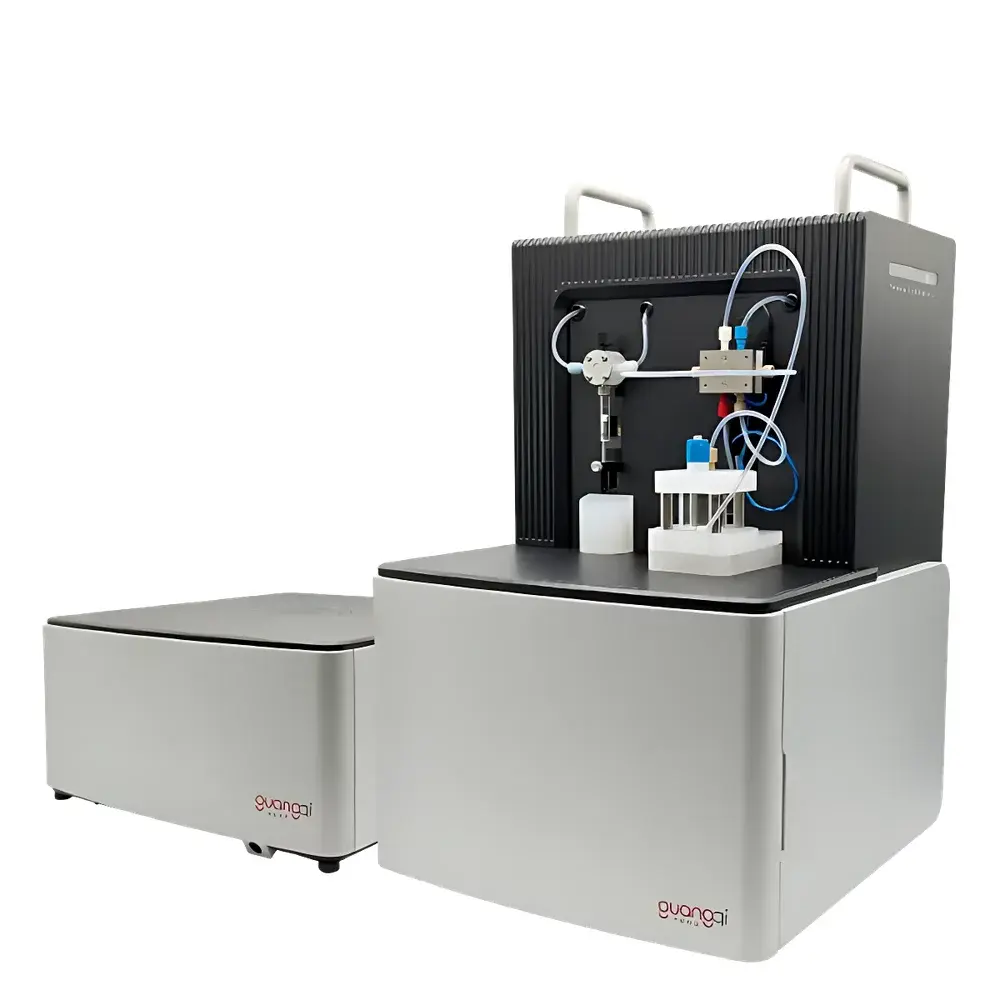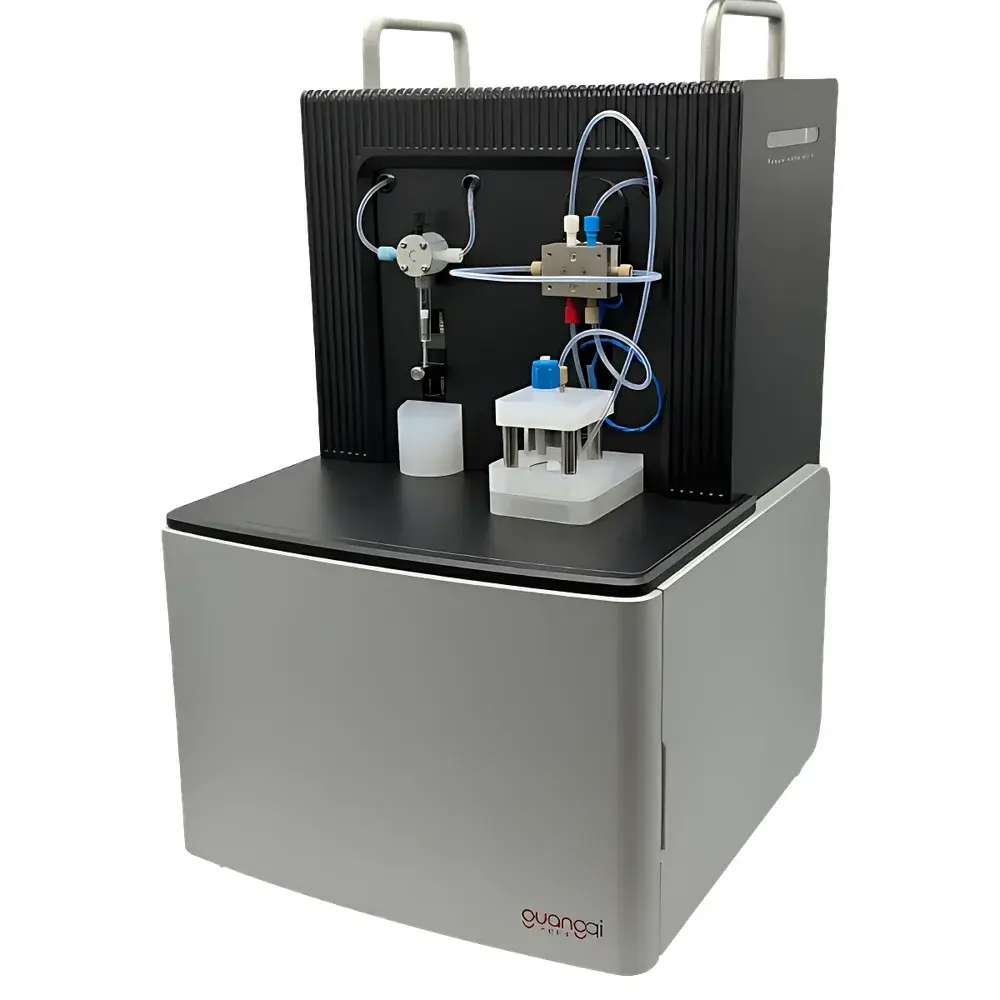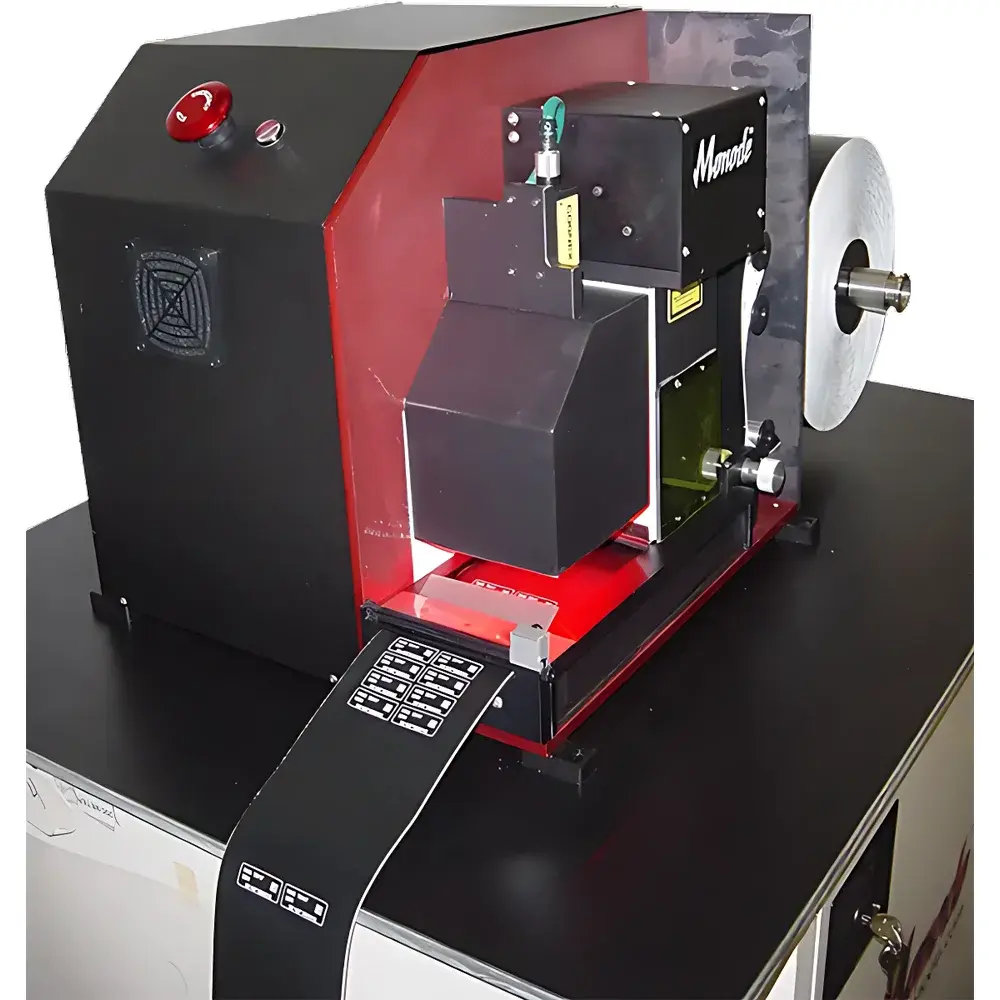
MONODE Vestige Series Revolution Laser Marking System
| Brand | MONODE |
|---|---|
| Origin | USA |
| Manufacturer Type | Authorized Distributor |
| Category | Imported Equipment |
| Model | Vestige Series Revolution |
| Laser Source | Pulsed Fiber (10 W or 20 W), Diode-Pumped, Air-Cooled |
| Compliance | FDA 21 CFR 1040.10, ANSI Z136.1-2000, MIL-STD-130 |
| Label Feed | Motorized Roll-to-Roll (4″ × 1000 ft) |
| Integrated Fume Extraction | HEPA-Filter Replaceable |
| UID Verification | Patented In-Line Validation Engine |
| Maintenance Profile | Low-Cost Scheduled Maintenance |
Overview
The MONODE Vestige Series Revolution Laser Marking System is a precision-engineered, Class 4 industrial laser marking platform designed specifically for high-integrity identification in semiconductor assembly, microelectronics packaging, and defense-grade component traceability workflows. Utilizing a diode-pumped, air-cooled pulsed fiber laser source (available in 10 W or 20 W nominal output), the system delivers consistent, non-contact, permanent marking on substrates including silicon wafers, ceramic packages, metal leadframes, polyimide tapes, and engineered plastics. Its optical architecture is optimized for high beam quality (M² < 1.3), enabling fine-feature resolution down to 25 µm line width with sub-micron positional repeatability. The system operates under strict regulatory alignment—fully compliant with FDA 21 CFR 1040.10 for laser product safety and ANSI Z136.1-2000 for safe use of lasers in occupational environments—making it suitable for ISO 9001-certified cleanrooms and ITAR-controlled facilities.
Key Features
- Integrated roll-to-roll label handling: motorized 4-inch core feed supporting continuous 1000-foot label rolls; synchronized with laser pulse timing for zero-skew marking on pressure-sensitive adhesives and thermal-transfer media.
- Dual-mode marking capability: simultaneous laser ablation (for direct part marking) and laser-assisted die-cutting (for contour separation of labels), eliminating secondary mechanical punching steps.
- Onboard fume management: sealed extraction chamber with user-replaceable HEPA filtration (ISO 16890-compliant), rated for particulate capture efficiency ≥99.97% at 0.3 µm—critical for maintaining ISO Class 5 cleanroom air quality during extended operation.
- UID-compliant verification engine: patented real-time image capture and OCR-based validation against IUID Registry schema (MIL-STD-130 Annex D); auto-generates audit-ready PDF reports with timestamped digital signatures and SHA-256 hash logs.
- Modular optical path design: field-swappable galvanometer scan heads and F-theta lenses support rapid reconfiguration between 100 mm × 100 mm and 300 mm × 300 mm marking fields without recalibration.
Sample Compatibility & Compliance
The Vestige Series Revolution supports marking on electrically sensitive and thermally constrained substrates common in front-end and back-end semiconductor manufacturing—including bare die, wafer-level CSPs, QFNs, BGA substrates, and flex PCBs with solder mask thicknesses from 12–50 µm. All marking parameters (pulse width, frequency, peak power, hatch spacing) are programmable via deterministic control loops to prevent thermal damage (ΔT < 15 °C rise at substrate interface). Regulatory documentation includes full traceability to NIST-traceable power meter calibration certificates, laser safety interlock schematics per UL 61010-1, and formal compliance declarations for MIL-STD-130 revision G, ISO/IEC 15459-1 (Unique Identification), and EU RoHS Directive 2011/65/EU. System firmware adheres to IEC 62443-3-3 security requirements for industrial control systems.
Software & Data Management
Controlled via MONODE’s TraceMark Studio v4.2—a Windows-based application built on .NET 6 with native support for OPC UA server integration. The software provides role-based access control (RBAC) aligned with FDA 21 CFR Part 11 requirements, including electronic signature enforcement, audit trail logging (immutable SQLite database with write-once storage), and automatic backup to network-attached storage (NAS) with AES-256 encryption. Batch job templates can be exported as XML for version-controlled deployment across multiple units. Native import/export of IPC-2581 and Gerber X2 files enables direct synchronization with CAM workflows used in advanced packaging lines.
Applications
- Direct part marking (DPM) of semiconductor dies and packages per JEDEC J-STD-020 and JESD22-A110 for moisture sensitivity level (MSL) tracking.
- Production-line UID labeling of DoD-contracted components with automated MIL-STD-130-compliant data matrix encoding (ECC200, 16×16 to 48×48 cells).
- In-line serialization of fan-out wafer-level packages (FOWLP) prior to singulation, ensuring zero duplication across multi-die panels.
- Traceability marking on RF shielding cans, MEMS sensor housings, and high-frequency substrate carriers requiring minimal HAZ (heat-affected zone).
- Label-on-label marking for hybrid assemblies combining SMT components and wire-bonded ICs, where mechanical stress from traditional stamping must be avoided.
FAQ
Does the Vestige Series Revolution support barcode verification per ISO/IEC 15416?
Yes—the integrated vision module performs real-time ISO/IEC 15416 grading (A–F scale) on all Data Matrix symbols and automatically rejects marks failing Grade C or lower.
Can the system be integrated into a SECS/GEM environment?
Yes—TraceMark Studio includes a certified SECS/GEM interface compliant with SEMI E30 and E40 standards, enabling host-directed job dispatch and status reporting.
What is the mean time between failures (MTBF) for the laser source?
The fiber laser module is rated for ≥100,000 hours MTBF per Telcordia GR-468-CORE, with full warranty coverage for 36 months or 20,000 operating hours, whichever occurs first.
Is remote diagnostics supported?
Yes—via encrypted TLS 1.3 tunnel and MONODE’s SecureLink Remote Support Portal, which complies with NIST SP 800-46 Rev. 2 guidelines for remote maintenance access.
How is calibration maintained across production shifts?
Each unit ships with a NIST-traceable calibration certificate and includes automated daily self-check routines that validate beam positioning accuracy, pulse energy stability, and focus spot size using internal photodiode and CCD reference targets.