
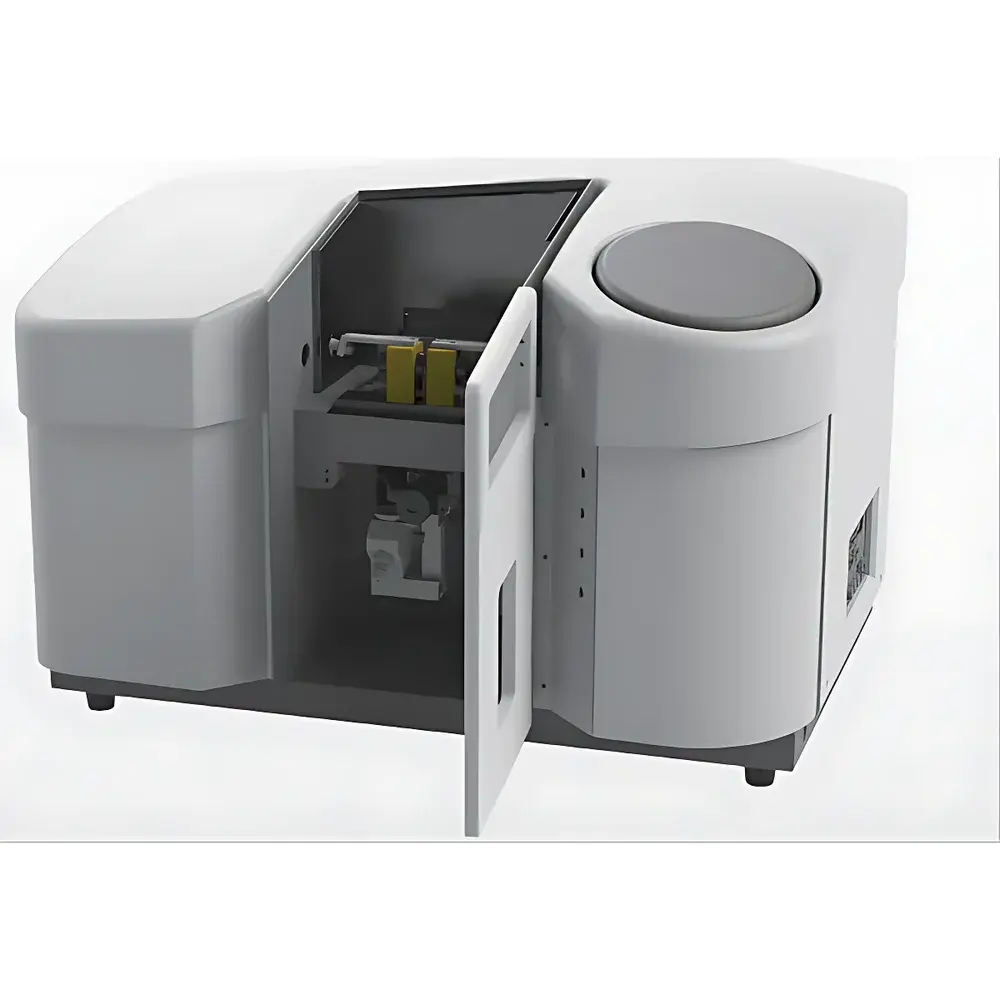
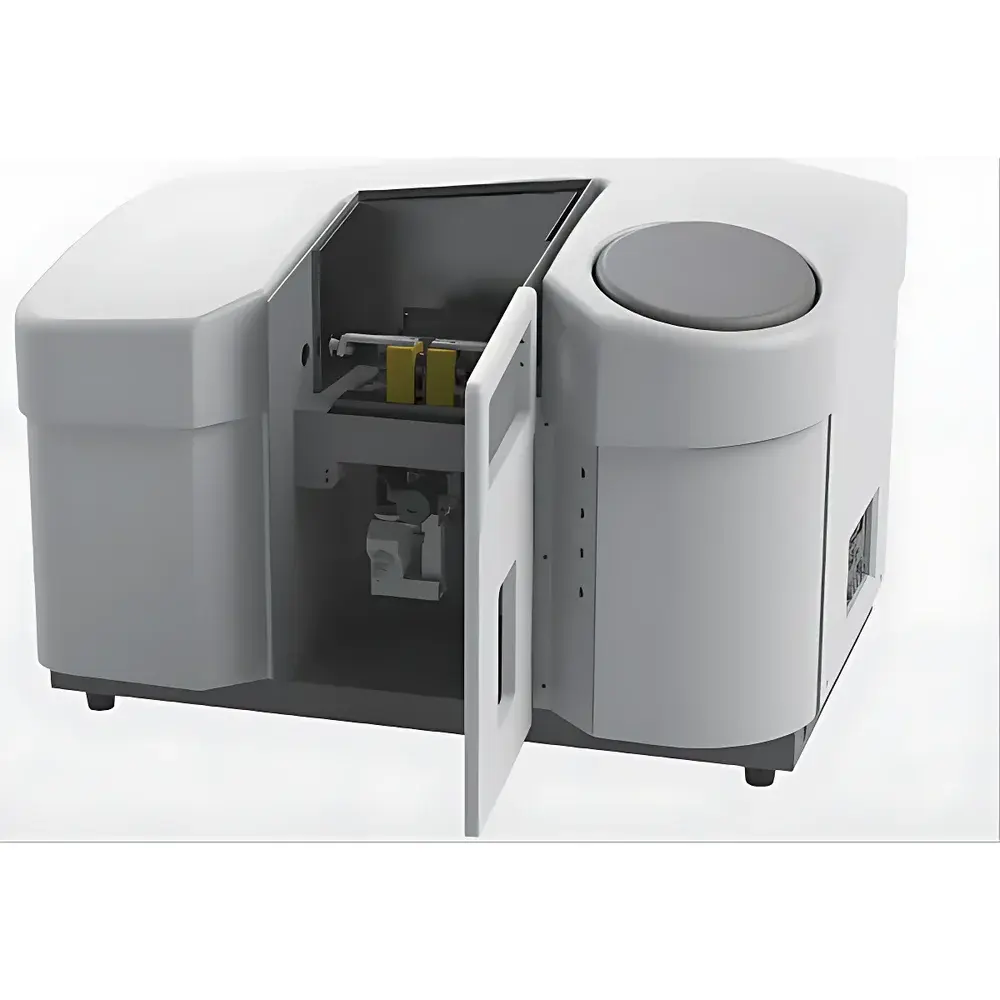
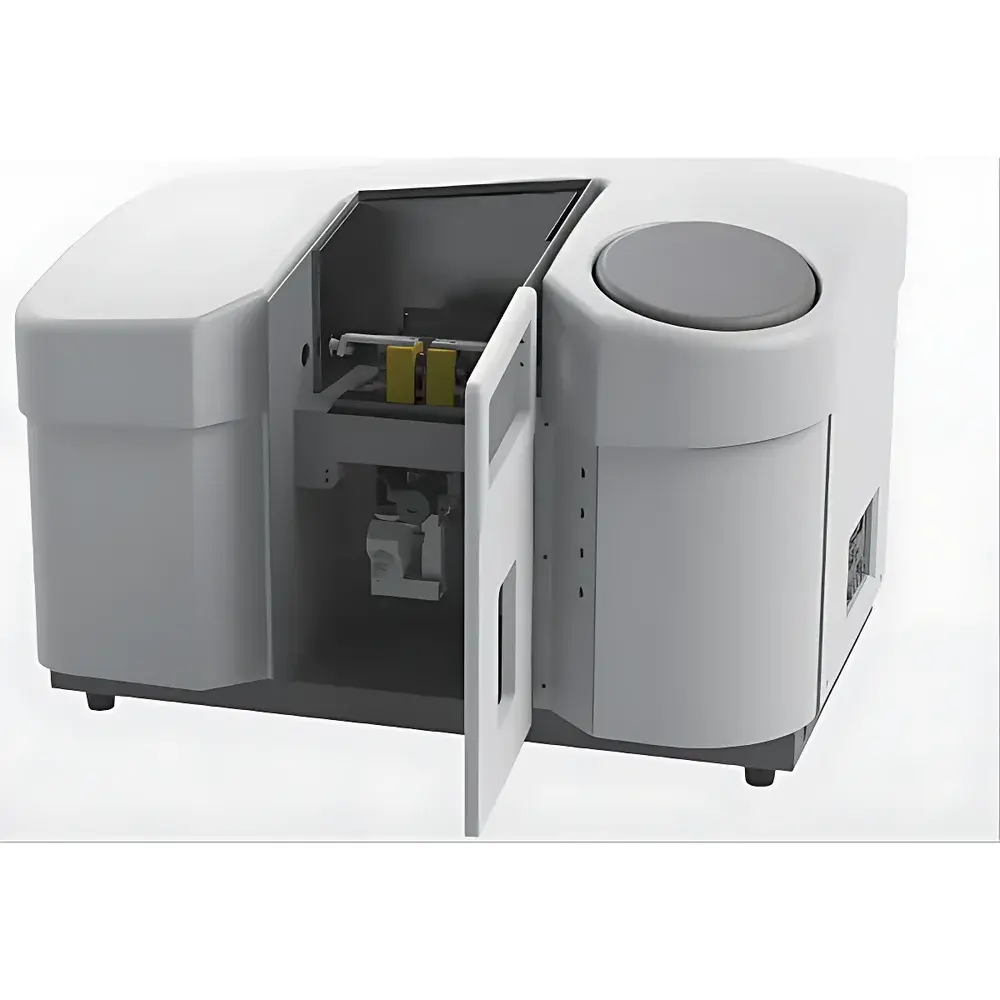
DELEITE AAS-9000G Flame and Graphite Furnace Atomic Absorption Spectrophotometer
| Brand | DELEITE |
|---|---|
| Origin | Shanghai, China |
| Manufacturer Type | Authorized Distributor |
| Model | AAS-9000G |
| Quotation | Upon Request |
| Optical Design | Single-beam |
| Detector | Photodiode Array (PDA) |
| Wavelength Range | 185–190 nm |
| Wavelength Automation | Motorized Auto-Scanning & Peak Search |
| Spectral Bandwidth | 0.1, 0.2, 0.4, 0.7, 1.4, 2.0 nm (6-step motorized selection) |
Overview
The DELEITE AAS-9000G is a dual-mode atomic absorption spectrophotometer engineered for high-precision elemental quantification in liquid samples via flame atomic absorption spectroscopy (FAAS) and graphite furnace atomic absorption spectroscopy (GFAAS). It operates on the fundamental principle of measuring ground-state atomic vapor absorption at element-specific resonance wavelengths—typically within the ultraviolet and visible spectral region—following atomization in either an air-acetylene flame or electrothermally heated graphite tube. Designed to meet rigorous analytical demands across environmental, clinical, industrial, and regulatory laboratories, the AAS-9000G integrates a single-beam optical architecture with a photodiode array detector, enabling rapid spectral acquisition and stable baseline performance. Its operational wavelength range (185–190 nm) is optimized for high-sensitivity detection of key elements including arsenic, selenium, antimony, and mercury—elements requiring vacuum UV capability due to strong atmospheric oxygen absorption below 190 nm. The instrument’s fully automated wavelength scanning, peak search, and bandwidth selection ensure reproducible method setup and alignment-free operation.
Key Features
- Dual-atomization capability: Integrated flame and graphite furnace systems with seamless mode switching and automatic parameter matching.
- 8-position motorized lamp turret: Supports simultaneous preheating and automatic selection of hollow cathode lamps (HCLs) or electrodeless discharge lamps (EDLs); user-definable working/preheat lamp assignment.
- Full-reflection optical path: Achromatic over full operational range; eliminates chromatic aberration and ensures consistent spectral resolution across wavelengths.
- Background correction: Dual-mode correction available—deuterium arc (D₂) and self-reversal (SR)—for accurate compensation in complex matrices containing molecular absorption or scattering interferences.
- Flame system enhancements: Titanium alloy burner head for thermal stability and rapid equilibrium; real-time monitoring of acetylene pressure, flame status, coolant flow, and gas leakage.
- Graphite furnace innovations: Longitudinal heating design ensures uniform temperature distribution along the graphite tube axis; integrated safety interlocks for argon pressure, cooling water flow, furnace body temperature, power supply integrity, and electrical contact resistance.
- Motorized spectral bandwidth selection: Six discrete slit widths (0.1–2.0 nm) automatically engaged per method, supporting both high-resolution trace analysis and broad-band multi-element screening.
Sample Compatibility & Compliance
The AAS-9000G accommodates aqueous solutions, acid-digested environmental extracts (e.g., EPA Method 200.7, 200.9), biological fluids (serum, urine), food homogenates, and geological leachates. Its hardware and firmware architecture support compliance with internationally recognized quality frameworks: data integrity safeguards—including user-level permission control, electronic signatures, and audit-trail logging—align with FDA 21 CFR Part 11 requirements. Instrument performance verification follows ISO/IEC 17025 principles and ASTM E1901 (Standard Test Method for Determination of Elements by GFAAS) and ASTM D3559 (for lead in water by FAAS). Routine calibration adheres to USP and CLSI EP28-A3c guidelines for accuracy, precision, and linearity assessment.
Software & Data Management
The embedded Windows-based acquisition and analysis software provides method development wizards, multi-point calibration (linear, quadratic, weighted), limit-of-detection (LOD) and limit-of-quantitation (LOQ) calculation, QC charting (Levey-Jennings, Westgard rules), and batch report generation compliant with GLP/GMP documentation standards. All raw spectra, measurement logs, instrument configuration snapshots, and user actions are timestamped and cryptographically hashed for tamper-evident audit trails. Data export supports CSV, XML, and PDF formats compatible with LIMS integration (via ASTM E1384 or HL7 messaging protocols). Remote diagnostics and firmware updates are supported via secure TLS-encrypted connection.
Applications
The AAS-9000G delivers validated performance in regulated and research environments requiring sub-pptr detection limits. Key use cases include: heavy metal screening in drinking water per WHO and EU Directive 2020/2184; cadmium and lead quantification in soil per ISO 11466; arsenic speciation support in rice flour following AOAC 2014.02; residual catalyst metal analysis (e.g., Pd, Pt) in pharmaceutical intermediates per ICH Q2(R2); and essential element profiling (Zn, Cu, Fe, Mn) in clinical nutrition studies. Its dual-atomization flexibility enables method transfer between routine high-throughput flame analysis and ultra-trace graphite furnace workflows without hardware reconfiguration.
FAQ
Does the AAS-9000G support sequential multi-element analysis?
No—it performs single-element analysis per measurement cycle, consistent with conventional AAS methodology. Multi-element capability requires external sample introduction synchronization or complementary ICP-OES instrumentation.
Is vacuum purging required for operation below 190 nm?
Yes. The 185–190 nm range necessitates nitrogen purge or vacuum optical path to mitigate O₂ absorption; the system includes integrated N₂ purge port and pressure monitoring.
Can the software generate 21 CFR Part 11-compliant audit trails?
Yes—full electronic record retention, user authentication, action logging, and immutable archive export are enabled by default and configurable per site validation protocol.
What maintenance intervals are recommended for the graphite furnace components?
Graphite tubes: replaced after 200–500 firings depending on matrix aggressiveness; platform and furnace liner inspected quarterly; autosampler probe cleaned daily per SOP.
Is third-party LIMS connectivity supported?
Yes—via standard ODBC drivers and configurable ASCII/XML output templates; API-level integration available under extended support agreement.
Related Products




