
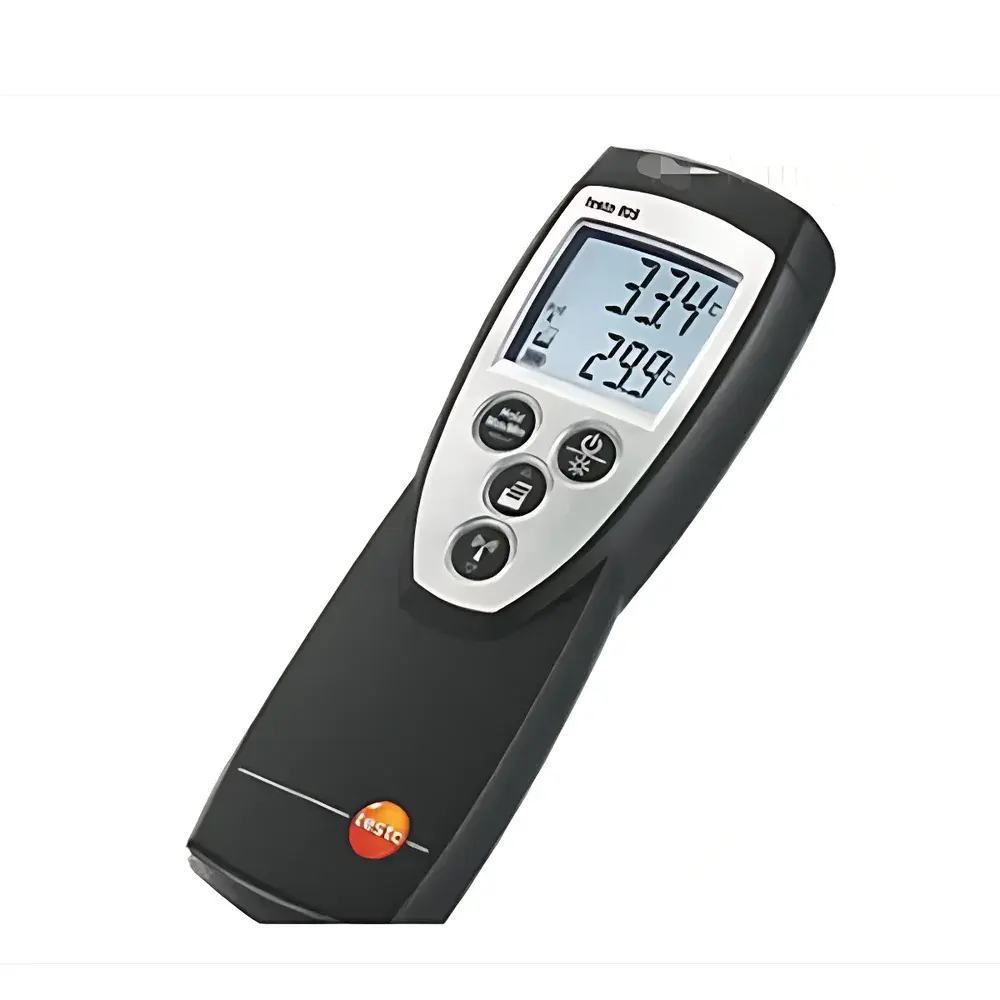
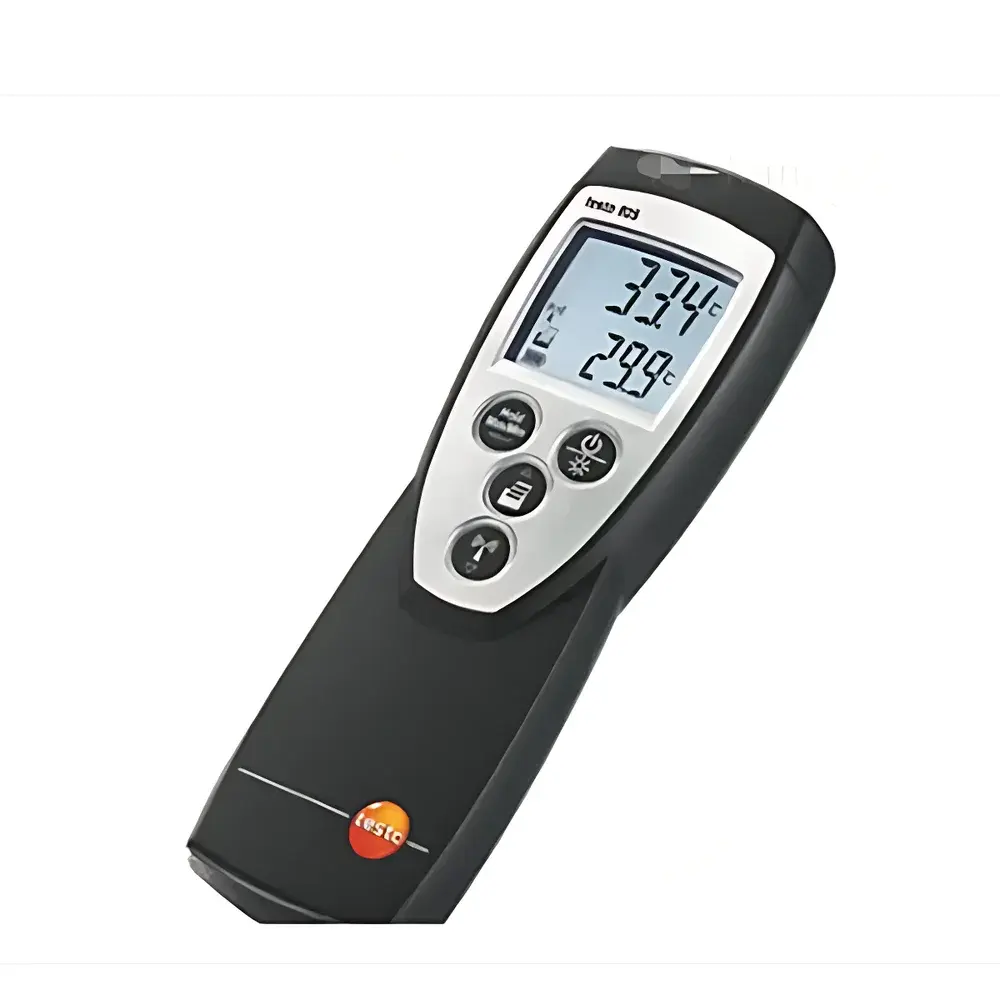
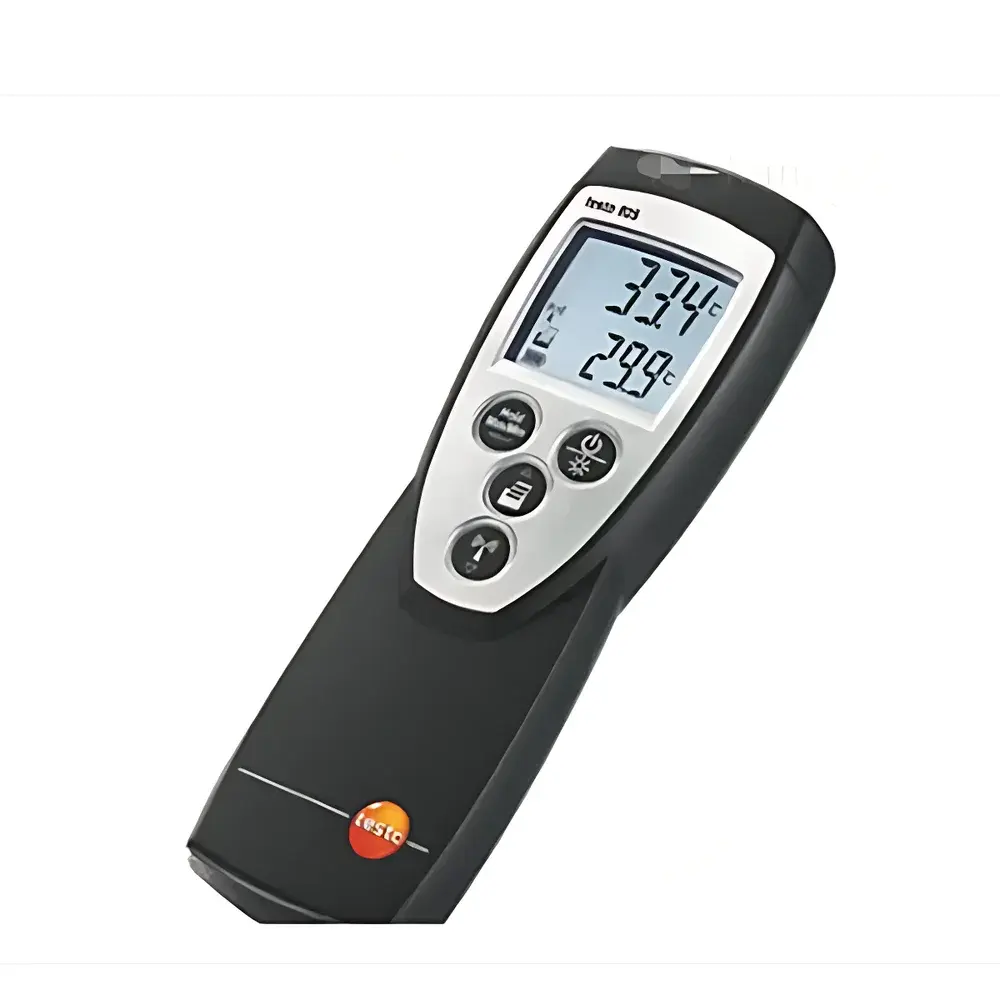
testo 735-1 Precision Multi-Channel Temperature Meter
| Brand | testo |
|---|---|
| Origin | Germany |
| Model | 735-1 |
| Input Channels | 1 × Pt100 + 2 × Thermocouple (Type K, J, T, N, S, R, B, E, L, U) |
| System Accuracy (with optional high-precision Pt100 probe) | ±0.05 °C |
| Resolution | 0.001 °C |
| Display | Dual-line LCD with simultaneous 3-channel readout |
| Alarm | Audible limit alarm |
| Data Logging | Internal storage for min/max/avg/ΔT |
| Print Output | Optional infrared printer interface with programmable cycle (1 min – 24 h) |
| Protection Rating | IP65 |
| Calibration | Full-scale system adjustment capability |
| Compliance | Designed to support GLP/GMP traceability workflows |
Overview
The testo 735-1 Precision Multi-Channel Temperature Meter is an engineered solution for laboratory, calibration, and industrial quality assurance environments requiring traceable, high-fidelity temperature measurement across multiple points simultaneously. Based on the fundamental principles of resistance thermometry (for Pt100 inputs) and thermoelectric voltage detection (for thermocouple inputs), the instrument integrates signal conditioning circuitry optimized for low-noise, high-stability analog-to-digital conversion. Its architecture supports real-time acquisition from three independent sensor channels—configured as one Pt100 input and two thermocouple inputs—with all values displayed concurrently on a dual-line LCD. The device is designed to serve as a reference-grade portable temperature meter, particularly when paired with testo’s certified Class A or 1/3 DIN Pt100 insertion probes, enabling system-level accuracy of ±0.05 °C and resolution down to 0.001 °C over defined ranges. This performance level meets the metrological requirements for secondary standard applications in accredited calibration labs, HVAC commissioning, pharmaceutical process validation, and food safety audits.
Key Features
- Triple-input architecture: Dedicated Pt100 channel (4-wire compatible) plus two universal thermocouple inputs supporting Type K, J, T, N, S, R, B, E, L, and U sensors
- Simultaneous real-time display of all three channel readings, including ΔT (temperature difference), min/max/avg values, and hold functions
- Programmable audible alarm triggered when measured values exceed user-defined upper/lower limits
- IP65-rated enclosure ensuring dust-tightness and protection against low-pressure water jets—suitable for demanding production floor or field use
- Full-scale system adjustment capability via built-in calibration offset functions, supporting periodic verification without external hardware
- Battery-powered operation (included rechargeable Li-ion) with >15 hours typical runtime and low-battery indicator
Sample Compatibility & Compliance
The testo 735-1 interfaces exclusively with industry-standard contact temperature sensors—primarily Pt100 RTDs (IEC 60751 Class A or better) and thermocouples conforming to IEC 60584-1. It does not support non-contact (infrared) or wireless probe types. Sensor compatibility extends to immersion, surface, air, and penetration configurations depending on probe selection. From a regulatory standpoint, the instrument supports documentation practices aligned with ISO/IEC 17025, ASTM E2877 (for thermocouple systems), and USP Analytical Instrument Qualification. While the meter itself is not FDA 21 CFR Part 11–compliant out-of-the-box, its data output—including timestamped min/max/avg/ΔT records and printable reports—can be integrated into validated electronic lab notebook (ELN) or LIMS workflows where audit trails are managed at the system level. Factory calibration certificates (traceable to DKD/DAkkS standards) are supplied with each unit.
Software & Data Management
Data handling is executed locally without proprietary software dependency. All measurements—including instantaneous readings, statistical values (min/max/avg/ΔT), and time-stamped events—are stored internally and accessible via the front-panel interface. The optional testo Thermal Printer (model 0554 9440) connects via infrared and enables immediate hardcopy generation with customizable print intervals (programmable from 1 minute to 24 hours). Printed reports include instrument ID, probe IDs (if entered), date/time stamp, measurement units, and pass/fail status relative to alarm thresholds. No cloud connectivity or firmware update mechanism is embedded; configuration and calibration adjustments are performed manually using the keypad and menu navigation system. For archival purposes, users may manually transcribe or photograph printed outputs to satisfy GLP documentation requirements.
Applications
- Temperature mapping of stability chambers, autoclaves, ovens, and cold rooms per ISO 14644 and EU GMP Annex 15
- Verification of thermocouple-based process control loops in chemical and biopharmaceutical manufacturing
- Calibration of secondary temperature references in metrology labs operating under ISO/IEC 17025
- Validation of refrigerated transport units and warehouse temperature monitoring systems (HACCP, FSMA)
- Field verification of HVAC duct temperatures, chiller supply/return differentials, and building envelope thermal performance
- Educational use in engineering laboratories for comparative sensor characterization and uncertainty analysis
FAQ
What is the maximum achievable system accuracy with the testo 735-1?
System accuracy of ±0.05 °C is attainable only when used with a certified high-precision Pt100 insertion probe (e.g., testo 0600 9760) and within its specified operating range (typically −50 to +200 °C). Accuracy degrades outside this range or with non-certified probes.
Does the testo 735-1 support data export to a PC or USB storage device?
No. The instrument lacks USB, Bluetooth, or serial interfaces. Data retrieval is limited to on-screen review, internal memory recall, or infrared printing.
Can thermocouple cold-junction compensation be adjusted manually?
Yes. The device performs automatic CJC using an internal reference sensor, but users may apply manual offset corrections during system adjustment to account for known ambient deviations.
Is the testo 735-1 suitable for hazardous area use?
No. It is not intrinsically safe nor rated for Class I/II/III Division 1 or ATEX environments. Use is restricted to general-purpose industrial and laboratory settings.
How often should the testo 735-1 undergo functional verification?
Per ISO/IEC 17025 Clause 6.4.10, users should verify basic functionality (display, alarms, channel response) before each critical measurement session; full calibration against traceable standards is recommended annually or per organizational SOP.
Related Products





