
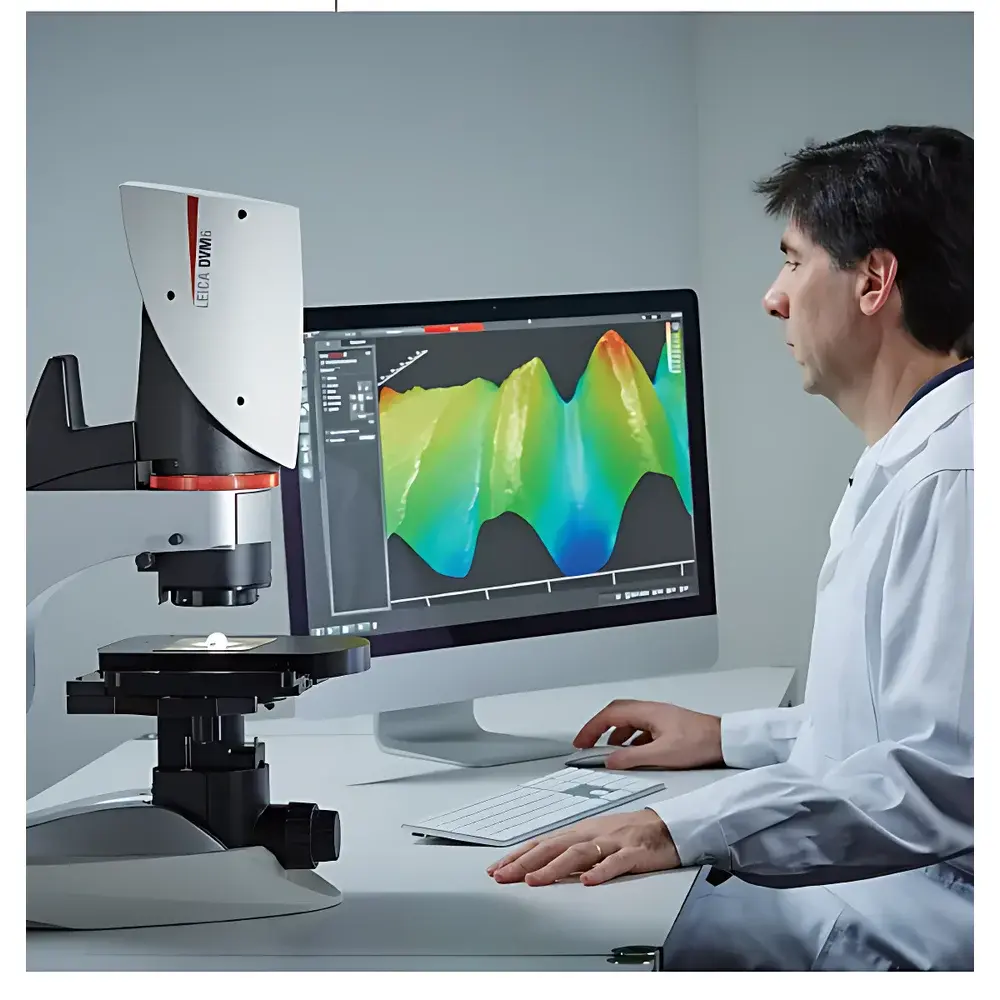
Leica DVM6A Digital 3D Extended Depth of Field Microscope
| Brand | Leica |
|---|---|
| Origin | Germany |
| Model | DVM6A |
| Optical Zoom Ratio | 16:1 |
| Tilt Range | ±60° |
| Magnification Ranges | Low (4.2–190×), Medium (16–675×), High (up to 1460×) |
| Field of View | Up to 35 mm |
| Minimum Resolvable Feature Size | 0.18 µm |
| Camera Resolution | 10 MP |
| Frame Rate | >30 fps |
| Illumination | Integrated LED with Multiple Contrast Modes |
| Software | LAS X (64-bit, Windows 7+) |
| Compliance | Designed for ISO/IEC 17025-compliant labs, supports audit-trail-enabled workflows per GLP/GMP and FDA 21 CFR Part 11 requirements |
Overview
The Leica DVM6A is a high-precision digital 3D extended depth of field (EDF) microscope engineered for industrial quality control, failure analysis, materials science research, and precision manufacturing inspection. Unlike conventional optical microscopes limited by shallow depth of field at high magnifications, the DVM6A employs a motorized focus-stacking algorithm combined with PlanApo-corrected optics to synthesize sharp, fully focused images across variable sample topographies—enabling true 3D surface reconstruction without mechanical sectioning or scanning electron microscopy (SEM) preparation. Its 16:1 continuous zoom system delivers calibrated magnification from 4.2× to 1460×, supporting both macro-scale overview and micron-level defect characterization on a single platform. The instrument integrates seamlessly into regulated laboratory environments through traceable calibration, sensor-driven component encoding, and metadata-rich image capture—ensuring repeatability and compliance in documentation-intensive workflows.
Key Features
- Motorized 16:1 optical zoom with real-time magnification encoding and automatic calibration—no manual recalibration required between sessions.
- ±60° tilt stage with programmable positioning and memory recall, enabling multi-angle surface inspection and oblique-view metrology.
- 10-megapixel color CMOS sensor with >30 fps live imaging and HDR capability—preserving detail in both shadowed and overexposed regions simultaneously.
- Integrated multi-LED illumination system with coaxial, ring, side, and transmitted light options—configurable for brightfield, darkfield, polarization, and differential interference contrast (DIC)-like rendering.
- Hybrid XYZ motion control: manual fine-tuning supplemented by motorized Z-focus and optional motorized XY stages for reproducible positioning and automated stitching.
- Full EDF acquisition with sub-micron axial resolution; generates topographic height maps and true-color 3D point clouds directly exportable as STL, OBJ, or CSV formats.
Sample Compatibility & Compliance
The DVM6A accommodates samples up to 35 mm in lateral dimension and accommodates heights compatible with standard Leica modular stands—including compatibility with the DVM6 M extension platform for oversized specimens (e.g., PCB assemblies, turbine blades, or composite laminates). All optical components are certified to DIN EN ISO 10110 standards for surface quality and wavefront fidelity. The system meets requirements for documented measurement traceability under ISO/IEC 17025:2017 and supports GLP/GMP-aligned operation via LAS X software’s built-in audit trail, electronic signature, and 21 CFR Part 11-compliant user access controls. Calibration certificates for magnification, focus step size, and illumination uniformity are available upon request.
Software & Data Management
LAS X is a native 64-bit application designed exclusively for Leica’s digital microscopy platforms. It provides intuitive workflow automation—from preset acquisition templates (single-frame, Z-stack, multi-position tile scan, or full XYZ mosaic) to post-processing quantification. Every captured image embeds full metadata: magnification, illumination settings, tilt angle, focus position, stage coordinates, and timestamp. Measurements in both 2D (length, area, angle, particle count) and 3D (roughness parameters Sa/Sq, step height, volume, curvature) comply with ISO 25178 and ASME B46.1 standards. Reports are generated with one click and exported to customizable Excel templates—including company branding, SOP references, and pass/fail thresholds. Image previews offer six auto-suggested enhancements (contrast, sharpening, noise reduction, etc.), allowing rapid optimization prior to final acquisition.
Applications
- Electronics: Solder joint inspection, wire bond integrity assessment, conformal coating thickness mapping, and PCB trace width verification.
- Materials Science: Grain boundary analysis, coating delamination detection, fracture surface topography, and additive manufacturing layer fidelity evaluation.
- Medical Device Manufacturing: Surface finish validation of stainless steel implants, polymer stent strut geometry, and laser-marked UDI compliance checks.
- Automotive & Aerospace: Paint defect classification, turbine blade leading-edge erosion quantification, and composite ply alignment verification.
- Forensics & Failure Analysis: Toolmark comparison, fracture origin localization, and corrosion pit morphology profiling with quantitative depth correlation.
FAQ
What distinguishes the DVM6A from the DVM6S and DVM6C configurations?
The DVM6A emphasizes large-area XY scanning and automated mosaic acquisition—ideal for inspecting extended surfaces such as wafers or printed circuit boards. The DVM6S prioritizes speed and repeatability in Z-stack acquisition, while the DVM6C maximizes optical resolution and color fidelity for critical documentation tasks.
Can the DVM6A perform quantitative roughness analysis per ISO 25178?
Yes—LAS X includes dedicated modules for areal surface texture analysis, computing Sa, Sq, Sz, and other parameters directly from EDF-derived height maps, with calibration traceability to NIST-traceable standards.
Is remote operation supported?
LAS X supports network-based client-server deployment, enabling remote image acquisition, annotation, and report generation via secure LAN or VPN connections—without compromising data integrity or audit trail continuity.
Does the system support third-party integration?
Via Leica’s open API (LAS X SDK), users can integrate the DVM6A into MES, LIMS, or custom QA dashboards using Python, C#, or LabVIEW—enabling automated trigger-based acquisition and structured metadata ingestion.
What maintenance is required to ensure long-term calibration stability?
Annual verification using Leica-certified calibration slides (magnification, focus step, illumination uniformity) is recommended. No routine optical alignment is needed—the PlanApo optics and encoded mechanics maintain factory calibration under normal operating conditions.



