
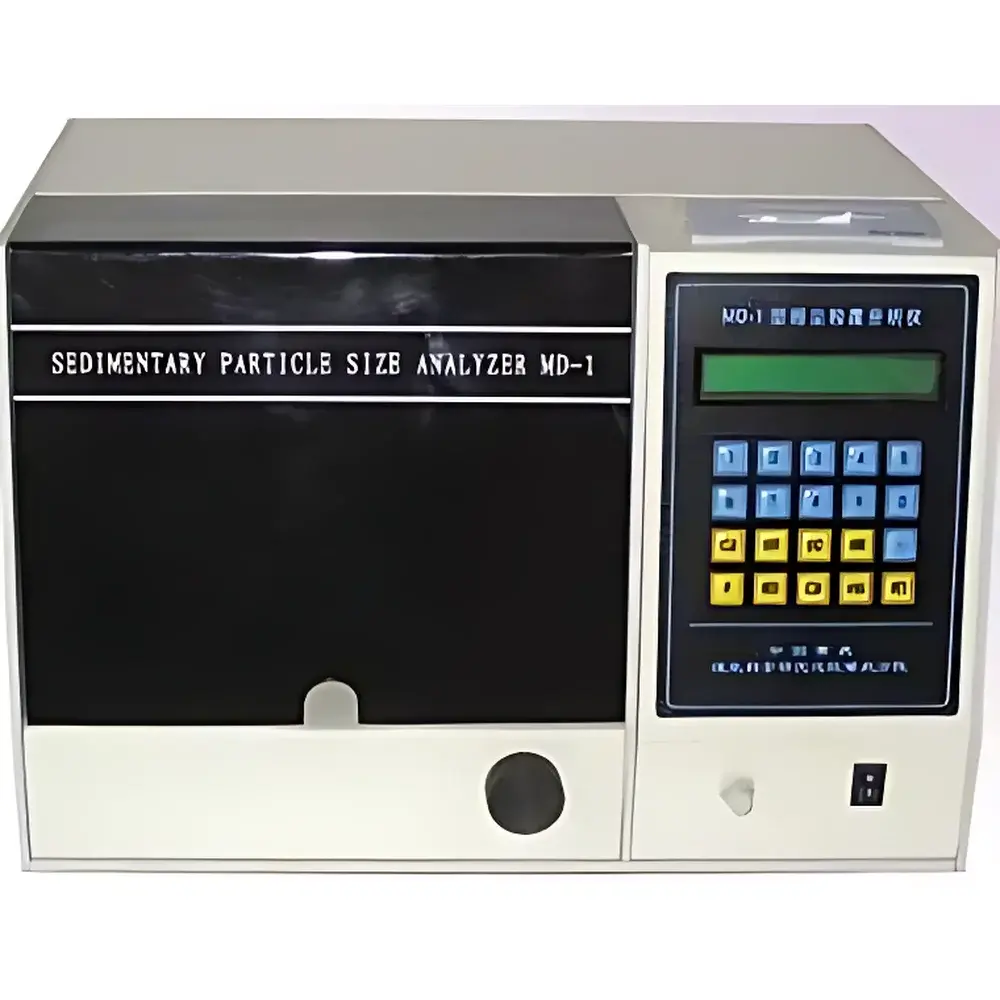
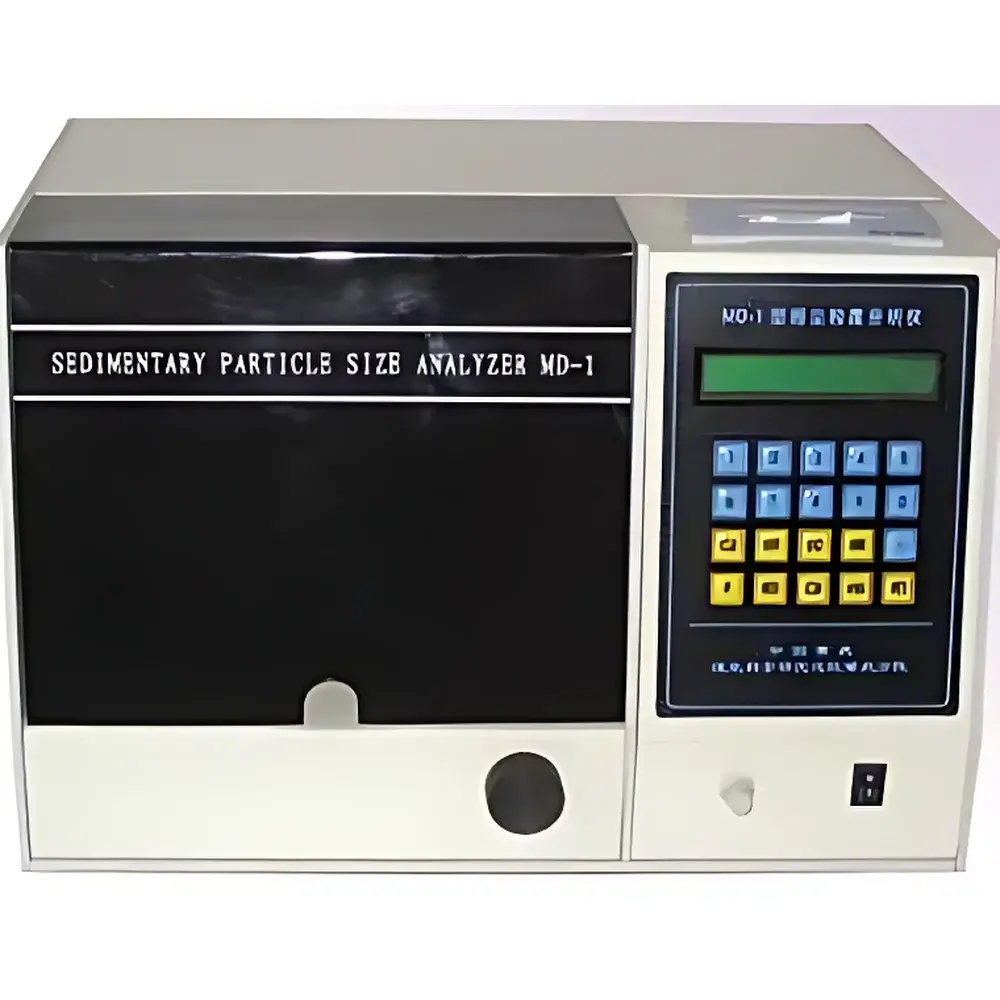
Loobo MD-1 Stokes-Based Dust Particle Size Analyzer
| Brand | Loobo |
|---|---|
| Origin | Shandong, China |
| Model | MD-1 |
| Measurement Principle | Stokes Sedimentation + Beer-Lambert Law |
| Particle Size Range | 0–150 µm |
| Resolution | 0.1 µm |
| Accuracy | ≤5% |
| Relative Error | ≤10% |
| Power Supply | 220 V AC |
| Dimensions | 430 × 285 × 300 mm |
| Weight | 15 kg |
| Data Storage Capacity | 40 particle size distribution profiles |
| Safety Classification | Non-explosion-proof |
Overview
The Loobo MD-1 Stokes-Based Dust Particle Size Analyzer is a dedicated laboratory instrument engineered for rapid, reproducible determination of airborne dust particle size distribution—commonly referred to as dust dispersibility—in occupational and environmental health monitoring applications. It operates on the fundamental physical principles of Stokes’ law for gravitational sedimentation velocity and the Beer-Lambert law for optical density measurement. As particles settle through a liquid medium under gravity, their terminal velocity correlates directly with diameter (assuming spherical morphology and known density), enabling indirect size classification. Simultaneous optical transmission measurement provides real-time quantification of suspended mass concentration at defined time intervals. This dual-physics approach eliminates reliance on manual gravimetric weighing or labor-intensive microscopic counting—reducing operator dependency and improving inter-laboratory consistency. The MD-1 is designed for routine use in industrial hygiene labs, mine safety departments, and municipal environmental monitoring centers where regulatory compliance with dust exposure limits (e.g., OSHA PELs, ACGIH TLVs) requires validated particle size fractionation data.
Key Features
- Stokes sedimentation methodology compliant with ASTM D1894 and ISO 13320 foundational sedimentation principles (adapted for respirable dust characterization)
- Integrated optical density detection system with auto-calibrated photometric circuitry; background signal range: 2500–3800 arbitrary units
- Onboard data storage for up to 40 complete particle size distribution profiles with timestamping and parameter logging (ρp, ρl, viscosity, settling height)
- Power-fail protection ensures retention of stored datasets during unexpected AC interruption
- Adjustable dispersion chamber alignment via precision rotary disk with optical path registration marks for repeatable optical coupling
- Real-time display of elapsed settling time (t) and corresponding optical density (OD); user-selectable termination via BRE key based on theoretical t50 or t90 calculation
- Standardized reporting output via built-in thermal printer or front-panel LCD screen; no external PC required for basic operation
Sample Compatibility & Compliance
The MD-1 is optimized for aqueous or low-viscosity organic dispersions of mineral dusts (e.g., coal, silica, limestone, cement), metal oxides, and other industrially relevant particulates. Sample preparation follows NIOSH Method 0600 and OSHA ID-142 guidelines for respirable dust extraction and suspension stabilization. While not certified to IECEx or ATEX standards, its non-explosion-proof design complies with general laboratory electrical safety requirements per IEC 61010-1. Instrument outputs support GLP-compliant documentation when paired with controlled procedural logs and manual audit trails. Though not FDA 21 CFR Part 11–validated out-of-the-box, raw OD vs. time datasets can be exported manually for secondary analysis in validated software environments.
Software & Data Management
The MD-1 features embedded firmware with menu-driven navigation (State 1–State 6 operational modes) supporting full measurement workflow control—from background calibration and blank correction to multi-point sedimentation profiling and cumulative mass distribution calculation. All stored results include metadata: date/time stamp, user-input parameters (particle density ρp, liquid density ρl, dynamic viscosity η, settling column height H), and measured optical density values. Data recall (RED key) and print (P key) functions allow selective retrieval of any of the 40 stored runs. No proprietary software installation is required; however, users may manually transcribe ASCII-formatted results into LIMS or Excel for statistical evaluation (e.g., d10, d50, d90, geometric standard deviation σg). Firmware supports zero-reset functionality to ensure baseline integrity prior to new analytical campaigns.
Applications
- Determination of respirable, thoracic, and inhalable dust fractions per ISO/TC 146/SC 2 definitions
- Verification of dust control efficacy in ventilation systems and local exhaust hoods
- Source characterization in quarrying, foundry, construction, and ceramic manufacturing facilities
- Supporting exposure assessment for regulatory reporting under EU Directive 2004/37/EC (carcinogens and mutagens)
- Educational use in occupational hygiene training programs for particle behavior modeling
- Pre-screening of filter media efficiency by analyzing upstream/downstream aerosol distributions
FAQ
What particle size standards are recommended for MD-1 verification?
Certified reference materials such as NIST SRM 1980 (silicon dioxide) or ISO 12103-1 A2 test dust are suitable for system verification; d50 accuracy validation should target the 10–13 µm range per manufacturer specification.
Can the MD-1 measure nanoparticles (<1 µm)?
No—the lower detection limit is constrained by Brownian motion dominance below ~1 µm and optical resolution limits; it is not suitable for nano-aerosol analysis.
Is temperature control available during sedimentation?
The MD-1 does not incorporate active thermal regulation; ambient lab temperature must be maintained between 2–40 °C per operating specifications to minimize viscosity drift.
How often should optical path alignment be verified?
Alignment should be confirmed before each daily use and after any transport or mechanical disturbance, using the rotary disk registration mark alignment procedure described in the operator manual.
Does the instrument comply with ISO 20685 for workplace aerosol sampling?
While the MD-1 itself is not an aerosol sampler, its analysis protocol aligns with ISO 20685 Annex B recommendations for post-sampling particle size distribution of filter-collected dust when properly re-dispersed.
Related Products







