
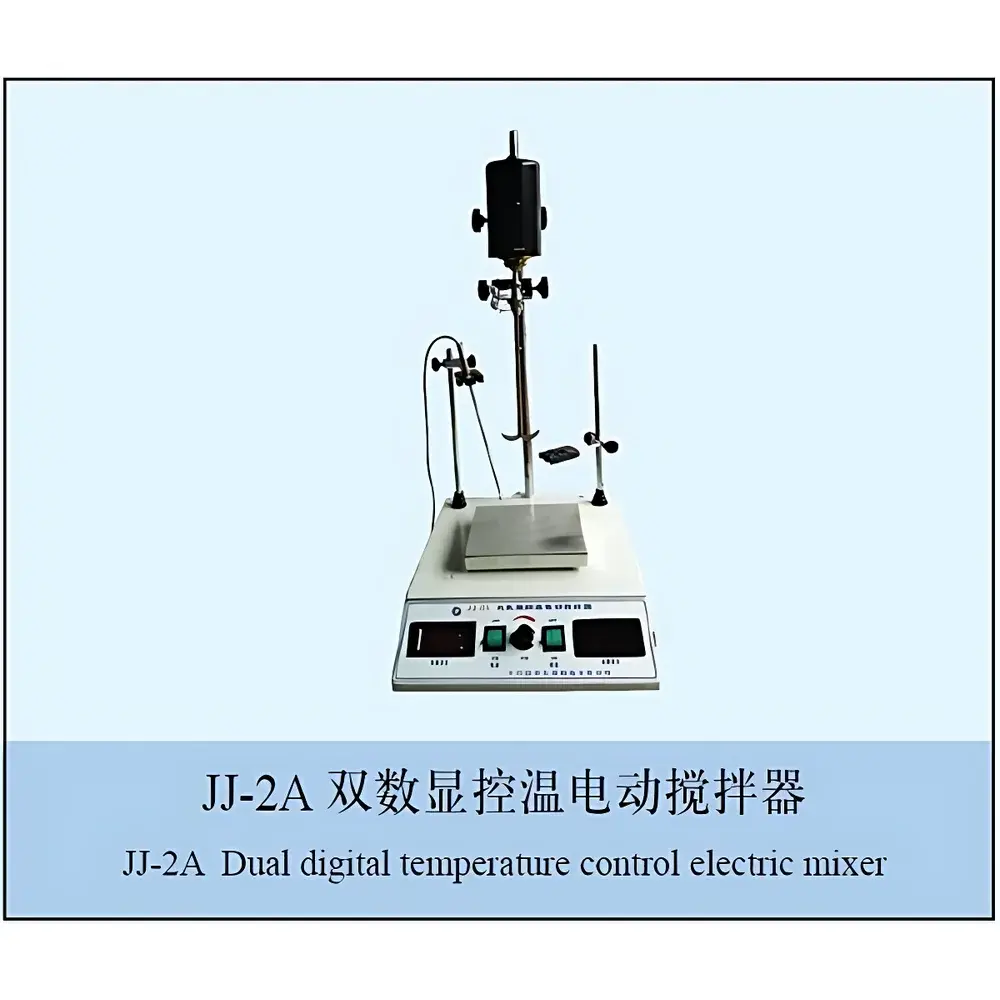
CZGY JJ-2A Dual-Digital Display Temperature-Controlled Electric Stirrer
| Brand | CZGY |
|---|---|
| Origin | Jiangsu, China |
| Manufacturer Type | Direct Manufacturer |
| Product Category | Domestic Laboratory Equipment |
| Model | JJ-2A |
| Instrument Type | Electric Stirrer |
| Max. Mixing Volume | 20 L |
| Speed Range | 0–3000 rpm |
| Temperature Control Range | Ambient to 100 °C |
| Power Supply | 220 V ±10%, 50 Hz |
| Motor Power | 100 W |
| Heating Power | 500 W |
| Working Plate Dimensions | 16 × 16 cm |
Overview
The CZGY JJ-2A Dual-Digital Display Temperature-Controlled Electric Stirrer is an integrated benchtop mixing and heating system engineered for precision, reproducibility, and operational stability in routine laboratory workflows. It combines a high-torque permanent-magnet DC motor with a PTC-based resistive heating module and dual independent digital displays—one for real-time rotational speed (rpm) and one for actual/setting temperature (°C). The instrument operates on the principle of mechanical shear-driven homogenization, where rotational energy from the motor is transferred via a stainless-steel stirring shaft to induce controlled laminar or turbulent flow within liquid-phase samples. Its design conforms to standard laboratory safety and electromagnetic compatibility requirements for Class I electrical equipment (IEC 61010-1), and it is routinely deployed in environments requiring simultaneous thermal regulation and mechanical agitation—such as solution preparation, dissolution testing, reagent synthesis, and pre-analytical sample conditioning.
Key Features
- Permanent-magnet DC motor delivering consistent torque across the full 0–3000 rpm range, with stepless analog speed control and minimal speed drift (< ±2% at setpoint under load)
- Dual LED digital displays: one for instantaneous rotational speed (0.1 rpm resolution), one for temperature (0.1 °C resolution), enabling concurrent monitoring without mode switching
- Integrated PID temperature controller with programmable parameters (P, T, E) accessible via front-panel SET key; default I = 180 s, D = 45 s for stable thermal response
- Stainless-steel stirring rod (316-grade compatible) and 16 × 16 cm ceramic-coated aluminum heating plate optimized for chemical resistance and uniform heat distribution
- Thermal cutoff protection and grounded chassis design compliant with IEC 61010-1 safety standards; includes earth terminal for mandatory grounding per lab electrical codes
- Compact footprint (220 × 180 × 350 mm) and low-noise operation (< 55 dB(A) at 1 m), suitable for shared analytical laboratories and teaching facilities
Sample Compatibility & Compliance
The JJ-2A accommodates glass, polypropylene, and borosilicate vessels up to 20 L capacity, supporting aqueous, organic, and mildly corrosive media (pH 2–12). It is not rated for explosive atmospheres (ATEX), vacuum, or pressurized applications. While not certified to ISO/IEC 17025 or GLP-specific validation protocols out-of-the-box, its dual-display architecture, traceable calibration points (speed verified with optical tachometer; temperature validated against NIST-traceable RTD probe), and configurable PID parameters enable user-led IQ/OQ documentation per internal SOPs. The device meets CE marking requirements for EMC (EN 61326-1) and Low Voltage Directive (2014/35/EU), and complies with national GB/T 12804–2011 standards for laboratory stirrers in China.
Software & Data Management
The JJ-2A operates as a standalone hardware-controlled system with no embedded firmware update capability or PC connectivity (RS-232/USB). All operational parameters—including speed setpoint, temperature setpoint, and PID tuning values—are configured manually via tactile push buttons and retained in non-volatile memory during power cycling. For regulated environments (e.g., pharmaceutical QC labs), users may implement external data logging using third-party thermocouple interfaces and rpm sensors linked to validated acquisition software (e.g., LabVIEW or MATLAB), provided such systems are qualified under 21 CFR Part 11 Annex 11 requirements. Audit trails must be maintained separately, as the unit itself does not generate electronic records or timestamps.
Applications
- Preparation of buffer solutions, culture media, and calibration standards in academic and industrial microbiology labs
- Dissolution profile studies (USP Apparatus II simulation) for solid oral dosage forms under controlled thermal conditions
- Homogenization of polymer emulsions, nanoparticle suspensions, and colloidal dispersions prior to DLS or TEM analysis
- Accelerated stability testing of formulations requiring isothermal agitation (e.g., 40 °C/75% RH preconditioning support)
- Teaching demonstrations of fluid dynamics principles (Reynolds number estimation, vortex formation thresholds) in undergraduate physical chemistry courses
- Supporting gravimetric analysis workflows where constant temperature minimizes solvent evaporation during titration reagent preparation
FAQ
What is the maximum recommended vessel diameter for optimal stirring efficiency?
For uniform torque transmission and minimal vortexing, use cylindrical containers with internal diameters ≤14 cm when operating above 1500 rpm.
Can the heating plate accommodate round-bottom flasks directly?
Yes—provided the flask base is flat-contact compatible (e.g., with ground-glass or reinforced bottom); use caution with thin-walled glass to prevent thermal stress cracking.
Is the temperature sensor calibrated to NIST-traceable standards?
The built-in PT100 sensor is factory-calibrated; users should perform periodic verification using a certified reference thermometer per ASTM E74 or ISO 17025 procedures.
Does the unit support continuous 24-hour operation?
Rated for intermittent duty (≤8 h/day); extended operation requires ambient temperature <30 °C and adequate ventilation around the rear cooling vents.
How is overtemperature protection implemented?
A redundant bimetallic thermal cutoff switch disconnects heating power if plate surface exceeds 110 °C, independent of PID control logic.



