
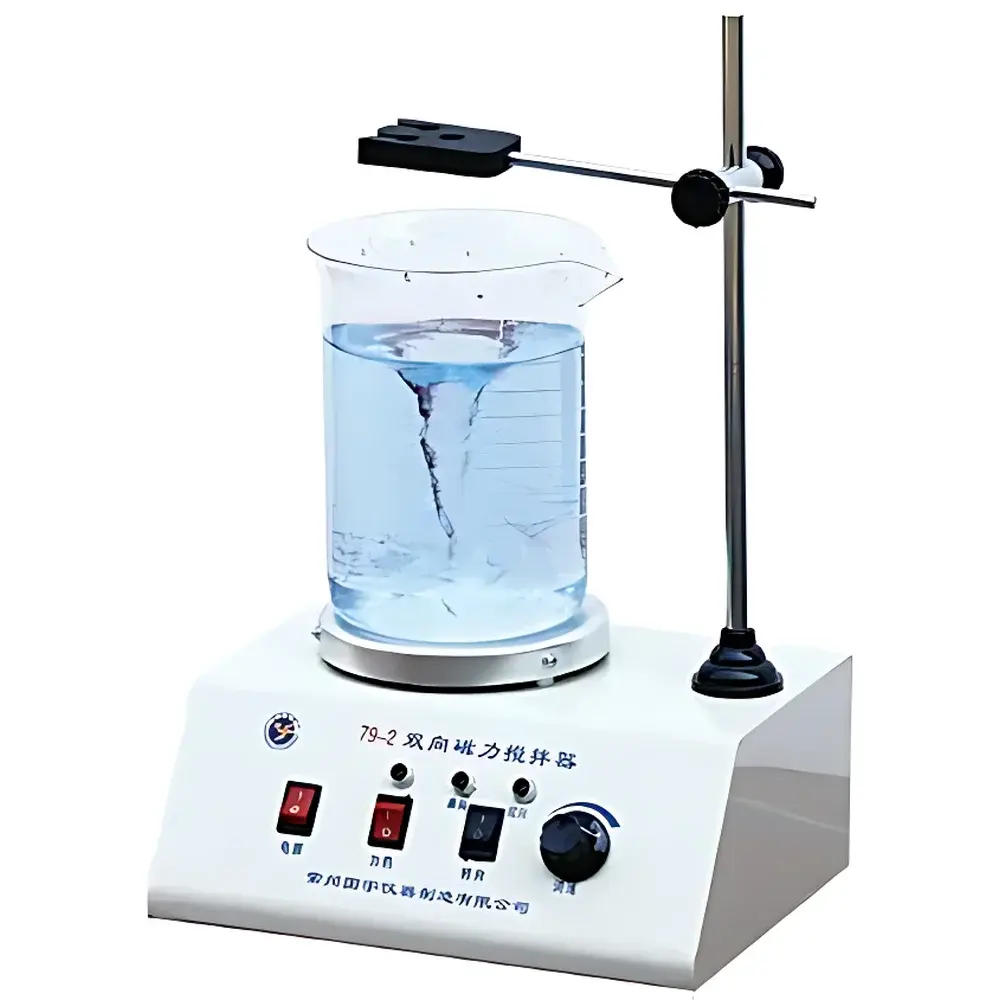
CZGY 79-2 Dual-Direction Magnetic Hotplate Stirrer
| Brand | CZGY |
|---|---|
| Origin | Jiangsu, China |
| Manufacturer Type | Direct Manufacturer |
| Instrument Type | Magnetic Stirrer |
| Maximum Stirring Volume | 1 L |
| Speed Range | 0–1600 rpm |
| Temperature Control Range | Ambient to 100 °C |
Overview
The CZGY 79-2 Dual-Direction Magnetic Hotplate Stirrer is a benchtop laboratory instrument engineered for precise, reproducible mixing and temperature-controlled homogenization of low-to-medium viscosity liquid samples. It operates on the principle of magnetic coupling: a rotating permanent magnet beneath a thermally stable ceramic-coated aluminum hotplate induces synchronous rotation of a PTFE- or glass-coated magnetic stir bar immersed in the sample vessel. Unlike single-direction units, the 79-2 incorporates an integrated timer-based polarity reversal mechanism that alternates motor rotation every 30 seconds—enabling bidirectional agitation to minimize vortex formation, reduce stratification, and improve suspension uniformity in heterogeneous mixtures such as precipitates, colloids, or cell suspensions. Designed for routine use in analytical, environmental, pharmaceutical, and academic laboratories, this stirrer delivers consistent thermal and mechanical performance without mechanical shaft penetration, ensuring contamination-free operation and ease of cleaning.
Key Features
- Dual-directional stirring cycle: automatic polarity reversal every 30 seconds (30 s clockwise / 30 s counterclockwise) to enhance mixing efficiency and particle dispersion
- Continuously variable speed control from 0 to 1600 rpm via analog knob—enabling fine-tuned adjustment for sensitive applications including enzymatic reactions or viscous polymer solutions
- Integrated heating element with PID-assisted temperature regulation (ambient to 100 °C), supporting simultaneous stirring and thermal equilibration
- 12 cm diameter chromium-plated aluminum hotplate surface—resistant to corrosion, thermally uniform, and compatible with standard borosilicate glassware (e.g., 50–1000 mL beakers)
- Low-noise, brushless DC motor design with vibration-dampened housing—ensuring stable operation during extended runs
- 40 W stirring motor + 200 W heating capacity—optimized for energy-efficient performance in continuous or intermittent duty cycles
- Grounded safety design with dedicated earth terminal—compliant with IEC 61010-1 requirements for laboratory electrical equipment
Sample Compatibility & Compliance
The 79-2 accommodates standard cylindrical vessels up to 1 L volume, including glass beakers, flasks, and crystallization dishes. It supports stir bars ranging from 20 mm to 50 mm in length, with PTFE-coated or encapsulated ceramic variants recommended for aggressive solvents or elevated temperatures. The unit meets general safety standards applicable to Class I, Group II laboratory appliances per IEC 61010-1 Ed. 3. While not certified to ISO/IEC 17025 or GLP-specific validation protocols out-of-the-box, its operational stability and repeatability support method validation under internal laboratory quality systems. Users performing regulated work (e.g., USP , ASTM D445) may document calibration procedures for speed and temperature against traceable references.
Software & Data Management
As a manually operated analog instrument, the 79-2 does not feature digital connectivity, onboard data logging, or software integration. All parameter adjustments—including speed and temperature setpoints—are performed locally via front-panel controls. This architecture ensures electromagnetic compatibility in RF-sensitive environments and eliminates firmware-related failure modes. For laboratories requiring audit trails or electronic records, external USB or RS-232 temperature/data loggers can be deployed alongside the unit to capture real-time plate surface temperature profiles. No drivers or proprietary software are required; compatibility extends to standard LabVIEW, MATLAB, or Python-based acquisition frameworks when interfaced via third-party sensors.
Applications
- Preparation of buffer solutions, reagent dilutions, and standard calibration mixtures in QC/QA labs
- Homogenization of biological suspensions (e.g., bacterial cultures, yeast slurries) prior to centrifugation or filtration
- Accelerated dissolution testing of solid dosage forms under controlled thermal conditions
- Supporting synthesis workflows involving reflux, precipitation, or pH-adjustment steps where gentle yet thorough mixing is critical
- Environmental sample digestion (e.g., EPA Method 3010A) requiring combined heating and agitation of acidic digestates
- Teaching laboratories—ideal for demonstrating kinetic principles, solubility equilibria, or heat transfer phenomena
FAQ
What is the maximum recommended continuous operating time at high speed?
At speeds above 1200 rpm, continuous operation should not exceed 4 hours per session to maintain motor longevity and thermal stability.
Can the unit be used without heating activated?
Yes—the stirring function operates independently of the heating system. Power to the heater must be manually disabled when only mechanical agitation is required.
Is the hotplate surface resistant to strong acids or organic solvents?
The chromium-plated aluminum surface offers moderate resistance to diluted acids and alcohols but is not suitable for prolonged exposure to concentrated HNO₃, HF, or chlorinated solvents; use appropriate containment (e.g., glass beaker) to protect the plate.
Does the 79-2 support external temperature probe feedback control?
No—it relies on built-in thermostat sensing only; no provision exists for external Pt100 or thermocouple input.
What stir bar size is optimal for 1 L solutions?
A 40–50 mm PTFE-coated stir bar provides optimal torque transfer and vortex control in 1 L beakers at mid-to-high speed ranges (800–1400 rpm).



