
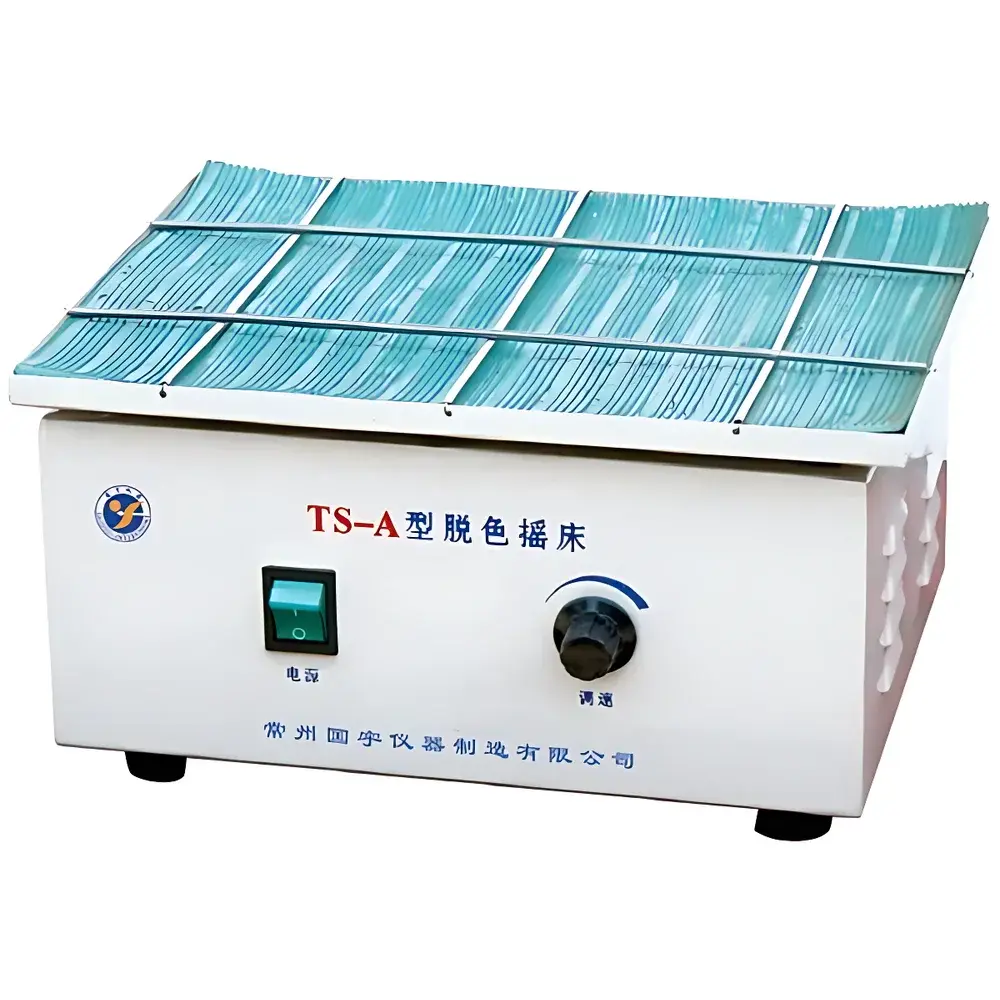
CZGY TS-A / TS-B / TY-80S Decolorizing Shaker
| Brand | CZGY |
|---|---|
| Origin | Jiangsu, China |
| Manufacturer Type | Direct Manufacturer |
| Product Category | Domestic |
| Models | TS-A (Horizontal Oscillating), TS-B (Rocking), TY-80S (Orbital) |
| Instrument Type | General-Purpose Laboratory Shaker |
| Timer Range | None |
| Oscillation Frequency | 50–300 rpm |
| Oscillation Amplitude | 20 mm |
| Temperature Control | Ambient-only (Non-Heated) |
| Platform Quantity | 1 |
Overview
The CZGY TS-A, TS-B, and TY-80S Decolorizing Shakers are purpose-engineered laboratory oscillators designed for consistent, low-shear mechanical agitation during post-electrophoretic processing and molecular biology workflows. Each model implements a distinct motion profile—horizontal linear oscillation (TS-A), seesaw-style rocking (TS-B), or circular orbital motion (TY-80S)—to optimize reagent penetration, uniform staining/dye removal, and gentle suspension of delicate biological matrices without compromising structural integrity. These shakers operate exclusively at ambient temperature and rely on brushless DC motor architecture to deliver stable rotational output across the full 50–300 rpm range, ensuring reproducible mixing performance essential for standardized protocols in gel documentation, immunoassay development, nucleic acid hybridization, and cell-based assays. Their robust mechanical design supports continuous-duty operation under standard laboratory conditions, with no thermal regulation or programmable timing functionality.
Key Features
- Three mechanically differentiated configurations: TS-A (horizontal reciprocating motion), TS-B (asymmetric rocking motion), and TY-80S (360° orbital motion), enabling selection based on protocol-specific fluid dynamics requirements
- Precision-engineered 20 mm amplitude ensures effective macro-mixing while minimizing bubble formation and sample splashing in open trays and gel cassettes
- Brushless DC motor drive delivers smooth, vibration-damped operation with minimal electromagnetic interference—critical for integration near sensitive detection systems
- Single-platform design accommodates standard electrophoresis trays (up to 330 × 290 mm footprint) and multi-well plates; platform surface features non-slip rubber matting for secure sample retention
- Fixed AC input (220 V ±10%, 50 Hz) with grounded three-prong connector—compliant with IEC 61010-1 safety standards for laboratory electrical equipment
- Manual speed control via calibrated rotary dial; no microprocessor-based interface or digital display—optimized for simplicity, reliability, and long-term serviceability
Sample Compatibility & Compliance
These shakers are validated for use with polyacrylamide and agarose gels housed in standard glass or plastic trays, immunoblot membranes (PVDF, nitrocellulose), hybridization bags, and microcentrifuge tube racks. They support common life science applications including Coomassie Brilliant Blue R-250 staining and destaining, silver nitrate-based gel visualization, autoradiography film development (fixing and washing steps), Western blot blocking and antibody incubation, Southern/Northern hybridization, and antigen–antibody binding kinetics studies. While not certified for GMP or GLP environments, their construction meets basic ISO 9001-aligned manufacturing controls. No regulatory certifications (e.g., CE, UL, FDA 21 CFR Part 11) apply due to absence of data logging, user authentication, or audit trail capabilities.
Software & Data Management
None. These instruments operate as analog, standalone hardware units with no embedded firmware, USB connectivity, or software interface. All operational parameters—including speed setting—are manually adjusted and retained only during active power supply. No data storage, export, or remote monitoring functionality is provided. This architecture aligns with ISO/IEC 17025 Clause 6.4.7 (equipment verification) requirements for non-automated instrumentation where calibration and functional checks are performed prior to each use cycle.
Applications
- Electrophoretic gel processing: fixation, staining (Coomassie, silver), destaining, and drying preparation
- Membrane-based assays: blocking, primary/secondary antibody incubation, wash cycles in Western and dot blot workflows
- Nucleic acid hybridization: pre-hybridization equilibration, probe hybridization, and stringent post-hybridization washes
- Radiographic film handling: developer, fixer, and rinse agitation in autoradiography and phosphorimaging workflows
- Cell suspension maintenance during transient incubation steps (e.g., co-culture washes, transient transfection recovery)
- Hematological assays: blood clot retraction studies and erythrocyte sedimentation rate (ESR) simulation protocols
FAQ
What is the difference between TS-A, TS-B, and TY-80S motion profiles?
TS-A generates horizontal back-and-forth translation ideal for even dye diffusion across flat gels; TS-B uses an asymmetric pivot to induce gentle rocking—preferred for membrane washing to prevent curling; TY-80S applies orbital rotation best suited for solution-phase reactions requiring homogeneous suspension.
Can these shakers be used inside cold rooms or incubators?
No. They lack environmental sealing or condensation-resistant components and are rated only for operation at ambient laboratory temperatures (10–30 °C, <80% RH).
Is speed calibration traceable to national standards?
Speed accuracy is verified against factory-set mechanical reference during production. Users should perform periodic verification using a handheld tachometer per ISO/IEC 17025 Clause 6.5.2 if required by internal QA procedures.
Does the platform accept custom fixtures or clamps?
Yes—the flat, threaded platform surface allows mechanical attachment of third-party holders, tube racks, or tray adapters using M4 or M5 fasteners.
What maintenance is required?
Annual inspection of motor coupling integrity and bearing lubrication status is recommended. No scheduled replacement parts exist; the brushless DC motor has a rated service life exceeding 20,000 operating hours under nominal load.




