
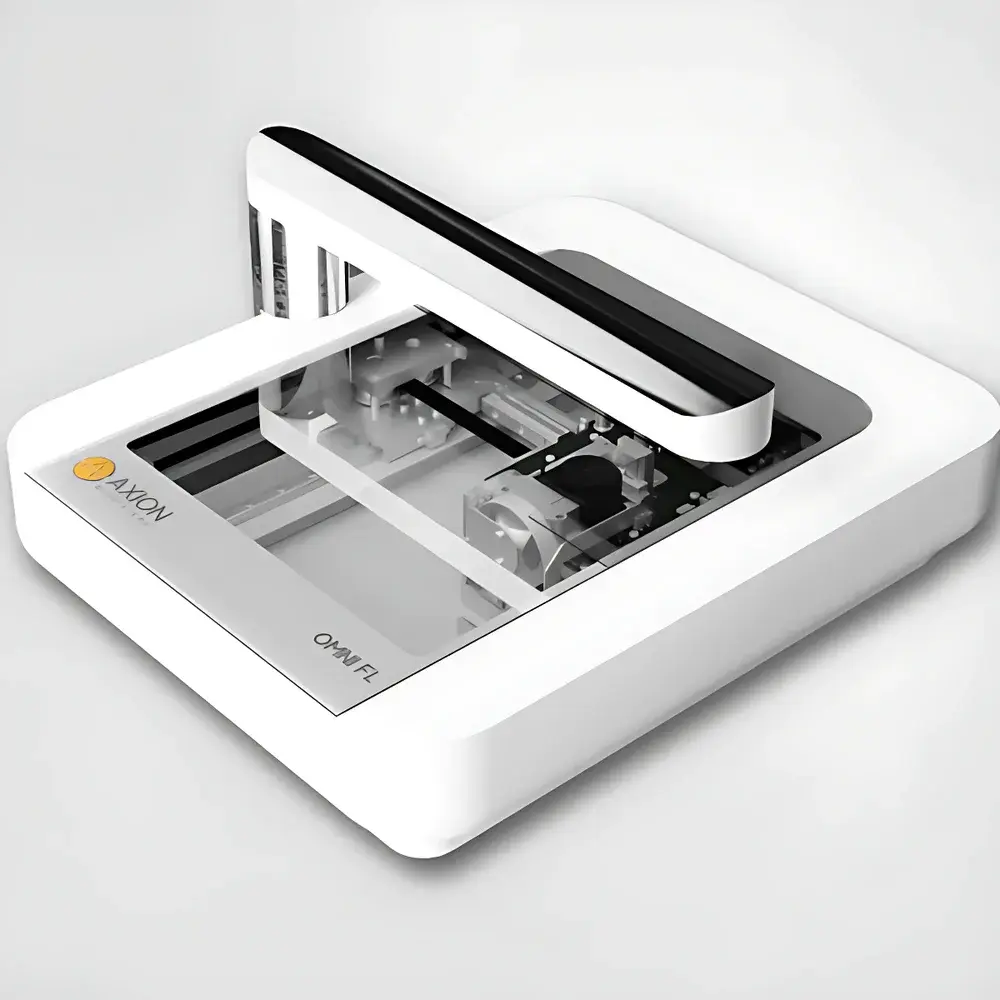
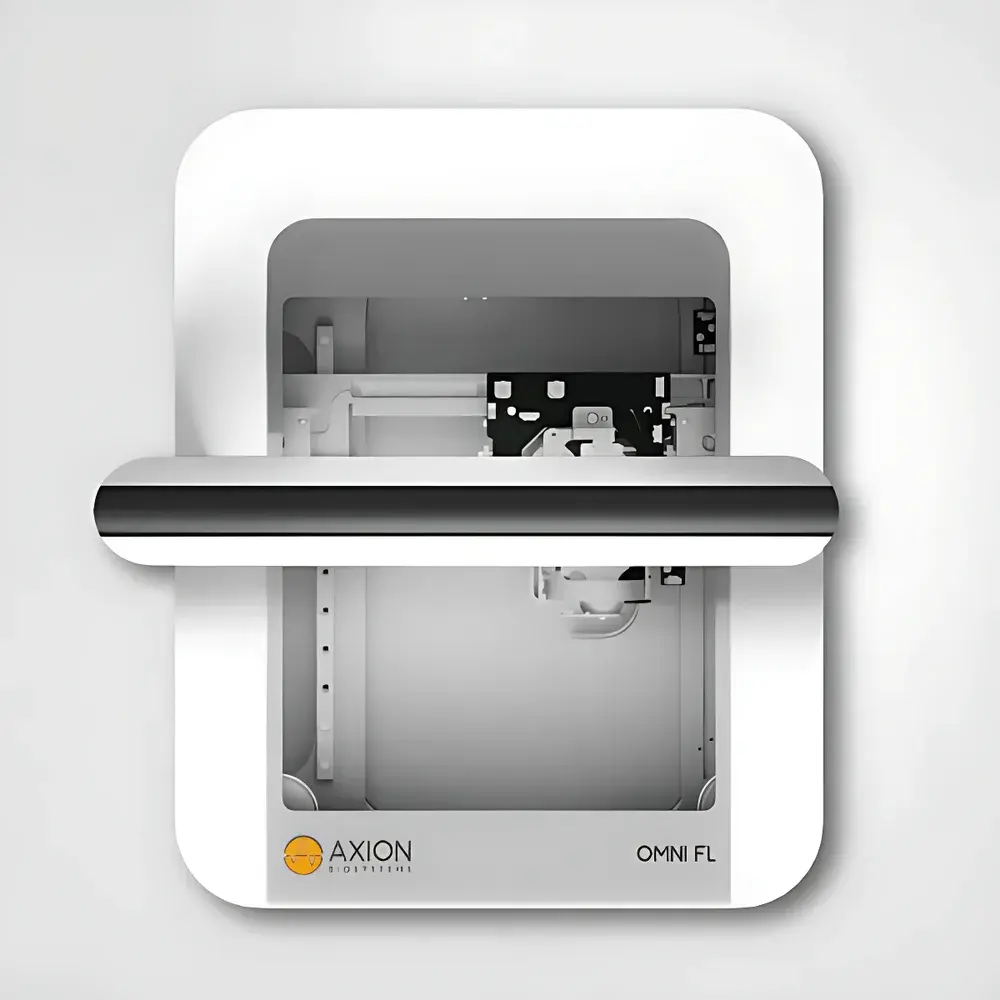
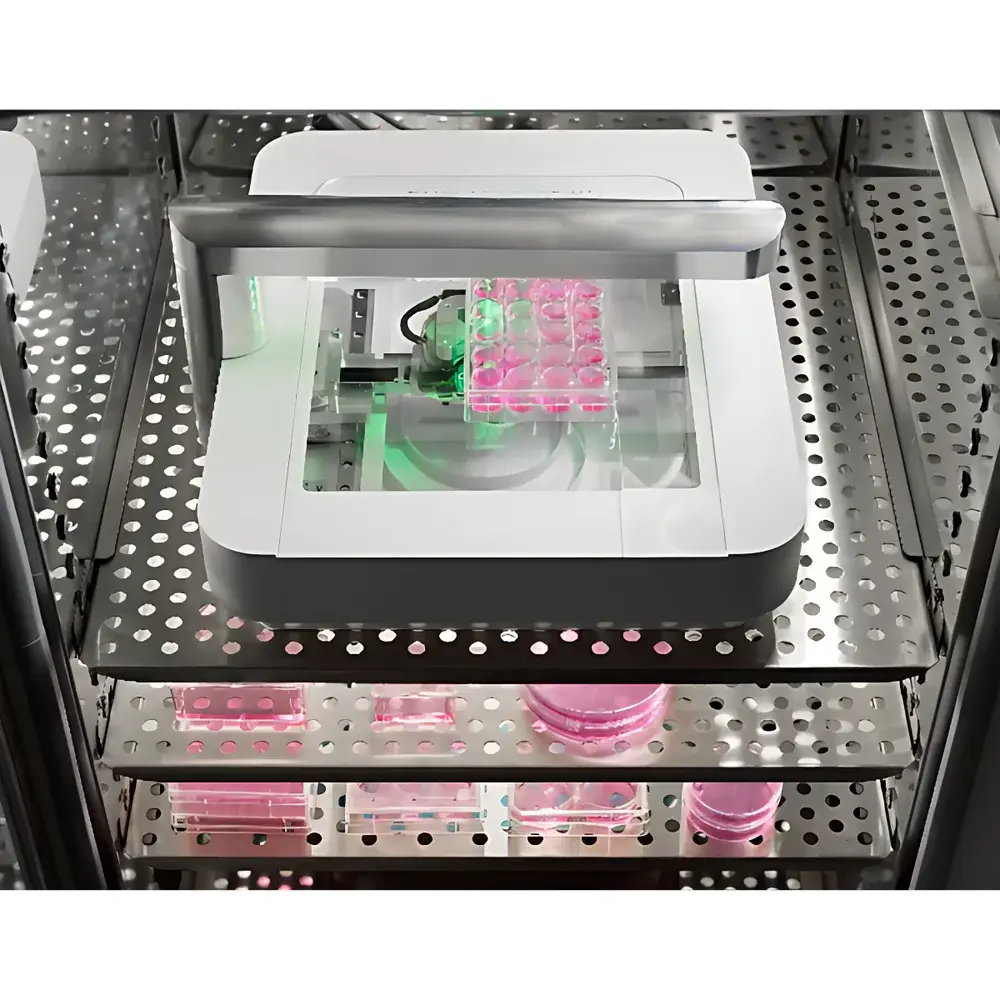
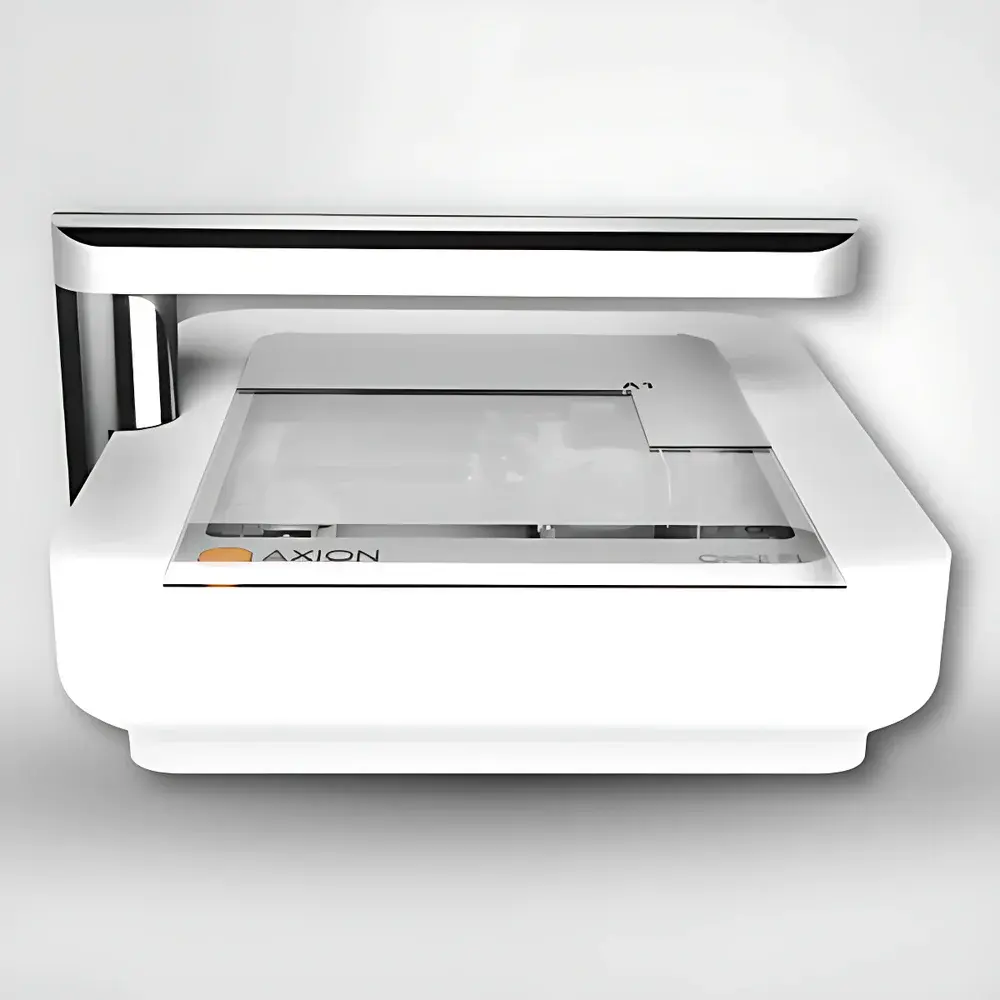
Axion Omni Live-Cell Real-Time Imaging System for Clonogenic Assays and Monoclonality Verification
| Brand | Axion BioSystems |
|---|---|
| Origin | Netherlands |
| Manufacturer | Axion BioSystems |
| Product Type | Imported Instrument |
| Model | Omni |
| Temperature Control Range | 5–40 °C |
| Humidity Control Range | 20–95% RH |
| Imaging Speed | Full-plate brightfield/fluorescence scan in ≤10 minutes |
Overview
The Axion Omni Live-Cell Real-Time Imaging System is an integrated, incubator-compatible high-content imaging platform engineered for longitudinal, label-free or fluorescent monitoring of adherent and suspension mammalian cells within standard tissue culture environments. Operating on a wide-field, motorized stage-based optical architecture, the Omni employs top-mounted LED illumination and a bottom-positioned, high-resolution CMOS sensor mounted on a precision XY translation stage to acquire tile-scanned images across multiwell plates and custom substrates. Its core measurement principle relies on quantitative phase-contrast and fluorescence intensity mapping—enabling non-invasive, kinetic assessment of cellular confluence, morphology, proliferation, and clonal expansion without fixation, staining, or endpoint harvesting. Designed specifically for regulatory-compliant cell line development workflows, the system supports continuous imaging over periods spanning days to weeks under physiologically relevant conditions (5–40 °C, 20–95% RH), making it suitable for ICH Q5D-compliant monoclonality verification and USP guidance-aligned clonogenic assay execution.
Key Features
- Incubator-integrated hardware architecture with full environmental tolerance (5–40 °C, 20–95% RH) and ESD-safe enclosure
- Automated panoramic tiling: generates seamless 86 mm × 124 mm composite images from up to 7,850 individual frames per plate
- Dual-channel acquisition: simultaneous or sequential brightfield and fluorescence (DAPI/FITC/TRITC/Cy5 compatible) imaging
- Sub-micron spatial resolution (≤1.2 µm/pixel at 4× objective) with auto-focus and drift compensation algorithms
- Modular software suite supporting FDA 21 CFR Part 11-compliant audit trails, electronic signatures, and data integrity controls
- Scalable throughput: supports 6–384-well plates, T25–T225 flasks, Petri dishes, and microfluidic devices (<55 mm height)
Sample Compatibility & Compliance
The Omni accommodates all optically transparent, flat-bottomed cell culture vessels meeting dimensional constraints (max height: 55 mm; max footprint: 86 mm × 124 mm). It has been validated for use with CHO-K1, HEK293, Jurkat, iPSCs, primary T cells, and organoid cultures. All firmware and analysis modules comply with ISO 13485:2016 design controls and support GLP/GMP-aligned documentation requirements. Image metadata—including timestamp, environmental logs, objective ID, exposure settings, and user credentials—is embedded in TIFF/OME-TIFF format files and archived with cryptographic hashing to ensure ALCOA+ (Attributable, Legible, Contemporaneous, Original, Accurate) data provenance.
Software & Data Management
Acquired images are transmitted via encrypted HTTPS to Axion’s secure cloud infrastructure or optionally routed to on-premise servers. The Axion Image Analysis Suite includes FDA 21 CFR Part 11–enabled modules for clonogenic analysis (colony count, area, circularity, growth kinetics), confluence quantification, scratch/wound healing migration tracking, spheroid/organoid segmentation, and fluorescent object counting. Raw data export (TIFF, OME-TIFF, CSV) is supported for integration with third-party tools including MATLAB, Python (scikit-image, CellProfiler), and commercial platforms such as MetaXpress and Harmony. Audit logs record every processing step—including parameter changes, manual corrections, and reanalysis events—with immutable timestamps and operator attribution.
Applications
- Clonogenic assays: Quantitative, time-resolved enumeration of colony formation dynamics—detecting initiation as early as day 2–3 post-seeding, enabling accelerated decision-making in cell line development
- Monoclonality verification: Continuous lineage tracing for regulatory submissions (EMA/CHMP/BWP/41568/2007, FDA CMC guidance), satisfying ICH Q5D requirement for “reasonable assurance” of single-cell origin
- Cytotoxicity profiling: Real-time IC50 determination using proliferation arrest, morphological degeneration, and membrane integrity loss metrics
- Tumor spheroid & organoid assays: Growth kinetics, necrosis onset, and drug penetration modeling in 3D models
- Immunooncology assays: CAR-T cytotoxicity, target cell lysis kinetics, and immune synapse formation in co-culture formats
- Transfection/transduction efficiency: Fluorescent reporter expression kinetics correlated with functional outcomes
FAQ
How does the Omni acquire images inside a CO2 incubator?
The system uses a top-illuminated LED array and a bottom-mounted, motorized imaging head that moves beneath the sample plate. Brightfield tiling captures ~7,850 sub-images per plate, which are stitched into a single high-resolution mosaic (86 mm × 124 mm). Fluorescence mode allows user-defined ROI targeting per well to minimize phototoxicity.
Which image analysis modules are available?
Pre-validated modules include Clonogenic Analysis, Confluence Quantification, Organoid Morphometrics, Scratch/Wound Healing, Stem Cell Differentiation Scoring, and Fluorescent Object Counting. Custom algorithm development services are available upon request.
Is the Omni compatible with standard cell culture incubators?
Yes—the entire system operates reliably at 5–40 °C and 20–95% RH. It requires only standard AC power and Ethernet connectivity; no external gas lines or cooling units are needed.
What vessel formats can be imaged?
All flat-bottom, optically clear vessels ≤55 mm tall and ≤86 mm × 124 mm in footprint: 6–384-well plates, 35–150 mm dishes, T25–T225 flasks, and microfluidic chips with glass or polymer substrates.
Does the system support regulatory submissions?
Yes—software includes 21 CFR Part 11 compliance features (electronic signatures, role-based access control, audit trail review/export), and raw data meets FAIR principles (Findable, Accessible, Interoperable, Reusable) for inclusion in IND/BLA dossiers.




